Our universe is a factory of extremes. We say this because in it, stars blast, black holes form, and galaxies collide… all on a scale that defies imagination. But now and then, something happens that makes even the most experienced astronomers wonder: “Is this serious?” And in October 2022, that’s exactly what happened. A cosmic event so absurdly bright that it blinded sensors on satellites around Earth, it appeared out of nowhere, with an intensity that defied any previous explanation. Now, almost two years later, we’re still trying to understand how something like this was possible.
What if the universe screamed, and we heard it?
On October 9, 2022, a flash of gamma rays streaked across the cosmos and reached us here on Earth. The signal was so strong that most high-energy telescopes simply froze; it was essentially like a camera bursting with light. And within hours, the global scientific community was on alert. Scientists say it was as if the universe had screamed.
But this scream, unlike anything we’ve ever seen, didn’t last just a few seconds. The intensity of the radiation was so extreme that the “echoes” were still visible weeks later. By this point, the event already had a name: GRB 221009A. But it soon gained a more appropriate nickname: BOAT, which stands for Brightest Of All Time. That’s because it wasn’t just bright… it was the brightest in history.
How could the brightest blast ever come from an ordinary star?
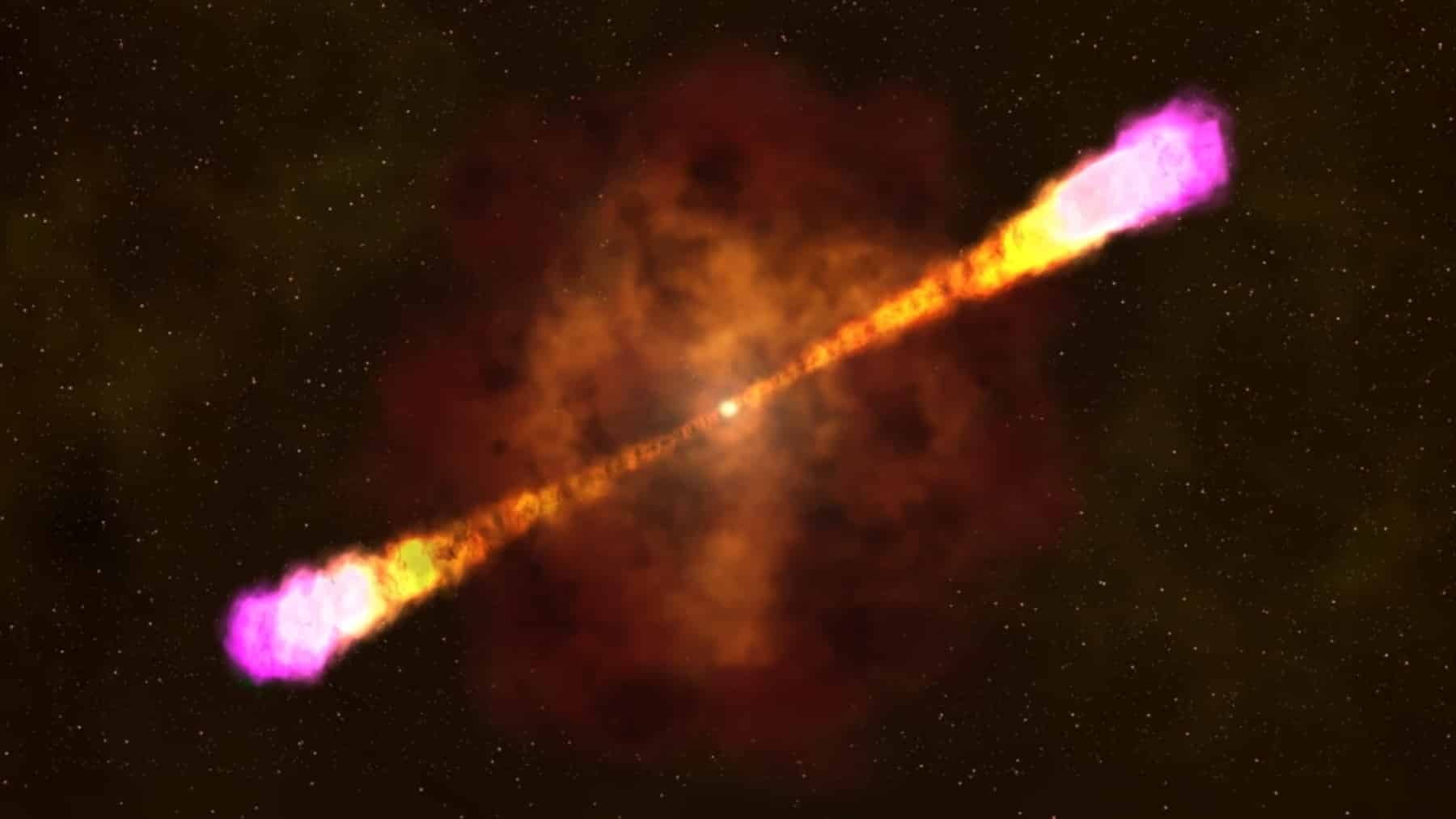
Now for the truly fascinating part: this explosion happened 1.9 billion years ago. That’s right, when the first complex organisms hadn’t even emerged on Earth, a colossal star in a distant galaxy collapsed, released a jet of energy at nearly the speed of light, and died spectacularly. In a more recent study, led by researchers at Northwestern University and based on data from the James Webb Space Telescope (which just announced a historic discovery in the Milky Way), it’s confirmed that BOAT was the result of the collapse of a massive star that went supernova.
What’s more, for the first time, we were able to observe this supernova “hidden” behind the initial flash. And within all this, came the surprise: the supernova itself was normal. Yes, no extra brightness, no unusual intensity. As if a “basic” stellar explosion had given rise to the largest GRB ever recorded. Which, of course, only increased the mystery.
The star died but left behind a hand‑sculpted jet
Another factor that caught scientists’ attention was the shape of the jet generated by the explosion. Thanks to NASA’s NuSTAR telescope, it was possible to observe that the jet had a distinctive structure: an extremely focused core and more open sides, like a “distorted cone of light.” What’s more, the energy within the jet varied depending on the distance from the center, as if the particles closest to it were traveling with greater force than those at the edges. This had never been observed in a long-duration GRB.
“We observed no signatures of these heavy elements, which suggests that extremely energetic GRBs like BOAT do not produce these elements. This does not mean that all GRBs do not produce them, but it is crucial information as we continue to understand the origin of these heavy elements.,” said Peter Blanchard who led the study.
The best explanation so far? Scientists point to some very particular characteristics of the original star, such as its density, rotation, or magnetic field, that directly influenced the way the jet emerged from the explosion. It’s as if the collapse were “sculpting” the jet with the star’s resistance. Perhaps this hypothesis also explains this other, powerful explosion ever recorded in the universe, which is pointed at Earth.