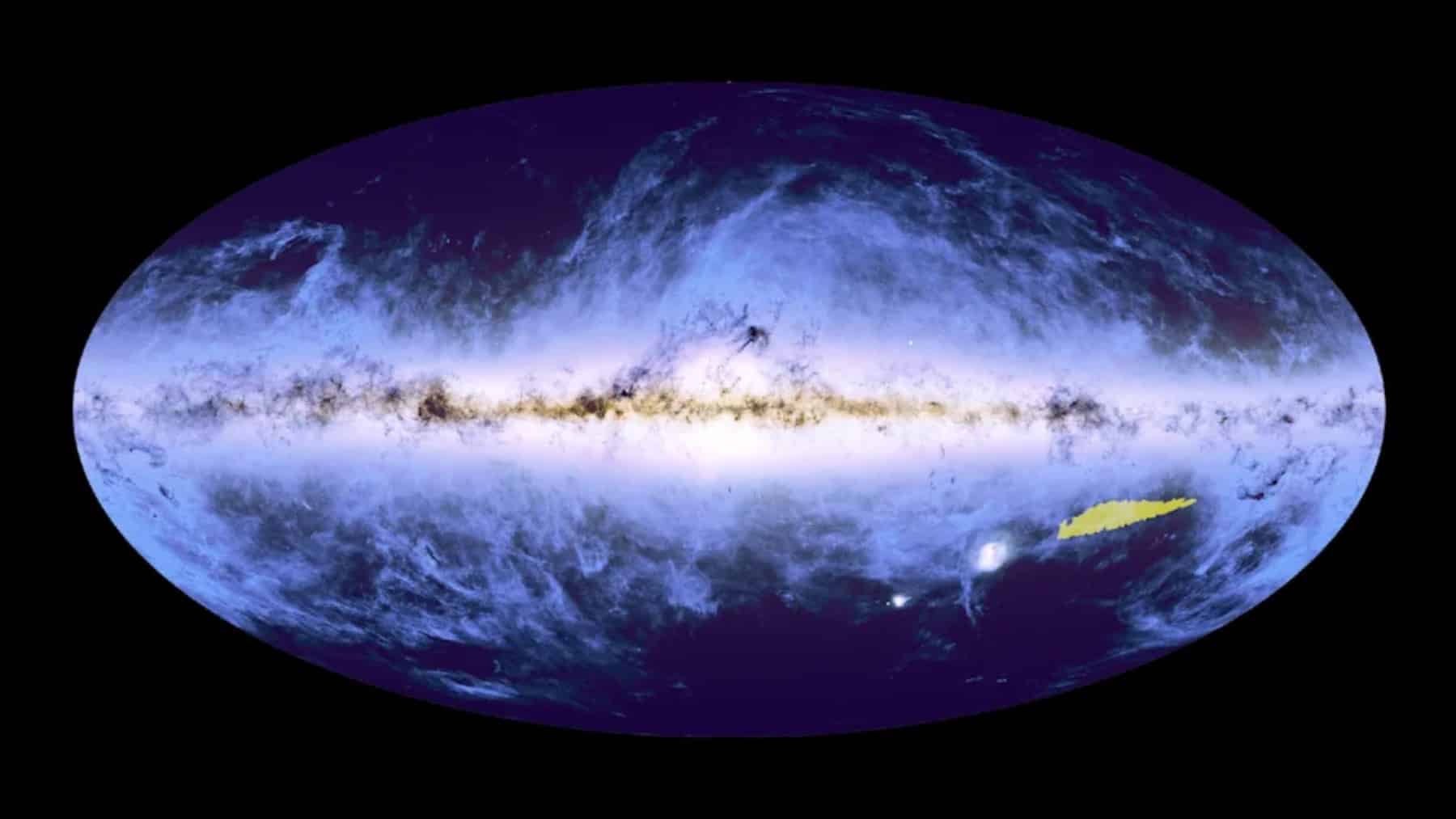
When scientists look to the sky, in addition to wondering how life came about after the Big Bang, they expect to find what they are already used to: punctual signs of quasars and galaxies in formation. However, this time it was very different… they came across something much rarer: a kind of cosmic fog, almost like a faint and ghostly glow coming from a cluster of galaxies located 10 billion light-years from Earth. This discovery, in addition to making history, cuts a long way back and is also rewriting what we know about the energy present in the early universe.
The sign that came from a cosmic infancy
To capture these historic signals, astronomers used the European radio telescope LOFAR, which managed to capture, in the SpARCS1049 cluster, a gigantic cloud of charged particles that emitted radio waves and revealed the presence of magnetic fields and very high-energy processes in the early cosmos. After some analysis, they were able to identify this phenomenon as a radioactive mini-halo. Up until then, it was nothing new, but these mini-halos are normally found in closer galactic clusters, less than 5 billion light-years away. And, well, this time, they were detected about 10 billion years ago, that is, twice the previous record.
“It’s amazing to find such a strong radio signal at this distance. It means that these energetic particles and the processes that create them have been shaping galaxy clusters for almost the entire history of the universe”, said Roland Timmerman, from the Institute of Computational Cosmology.
And why do these halos matter so much? This type of structure indicates that the space between galaxies is not empty. In fact, it is filled with hot plasma and high-energy particles, in a veritable cosmic ocean invisible to ordinary light.
Two theories for the secrets of this cosmic infancy
And how is it possible for this halo to exist so far away? How was it created? We still don’t have a concrete explanation, but experts have already created two hypotheses:
- The first focuses on the supermassive black holes that inhabit the centers of galaxies (in fact, this raises questions like, why do black holes never run out of fuel?). How so? Well, when they absorb gas, they can release jets of plasma at speeds close to the speed of light, which, over time, scatter energetic electrons throughout the cluster. And if these jets are frequent enough, they can energize the entire region around them.
- The second involves collisions of particles (such as protons and heavy nuclei) in the cluster’s superheated gas. It is these collisions that create electrons that, when interacting with magnetic fields, emit radio radiation. It is worth noting that this explanation in itself would have an advantage: this process could continue for billions of years, even without new jets from black holes, maintaining constant brightness.
It looks like we are ready for the next step
And by the looks of it, this is just the beginning. Scientists already suspect that there are other similar halos out there, but they are still beyond the reach of our current equipment. The good news? That could change soon. With the arrival of the Square Kilometre Array, the largest radio telescope ever built, we expect to be able to capture even more subtle signals and understand the magnetic fields of these distant clusters with much greater precision.
According to astrophysicist Julie Hlavacek-Larrondo, “We are only scratching the surface of how energetic the early universe really was.” It seems that the halo has just become a clear clue that the most intense and mysterious physical processes in the universe were already active in its first billion years. All this thanks to our telescopes, such as the famous James Webb.