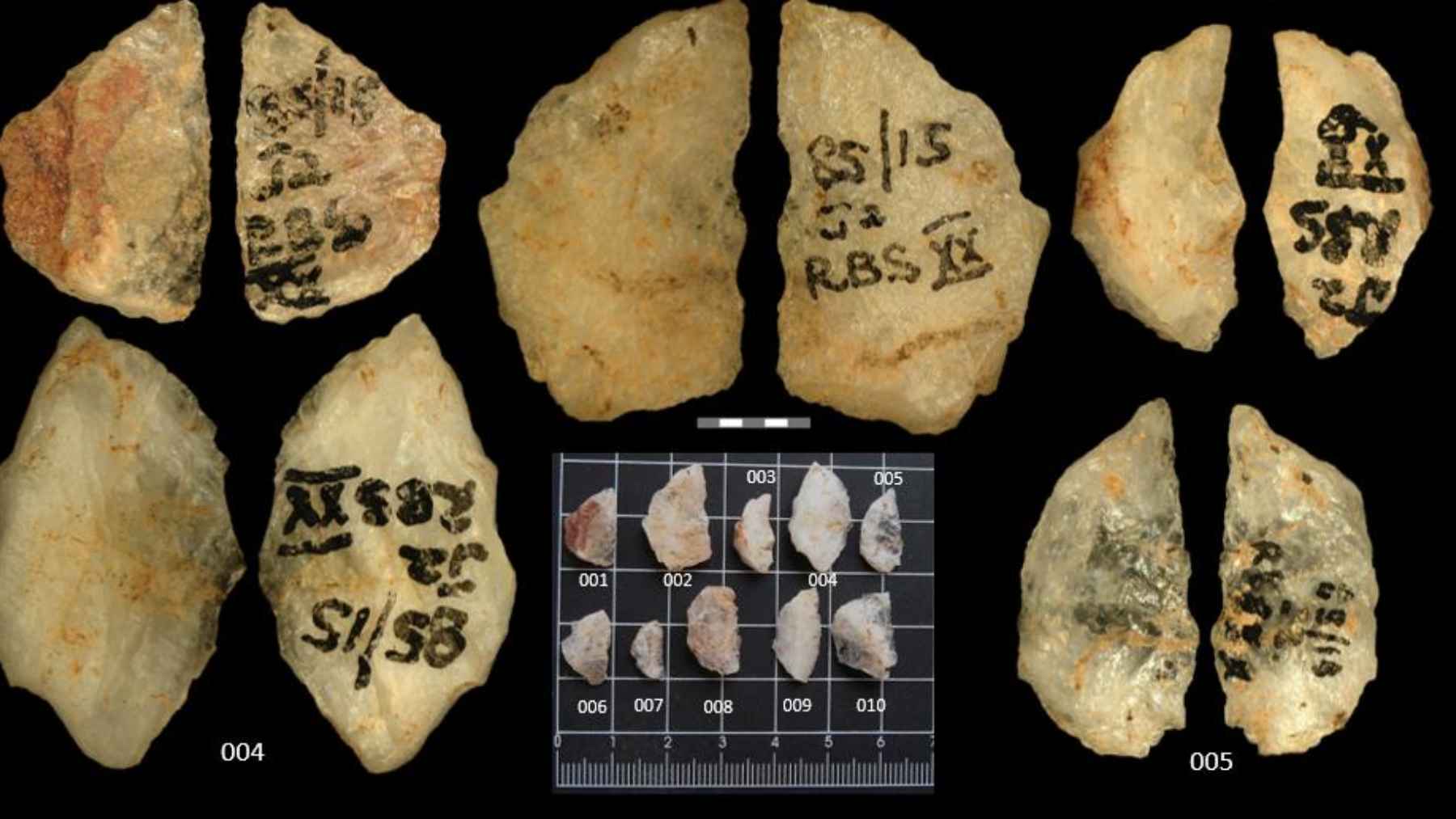
Sixty thousand years ago, long before farms, cities, or written language, people in southern Africa were already brewing a deadly poison from a local bulb and painting it onto tiny stone arrowheads.
A new study of tools from Umhlatuzana Rock Shelter in KwaZulu Natal, South Africa, has revealed the oldest direct evidence of poisoned weapons ever found, pushing this kind of chemical technology back more than fifty thousand years.
Chemical study of 60,000 year old quartz arrowheads
Researchers analyzed ten quartz microliths from a layer dated to about 60,000 years ago. On five of them, they detected traces of two toxic alkaloids called buphanidrine and epibuphanisine.
These compounds match those found in Boophone disticha, a bulbous flowering plant native to African savannas and open grasslands. Local hunters know it as gifbol or poisonous onion, and it has a long reputation as a powerful arrow poison.
So what does this really tell us about early humans? For one thing, they were not just chipping rocks and hoping for the best. They were reading the landscape, learning which plants could kill, and figuring out how to turn that knowledge into reliable hunting tools.
The same plant-based toxins show up on four bone arrowheads collected in southern Africa around 250 years ago and now held in Swedish museum collections. That continuity suggests a poison recipe that survived in oral tradition for tens of thousands of years.
Deadly plant Boophone disticha and its impact
Boophone disticha is not a casual houseplant. Its large underground bulb concentrates a cocktail of alkaloids with strong effects on the nervous system. In animals, the poison can cause agitation, loss of coordination, breathing problems, coma, and often death.
In humans, exposure may trigger nausea, visual disturbances, hallucinations, and eventually respiratory failure if the dose is high.
Traditional healers in parts of Africa use carefully prepared extracts in small doses, but the same chemistry can become lethal when concentrated on a hunting weapon.
According to the research team, the Stone Age hunters probably processed the bulb’s milky sap by sun drying it into a gum or gently heating it over a fire, sometimes mixing it with other ingredients, before smearing it onto arrow tips. The poison they identified is surprisingly resilient.
Similar Boophone residues on 19th century arrows have been shown to retain active components even after a century, and the new study explains that buphanidrine’s molecular structure helps it survive in soil for tens of thousands of years.
Oldest evidence of poisoned weapons in human history
This discovery also rewrites the timeline for poisoned weapons. Until now, the oldest clear examples dated to the mid-Holocene period, roughly nine thousand to five thousand years ago, including poisoned bone points from a four thousand year old Egyptian tomb and from Kruger Cave in South Africa.
Finding plant toxins on much older microlithic arrowheads at Umhlatuzana shows that both the bow and chemical enhancement of arrows were already part of human hunting strategies deep in the Pleistocene.
Stone Age hunting strategies and planning
Using poison changes what a hunt looks like in practice. Instead of needing a perfect, instantly fatal shot, hunters can fire a small stone tipped arrow from a safer distance, then track a wounded antelope as the slow-acting toxin weakens it over hours.
That means less risk, less energy spent in a sprint, and a higher chance of bringing meat home. As one of the study’s authors, Anders Högberg, notes, using such weapons demands planning, patience, and a clear sense of cause and effect.
Early chemistry and human connection to nature
There is also an important ecological story here. Boophone disticha grows in dry savannas, grasslands, and open woodland, where its fan of leaves and half-exposed bulb are easy to spot once you know what to look for.
Learning which parts of the plant are dangerously toxic, which are less so, and how to process them safely reflects a close, experimental relationship with the local flora.
That same plant has been used as both a medicine and a poison by Indigenous communities across southern Africa, showing how finely people have tuned their knowledge to their environments over many generations.
For readers today, it is tempting to think of chemistry as something that happens in labs with white coats and glassware. Finds like these remind us that the first chemists were also foragers, hunters, and caregivers, testing plants over campfires and in rock shelters. The tools may be tiny, but the story they carry is huge.
The study was published in Science Advances.