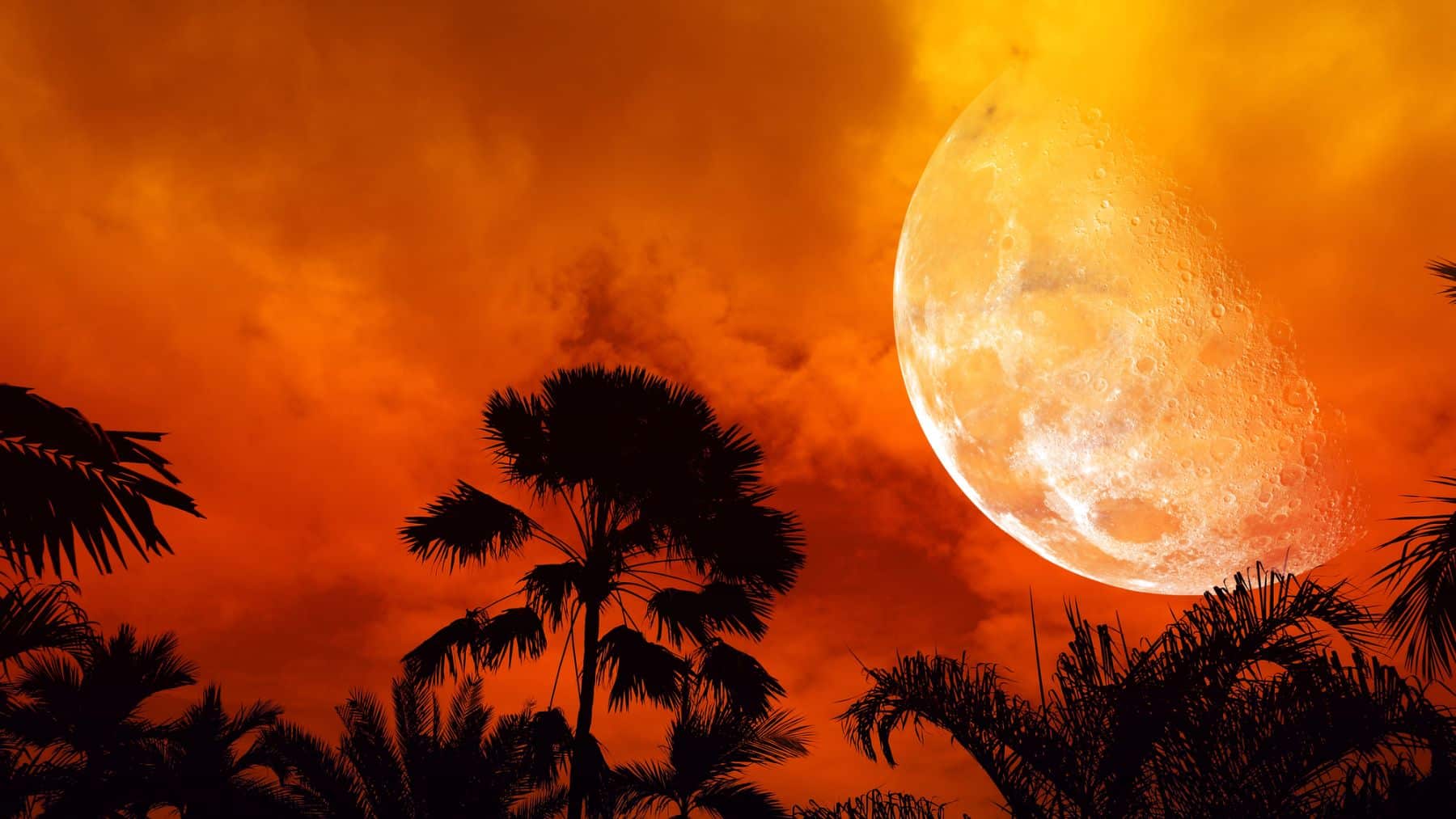
The skies of North America will witness an unusual celestial moment of exceptional beauty. A total lunar eclipse, ‘Blood Moon,’ will appear during the night of March 13-14, 2025, the first such occurrence in two and a half years, and it will remain the best view until 2029. All necessary information about witnessing this extraordinary phenomenon is presented below.
The Moon will display a remarkable red hue because of this scientific reason.
When Earth intercepts solar light between the Moon and the Sun, a Blood Moon displays a reddish hue. Blue light scatters throughout the atmosphere before reaching the Moon until it produces red light transmission. A Full Moon turns red, making it one of its well-known names.
On its way, a ‘Blood Moon’ event syncs with the complete stage of the traditional “Worm Moon,” which marks the March full moon. Native American and European traditions used this name to indicate when earthworms appear during early spring because of the warming soil conditions.
The most favourable times and places exist for observing the eclipse.
A lunar eclipse will occur during the nighttime hours between March 13 and 14, 2025. The lunar eclipse will pass through its maximum phase within the time frame of North American observatories according to their different time zones. A fourth of the Moon will become totally dark in EST from 2:26 AM until 3:31 AM on March 14, but it will be visible in CST between 1:26 AM and 2:31 AM on that day.
Viewers across the Mountain and Pacific Time zones will experience the lunar eclipse from 12:26 AM to 1:31 AM (March 14). The Blood Moon Eclipse appeared through Alaska Time as it branched during 10:26 p.m. until 11:31 p.m. on March 13 followed by its appearance through Hawaii Time duration from 8:26 p.m. until 9:31 p.m. on the same day. Reading lights on the Moon through Earth’s shadow process is equally mesmerizing because it shows the Moon’s gradual convergence into and subsequent escape from shadows.
Proper viewing conditions will develop by adhering to fundamental guidelines.
Observing Blood Moon’s coppery and reddish colours depends on being in Earth’s shadow’s path. The Earth’s atmosphere makes the blood moon look dark. How light is refracted through an atmosphere impacts spectacles like these. The amount of flame and soil pollution changes how clear these spectacles are, so there is an essential correlation between pollution and the occurrence of blood moons.
Observation of this eclipse requires no specific position for the viewer. Illumination by city lights does not diminish the beauty value of lunar events much. Star visibility that crosses near the moon will diminish as light pollution does its damage to the darkness of night under a total lunar eclipse.
Astrophotographers who want to capture wide-angle sky and landscape shots should go to dark sky sites, but telescope close-ups require only a clear night sky. Most people recommend dressing warmly, with blankets and hot beverages, when observing the event during its March Northern Hemisphere nighttime occurrence. Despite their ability to improve their view, people can only observe the whole phenomenon through their naked eye.
The next full moon is coming soon—Here’s what you need to know
The last winter full moon of the Northern Hemisphere arrives soon as the Worm Moon. The Pink Moon will lead the first spring full moon when it appears on April 12, 2025. The upcoming celestial display will begin with a March 29 partial solar eclipse, which observants in northeastern North America and Europe can witness.
The total lunar eclipse of the Blood Moon is a sight to behold; it turns everybody’s attention. Astronomy enthusiasts will feast on this —the event won’t occur until 2029. The Blood Moon’s dim red colour appears most brightly when it is at a position opposite the sun so that no sunlight can reach it.