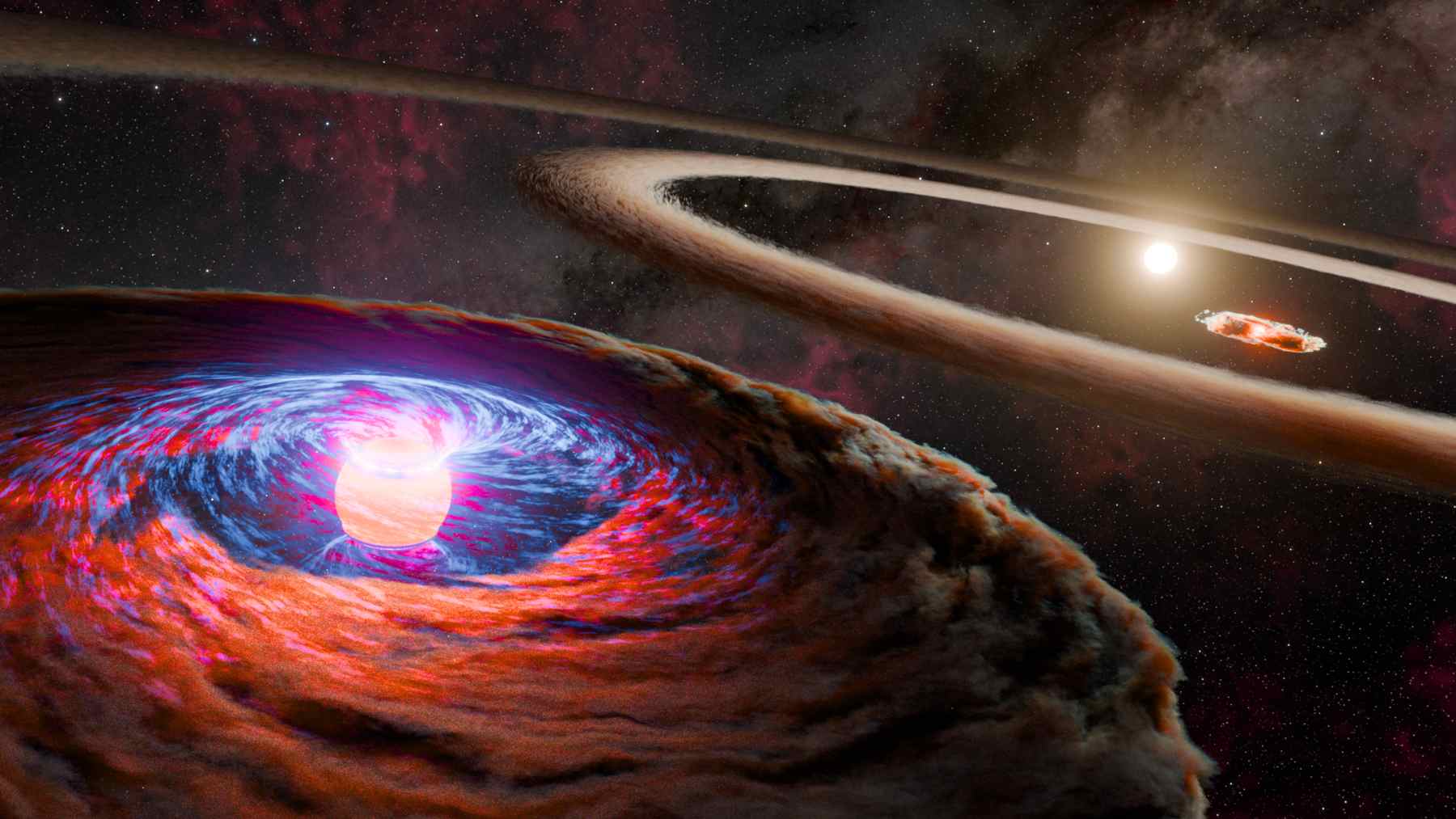
What does a newborn planet look like while it is still under construction? For the first time, astronomers have captured an exceptionally clear view of one in action, growing inside a dusty disk that surrounds a young star similar to our own Sun.
WISPIT 2b and a newborn gas giant
The planet, named WISPIT 2b, is a gas giant about five times the mass of Jupiter and only around five million years old, which makes it a cosmic infant compared with our 4.6 billion year old solar system. It orbits a star called WISPIT 2, and sits inside a sharply defined gap in a spectacular multi ring disk of dust and gas that stretches hundreds of times farther out than the distance between Earth and the Sun.
Planet formation and disk gaps
For scientists who study how planets form, this system is close to a dream come true. For years, theory suggested that the clean gaps seen in many young disks might be sculpted by hidden planets. Now WISPIT 2b offers rare, direct proof inside one of those gaps.
ESO Very Large Telescope observations
Researchers from Leiden University, the University of Galway and the University of Arizona made the discovery using the European Southern Observatory’s Very Large Telescope in Chile (ESO), along with specialized instruments that can block the glare of the star and pick out faint companions nearby. What began as a quick survey of many young stars, with only a few minutes spent on each target, turned into something much bigger when one object suddenly showed a bright, multi-ring disk in the images.
Christian Ginski, an astronomer at the University of Galway, recalls that surprise. The team expected to see at most a tiny point of light near the star that might betray a planet. Instead, they found a wide, structured disk with several rings and a striking gap. He explains that once they saw that pattern, they immediately requested deeper follow-up observations to search for a planet hidden inside.
Infrared and visible light reveal an accreting planet
Those follow-up images, taken in near-infrared light, revealed WISPIT 2b as a small but unmistakable dot sitting in the disk gap. Near-infrared observations are useful here because a very young planet is still hot from its formation and glows strongly at those wavelengths, which makes it stand out against the surrounding dust. The team then showed that this dot moves with the star and traces an orbit inside the gap, confirming it as a true planet rather than a background object.
At the same time, a companion study led by researchers at the University of Arizona spotted the planet in visible light, at a specific color linked to glowing hydrogen. That signal tells astronomers that gas is actively falling onto the planet and feeding its growth, possibly through a smaller disk of material that circles the planet itself. In simple terms, WISPIT 2b is still eating.
The dusty disk around WISPIT 2 extends out to about 380 astronomical units, roughly 380 times the distance between Earth and the Sun. It shows several bright rings separated by darker gaps, with WISPIT 2b sitting in one of those cleared zones. Hydrodynamic models suggest that a planet of roughly five Jupiter masses is powerful enough to push material away along its orbit and carve such a lane, which matches the estimates from the observations.
For early career scientists on the project, seeing that tiny dot inside the gap was a defining moment. Doctoral student Richelle van Capelleveen, who led the main analysis, called the system a “benchmark” that will anchor studies of planet formation for years. Fellow researcher Chloe Lawlor described WISPIT 2b as “a beautiful example of a planet that can be used to explore current planet formation models.”
Why this discovery matters for planetary systems
The discovery is part of a broader five year effort called WISPIT, short for Wide Separation Planets In Time. The project tracks how often gas giants appear on wide orbits around stars of different ages. By catching one so young and so clearly embedded in its birth environment, astronomers gain a rare before-and-after comparison between raw disk structures and the finished planetary systems we see in older stars.
For most of us, daily life is dominated by more down-to-earth concerns like the electric bill or the morning commute. Yet finds like WISPIT 2b quietly reshape the big picture that frames our own planet. Each new baby world helps researchers test ideas about how gas giants grow, how they rearrange dust and ice, and how rocky planets might later form in the safer inner zones. In the long run, that work feeds into the search for life-friendly environments around other stars and into a deeper understanding of how Earth’s own early environment came to be.
In the coming years, astronomers expect to point other powerful telescopes at WISPIT 2 and its young planet, watching how the gap evolves and whether additional hidden worlds reveal themselves closer in. If that happens, this “very hungry” planet and its sculpted rings will keep teaching us how solar systems are built, one orbit at a time.
The scientific study was published on the Astrophysical Journal Letters website.