What if the best record of your daily habits was stuck inside something that looks like a lump of old chewing gum? For Europe’s first farmers, that sticky record came from birch trees.
A new scientific study of tiny blobs of birch bark tar from Neolithic lakeside villages around the Alps has revealed what people were eating, how they fixed their tools, and even how they cared for broken pottery about 6,000 years ago. Researchers combined chemical tests with ancient DNA analysis and turned these black clumps into detailed “snapshots” of everyday life.
A sticky time capsule in the Alpine wetlands
Archaeologists examined 30 pieces of birch bark tar from nine Neolithic sites in and around the Alps. Some were loose lumps. Others clung to cracked pots or to flint blades where wood handles once touched stone. Chemical fingerprints confirmed that all of them came from birch bark tar produced by heating birch bark with very little oxygen, a process that essentially creates one of the oldest synthetic materials known on Earth.
Inside the tar, scientists found an unexpected treasure. Ancient DNA from humans, plants, and microbes had been trapped and protected for millennia. In waterlogged lake settlements, bones often rot away, but the waterproof, stable tar preserved biomolecules that would otherwise be lost. Each chewed lump became a tiny personal archive that survived long after the people themselves disappeared.
Chewed tar and Neolithic diets
Several pieces carried clear tooth marks and human DNA from both males and females, along with oral bacteria that normally live in the mouth. That pattern shows that people were not just handling the tar. They were chewing it.
Plant DNA in the same lumps pointed to recent meals. Traces of barley, wheat, peas, hazel, and beech suggest a mixed diet that blended early crops with woodland foods such as nuts. In some samples, scientists also detected conifer resin, probably added to alter how sticky or strong the tar felt between the teeth or in the hand.
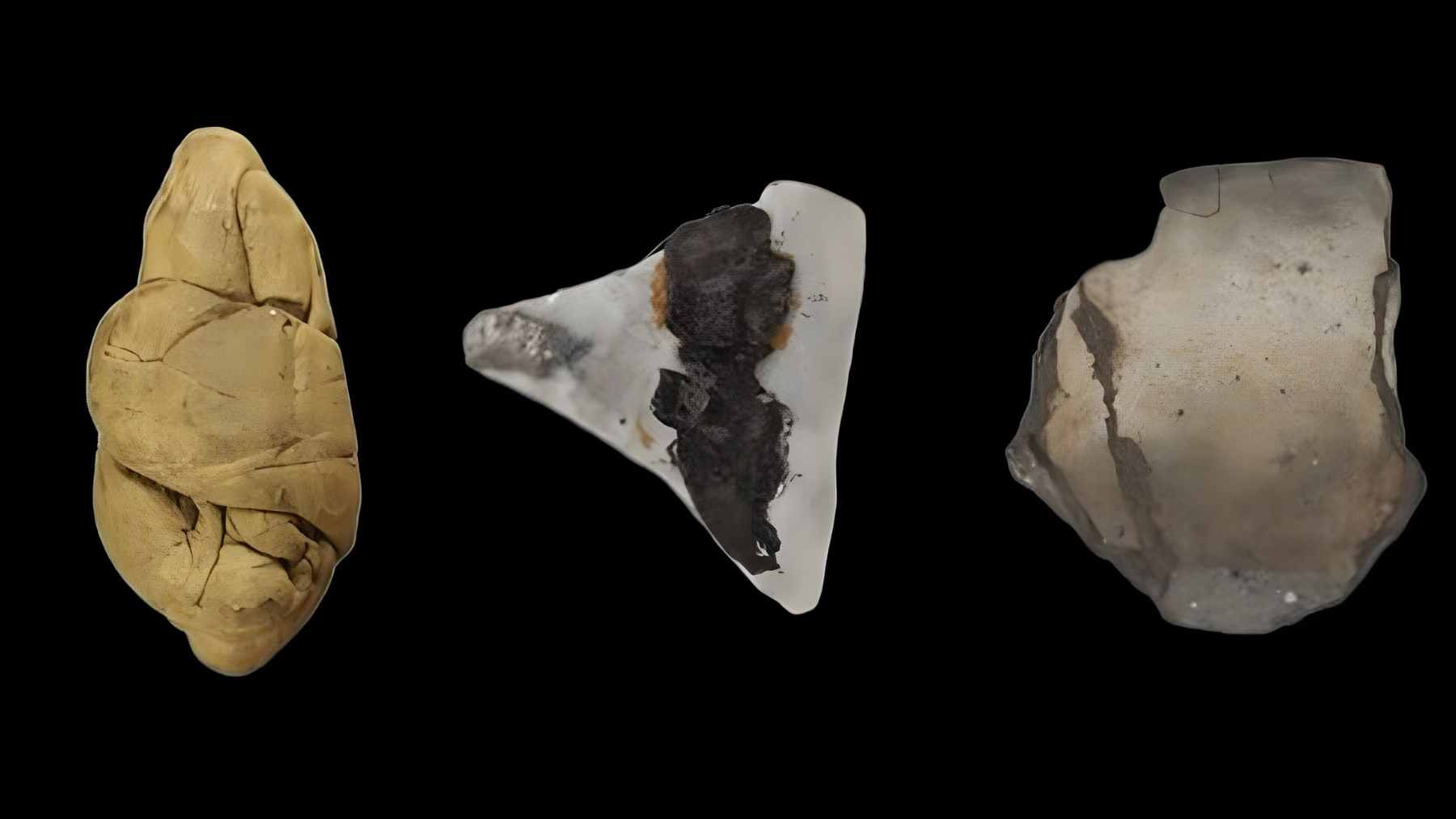
Researchers think people may have chewed the material to soften it before using it as glue, or possibly for hygiene or medicinal reasons, since birch tar is known to contain compounds with antimicrobial or biocidal properties.
So a single lump can tell a surprisingly intimate story. Someone eats a bowl of grain and peas, cracks a hazelnut, then pops a strip of birch tar into their mouth, mixing forest chemistry with farming life.
Glue, repair and quiet sustainability
The study also shows how central this natural material was to Neolithic technology. On pottery, tar was smeared into cracks and joins, effectively patching damaged vessels so they could keep serving in cooking or storage. Chemical markers reveal that some of these tar repairs were heated again and again during later use, which means the fix stayed in service for some time.
On flint blades, tar sat exactly where a wooden handle would meet the stone cutting edge. That confirms its role as a powerful hafting adhesive that kept tools together through daily work in fields and forests. Instead of throwing away a broken pot or a loose blade, Neolithic families reached for a renewable tree-based glue and gave their objects a second life. It is the repair culture many sustainability experts keep calling for today, just practiced with smoke, bark and patient hands.
Lessons from an ancient bio-based material
Beyond the vivid human stories, the work highlights two big themes that matter right now. First, birch tar behaves like a natural DNA safe. In fragile wetland environments where skeletons crumble, this kind of organic residue lets scientists recover information about identity, diet and health that would normally vanish. That opens the door for similar studies on other ancient glues, resins, and chewing materials in threatened archaeological sites.
Second, the findings remind us that sophisticated bio-based materials are not a modern invention. Neolithic makers learned to transform bark from local birch trees into a water-resistant, antibacterial adhesive and sealant using controlled heating with limited oxygen.
They relied on forests, lakes, and crops instead of fossil fuels and industrial chemicals. Their technology was still small scale, of course, but it shows how deeply human ingenuity has always been tied to nearby ecosystems.
For anyone worried about pollution from synthetic glues or the throwaway culture that fills landfills, there is something quietly powerful in these ancient black lumps. Six thousand years ago, Europe’s first farmers were already cooking, fixing, and crafting with a material that grew back in the forest. Now modern science is finally catching up and reading the story locked inside.
The study was published on “Proceedings of the Royal Society B“.