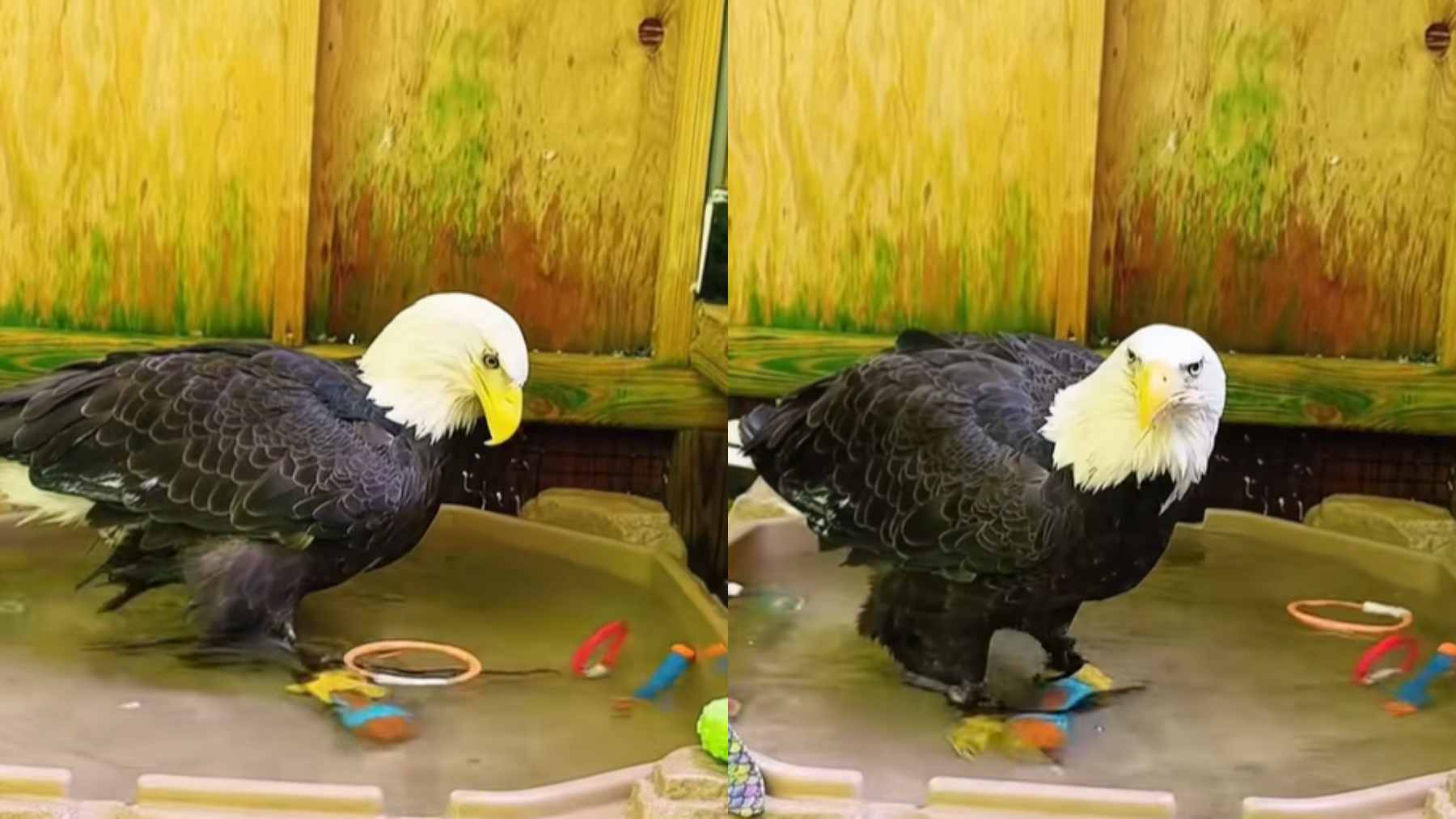
Aurora, a 12-year-old bald eagle who cannot return to the wild, has turned a simple pool day into a reminder of what wildlife rehabilitation can look like after rescue.
In a TikTok clip shared by Christine’s Critters on April 29, she stands in a shallow pool surrounded by toys, dipping her beak, lifting colorful rings, and flapping with clear energy.
It is an unexpected sight because bald eagles usually enter our imagination as symbols of power, height, and freedom. But Aurora’s playful bath points to something quieter and just as important. For permanently injured raptors, comfort, enrichment, and skilled human care can become the difference between merely surviving and having a daily life that still offers curiosity.
Why Aurora cannot fly
Aurora’s story began far from her Connecticut home. According to her official profile, she was struck by a truck, suffered severe fractures in her left wing, and was taken to the Raptor Rehabilitation Center in Quincy, Illinois.
After months of treatment, specialists determined she would not fly well enough to survive in the wild. She spent three years waiting for a permanent placement before Christine’s Critters brought her to Connecticut in 2016, a trip the center describes as a 17-hour journey by rental car.
Her health challenges did not end there. In 2021, her caregivers noticed a growth on the injured wing, later identified as a xanthoma, a noncancerous but often invasive tumor. By spring 2024, the growth had become uncomfortable enough that veterinarians and caregivers moved forward with a partial wing amputation.
A pool becomes enrichment
The clip that caught viewers’ attention is not dramatic in the usual wildlife sense. There is no soaring flight, no dive toward a fish, no cinematic mountain backdrop. Instead, there is Aurora standing in water with bright toys around her, looking startlingly comfortable in a setting many people associate with a happy child on a warm afternoon.
That matters. Christine’s Critters says its non-releasable birds live in species-appropriate aviaries and receive care meant to keep their lives enriched and fulfilling. In practical terms, that can mean small moments like a pool, a toy, a trusted routine, and enough safety for a bird with a hard past to explore her surroundings.
What makes the moment stick is the contrast. A bald eagle can carry the emotional weight of a national emblem, but here she is also simply an animal with preferences, habits, and little sparks of joy.
The eagle behind the symbol
Bald eagles are large birds by any everyday standard. The U.S. Fish and Wildlife Service notes that adults can measure 30 to 40 inches from head to tail, carry a 7-to-8 foot wingspan, and weigh 8 to 14 pounds.
That size is part of why Aurora’s pool scene feels so disarming. A bird built for wind and distance is now using a shallow pool as a safe piece of her world. Not what most people expect, right?
Her role also reaches beyond one viral clip. Christine’s Critters says Aurora became an educational ambassador, helping teach the public about lead poisoning in raptors and the conservation impact of the 1972 DDT ban.
What viewers saw
The online reaction leaned into the sweetness of it all. One viewer wrote, “All girls love accessories,” while another joked, “Even big eagles like Aurora are chicks.” The comments were lighthearted, but they captured something real about why the video spread so easily.
People are used to seeing eagles from a distance. They circle above highways, appear on seals and coins, and flash across documentaries in slow motion. Seeing one fuss over toys in a kiddie pool pulls that grand image down to eye level.
Still, the point is not to turn Aurora into a pet. She is a wild animal living under specialized care because her injuries made release impossible. The better takeaway is compassion with boundaries, a reminder that rescue work is tender, technical, and rarely as simple as a cute video makes it look.
What to do with injured wildlife
Aurora’s story also carries a practical lesson for anyone who finds an animal in trouble. Connecticut’s Department of Energy and Environmental Protection advises people not to intervene unless they are certain an animal is orphaned, clearly injured, or in immediate danger.
The agency also warns that people should avoid direct contact, keep pets and children away, place truly injured animals in a warm and quiet space only when safe, and contact an authorized wildlife rehabilitator. It adds that keeping wild birds or mammals as pets is illegal and can leave animals worse off, even when people mean well.
That is where licensed centers matter. At Christine’s Critters, the stated mission is rescue, rehabilitation, release when possible, and lifelong ambassador care when release is not possible.
A second chance
Aurora may never return to the sky in the way she once knew. But the pool, the toys, and the trust around her show that a rescued animal’s life does not have to be defined only by what was lost.
For the most part, that is what makes the video more than a charming internet moment. It opens a window into the quieter work behind wildlife conservation, where a single eagle’s comfort can teach people to look more carefully at every injured animal they might otherwise pass by.
The official profile was published on Christine’s Critters’ website.