At just 18, engineering student Ribal Zebian is trying something most city councils have not dared to do. The London, Ontario, teen has designed a tiny modular home he believes can be built in a single day, then plans to live in it for a full year to prove it can safely shelter people who are sleeping outside and help shrink the climate impact of housing.
His hometown has felt the pressure of Canada’s housing crisis in a very concrete way. London’s own evaluation of homelessness shows the number of people on its official by name list rose from about 1,844 in 2022 to more than 2,200 by 2024, with many living in encampments or rotating through shelters.
For a city of roughly 460,000 people, that is a heavy toll. It is also a reminder that climate-friendly housing solutions are meaningless if the most vulnerable residents have no door to close at night.
Canada’s residential and commercial buildings together are responsible for around 13 percent of the country’s greenhouse gas emissions when you look at heating, cooling, lighting and appliances. So every new unit that goes up, whether it is a luxury condo or a tiny shelter, shapes future energy use and the size of someone’s electric bill.
A one-day home for people living outside
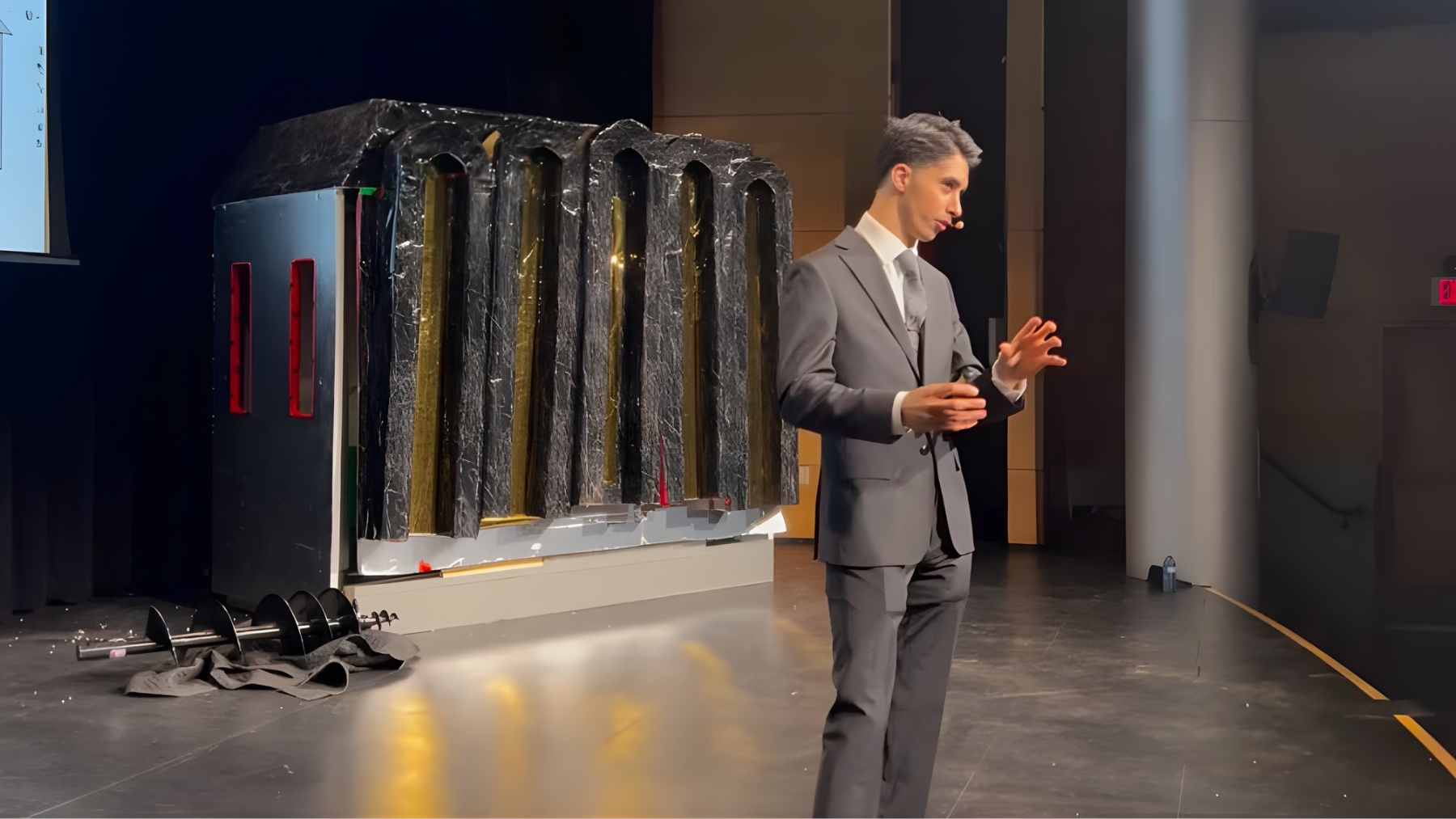
Zebian’s answer is a compact structure made from molded fiberglass panels and a roof that uses insulated PET plastic foam as its core. These panels include cavities for wiring and utilities and can be repeated like building blocks, which allows the shelters to be scaled up or down depending on the need.
His current prototype is small, roughly eight-feet by five-feet by eight-feet. He has said the design could be expanded to about three times that size, and the pieces are meant to be assembled on site in a single day with the right crew. The idea is simple. If a city or nonprofit has land ready, they could place a cluster of units quickly instead of waiting months for traditional construction.
Zebian stresses that the homes are not meant to be drab boxes. In interviews he has said he wants an affordable shelter that still has “architecturally-striking features” so residents feel they are living in a real home rather than a temporary crate.
Tiny house, big experiment
Beginning in May 2026, Zebian plans to move into one of his own units for twelve months, staying through summer heat, fall storms, deep-winter cold and spring thaw. It is a very personal form of product testing.
“What we want to see is if we can make it through all four seasons” he told CTV News, adding that living in the prototype will help him spot “every single mistake and error” so the design can be improved.
Anyone who has endured a drafty apartment or a surprise leak knows why that matters. A design that looks perfect on a computer can feel very different after a week of icy wind, condensation on the windows and a noisy heater that keeps you up at night.
Environmental promise and real-world limits
From an ecological point of view, modular construction has some clear potential. Building the same shell again and again can cut down on off cuts, packaging and wasted materials. Smaller well-insulated units usually require less energy for heating and cooling, which lowers emissions and helps keep monthly utility costs more manageable for residents who may already be choosing between rent and groceries.
There are trade offs. Fiberglass and PET foam are synthetic materials that come from fossil fuels. They are light and strong, which is helpful for durability and insulation, but they are not automatically “green.”
The environmental benefit depends on how long the shelters last, how easily they can be maintained or repaired and whether manufacturers eventually use recycled inputs. For the most part, experts say that good insulation and efficient heating do more to cut a building’s lifetime emissions than any single trendy material choice.
In other words, if a tiny home keeps someone warm with less energy and survives many winters without major repairs, it can still be a win for both people and the climate.
Not a silver bullet for homelessness
Zebian is clear that his invention is only one piece of a much larger puzzle. Estimates suggest London has around 1,800 people experiencing homelessness and that number has been rising, driven by high rents, inflation and gaps in mental health and addiction support.
Local advocates echo that view. Affordable housing organizer Gary Brown told CTV that tiny homes are “not the entire answer” yet they can be “part of the solution” when cities are “lagging behind” on building enough supportive units.
That lines up with London’s own research, which finds that highly-supportive housing paired with services can sharply reduce emergency room visits, police interactions and time spent in custody for people who had been living rough. A small private space is only one ingredient. Long-term funding, health care, counseling and income support still have to be there.
What happens next
For now, Zebian is refining the design and speaking with agencies that serve people who are unhoused, hoping to test a prototype in its intended role as transitional housing. If the yearlong trial in his own unit goes well, he wants to work with manufacturers to bring the cost down and scale up production.
Plenty of hurdles remain. Municipal zoning, building codes and neighborhood resistance can slow even the best ideas. Cities also have to ensure that quick-build solutions align with their climate plans, for example by wiring villages of tiny homes so they can eventually tap renewable energy and efficient heat pumps rather than locking in fossil fuel use.
Still, the project hints at a future where climate conscious design and social compassion are not competing priorities. They live in the same small footprint, with good insulation, a sturdy roof and a front door that finally locks.
The news report was published on Good News Network.