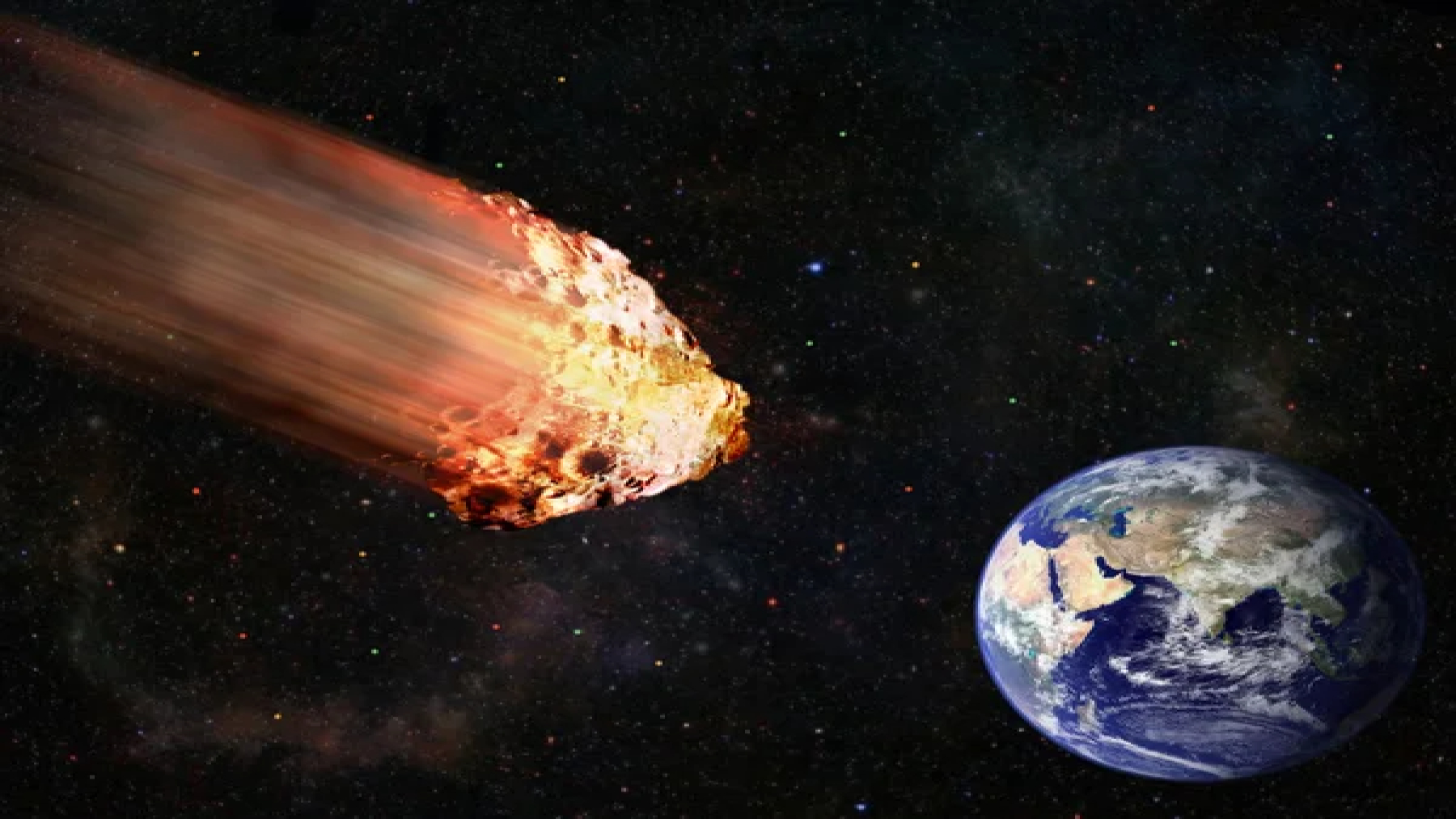
NASA has warned the globe of an important astronomical phenomenon. A big asteroid, called 2024 WY70, is on a collision course with Earth this weekend. Near 820 ft in diameter, it is the same size as the Empire State Building. Although it might sound scary that it is so close to the Earth, there is no current danger to our planet. This is an event in which the threats that travel through space are reminder events, as well as the extraordinary improvements occurring in asteroid tracking.
Dimension & distance of 2024 WY70 cause troubles for Earth
2024 WY70 is a giant asteroid, and it is a Near-Earth Object (NEO). These objects lie within approximately 120 million miles from the Sun, a distance that brings them to the closest possible distance from the Earth.
What makes 2024 WY70 even more interesting is its designation as a Potentially Hazardous Asteroid (PHA). Although the word “hazardous” may sound alarmist, it only means the size and its distance from the Earth. The asteroid is about 820 ft in diameter and some study calculates the size of the asteroid between 656 and 1,443 ft across.
To illustrate, the height of the Empire State Building in New York is about 1,250 feet, whereas the Eiffel Tower is about 1,060 feet. Although 2024 WY70 is large, it is still significantly less than many of the solar system’s biggest asteroids.
On January 18, 2024, the asteroid is predicted to be close to Earth at about 3.92 million miles, about 16 times farther from Earth than the moon. Although it is moving away in cosmic sense it is large and warrants attention (just like this asteroid which hit Earth and was 200 times bigger than the dinosaur killing one). However, the asteroid will be too faint to be visible to the unaided eye.
Asteroids such as 2024 WY70: Traces of the earlier solar system
Asteroids such as 2024 WY70 are solar system leftovers. These rocky bodies were left over after the formation of the planets and continue to orbit the Sun today. The asteroid belt between Mars and Jupiter is the main habitation of most asteroids, but gravitational capture by other objects can change their orbits, deflecting them onto crossing paths with the Earth.
With the advent of these related Near-Earth Objects (NEOs) such as 2024 WY70, the study of NEOs has received unprecedented attention in recent years. Keeping track and classifying near-Earth objects (NEOs) is a continual effort on NASA’s Jet Propulsion Laboratory (JPL) and its Center for Near-Earth Object Studies (CNEOS) where NEOs are continuously monitored and tracked according to their size and distance from our planet.
If these objects are identified early on, scientists are better positioned to ensure Earth is ready for any future close passes. Depending on their size, speed, and trajectory some NEOs could become a threat to our planet, if their trajectories run into Earth’s orbit. Asteroids are “potentially hazardous” if they are at least 460 ft in diameter and within about 4.7 million miles of Earth.
2024 WY70 satisfies both these requirements, which is why it’s intensely observed by the astronomers. Nevertheless, the existing technology to obtain the trajectory of the objects is massively complex, so one (but not the other) can precisely predict their orbits and pass-by distances.
NEO Tracking: Fundamental for Earth’s future security
Although 2024 WY70’s flyby does not currently place the Earth at risk, its flyby brings emphasis to the need for continuing studies on asteroids. NASA’s NEOs monitoring and classification missions are important in the prevention of any future NEOs impact on Earth.
The development of space technology and asteroid tracking has allowed us to now see objects that would not have previously been detected because they were too faint to observe. The future of asteroid detection and tracking may play a critical role in disaster avoidance.
Although the size and closeness of the asteroid may seem alarming, it must be noted that that type of events is not exceptional in the large scale of space. The real concern lies in larger objects that are harder to detect or track, which is why ongoing research is necessary. One day, technology that may deflect or protect the Earth from a collision with an asteroid will be a global concern.
The narrow miss of asteroid 2024 WY70 emphasizes the necessity of continued asteroid tracking and planetary protection. Although it does not reach the Earth, both in size and location, this fact highlights the urgency of current research.
The ongoing developments in space technologies could play a role at some stage in the mitigation of large, potentially hazardous asteroids. At present we can just enjoy the splendour of the universe while the experts watch over these stars (just like this asteroid which is taking the world by storm).