Alternative fuels to hydrogen and electricity are growing in popularity, and we’re not just talking about options like (experimental) nitrogen or green ammonia. A group of experts has just presented to the world the first engine without cylinders or pistons that runs on a fuel that is neither liquid, gaseous, nor solid. A hint: it is found in the interior of the stars, and is at an extremely high temperature, but has a thermal efficiency that shatters all records.
This is the “impossible engine”: It should not run, and experts cannot explain how it does
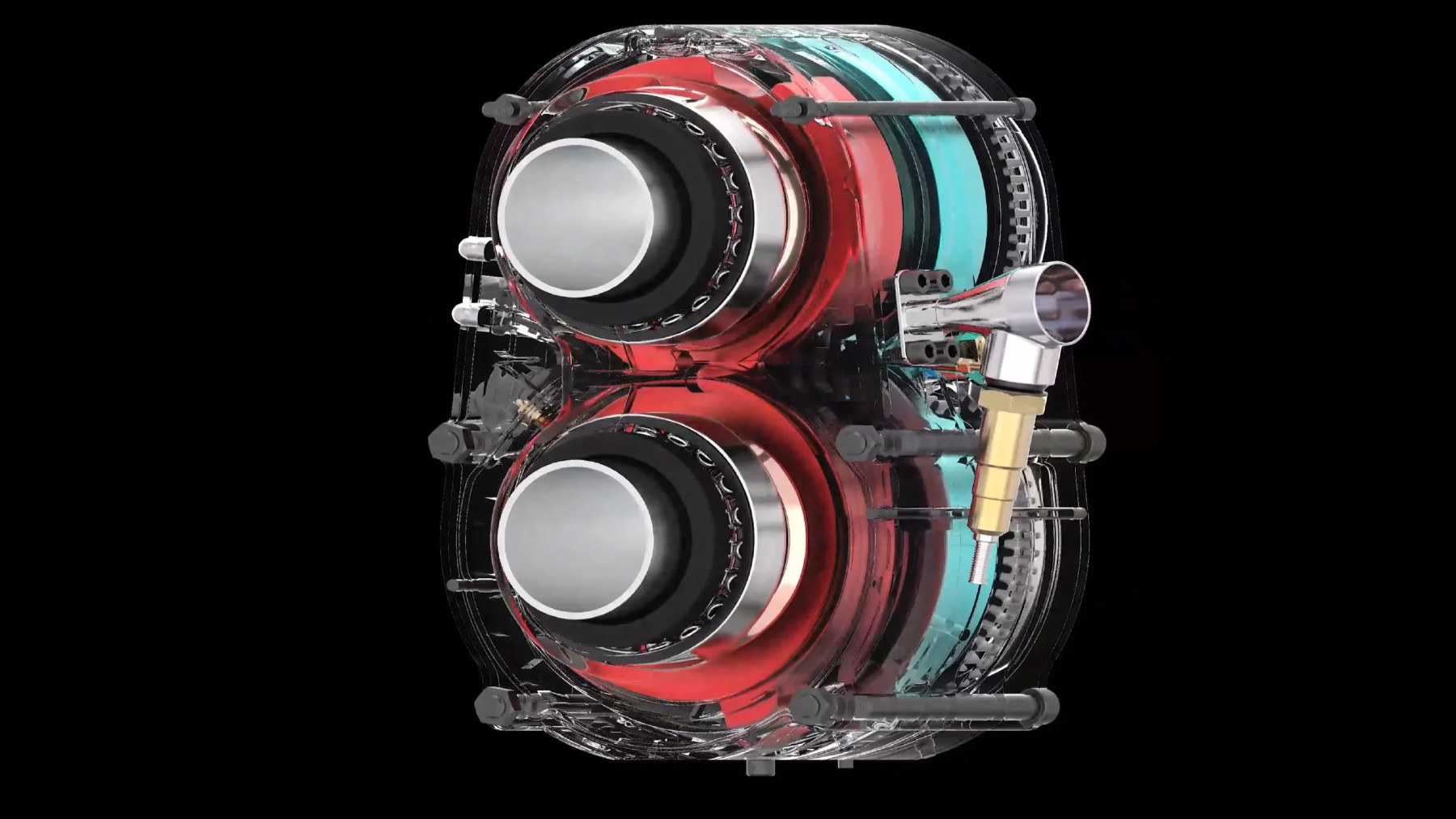
The Omega 1 engine can be described as a revolutionary invention that offers an exception to the ordinary internal combustion engine designs. In terms of design, the Omega 1 is quite a different story, but then again, it is not your run-of-the-mill Wankel rotary engine that uses no cylinders and pistons at all.
The Omega 1 engine has entirely changed the concept of the fundamental principle of any regular engine. Changing the fundamental method of converting the released fuel combustion energy into rotary motion compared to traditional cylinder-piston constructions, Omega 1 is designed with electromagnetic fields and a rotating rotor only.
This engine’s design consists of a central rotor that rotates in a stator assembly, which is surrounded by other rotors. A liquid fuel is continuously injected and burned in the combustion chamber to create a region of high pressure and high temperature, which is called plasma (remember, we have talked about this innovative fuel as “the fourth state of matter”).
Could plasma replace cylinders and pistons? This is how future engines would look like
This plasma tends to be influenced by the electromagnetic fields of the stator, which results in the creation of rotor and rotational power. Several mechanical constraints and parts, such as cylinders and pistons, are not used in this type of engine. Such an approach makes the Omega 1 design more effective, requiring less maintenance and being more compact in total dimensions at the same time.
The self-building of the Omega 1 engine has been done, and very good performance has been achieved. Independent trials conducted using a model Omega 1 engine have shown that the scale and configuration of the power range from 500 to 1000 horsepower. It should be noted that the Omega 1 engine shows an exceedingly high power density, with more than 2 horsepower per weight of the engine.
To a certain extent, the Omega 1 has the characteristic of improving at least 30 percent of the fuel economy compared to the conventional internal combustion engine. This is due to the enhanced working environment in terms of temperature and pressure of the engine and the exclusion of mechanical losses such as cylinders and pistons.
Future plans for the Omega 1 engine: Towards a futuristic mobility without conventional fuels
The Omega 1 engine should be capable of running on different liquid and gaseous fuels, including normal hydrocarbons, biofuels and even hydrogen. This versatility enables the engine to be fine-tuned to representative applications and the available energy types. The engine structure is rather modular, so the company can increase or decrease power outputs according to a specific application.
Even if changes are made in the form of content later on, the modular design makes it possible to carry out this alteration with much ease. The Omega 1 engine was originally designed and tested by a team of engineers /scientists at a well-known research and development company, Astronaerospace, which specializes in the development of advanced propulsion systems.
This Omega 1 engine could be the definitive leap towards zero-emission mobility, with an alternative to EVs and FCEVs. Obviously, it will not be marketed on the same scale or for the same vehicles, but it is already experimental and not just a theoretical basis (as is the case with other fuels). Experts are shocked by what they have discovered, and they have reason to be optimistic: this prototype revolutionizes everything we knew about mobility.