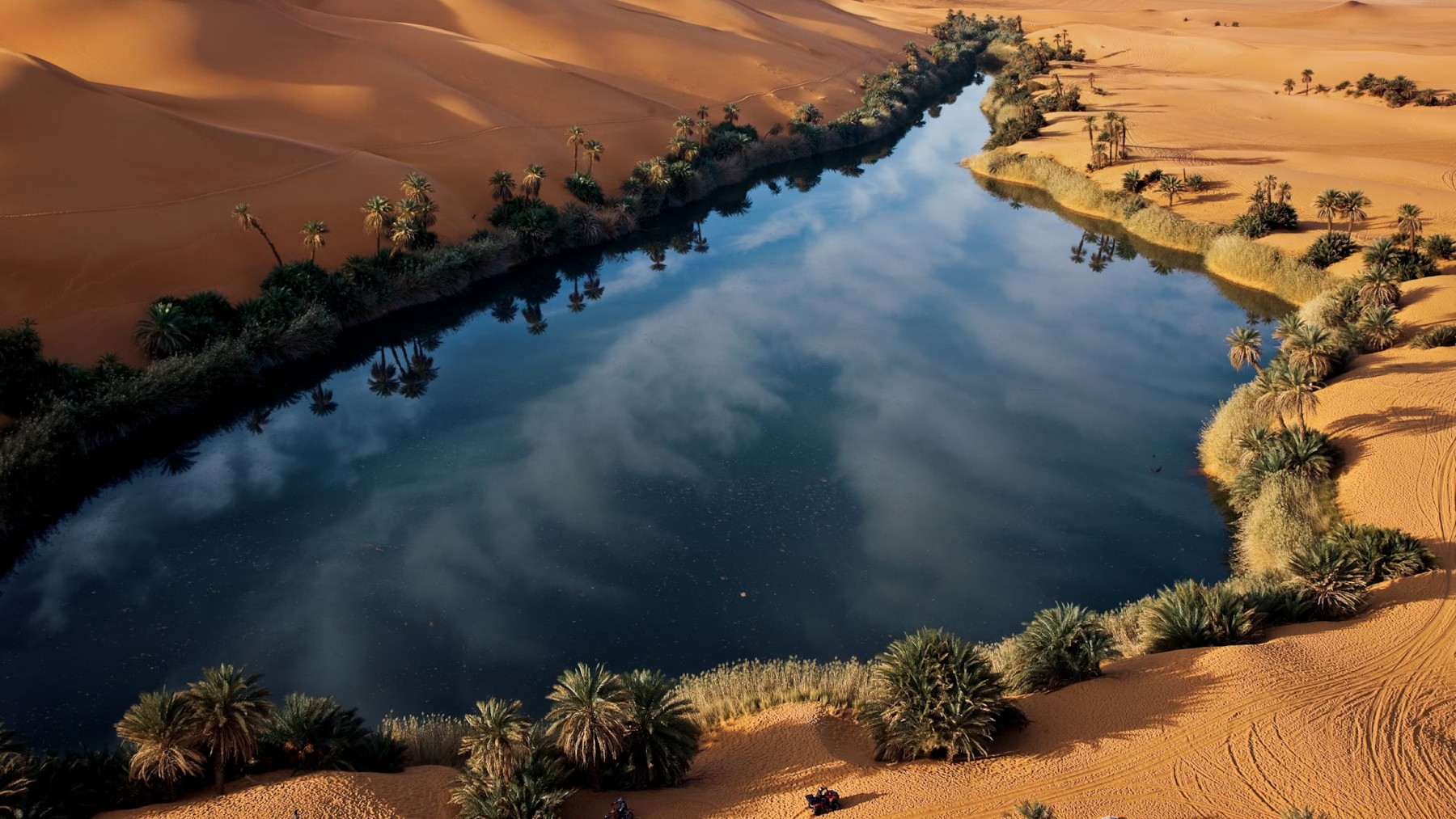
The Sahara has always been considered a barren place, except for the oases we have always seen in the movies. Great projects such as the Great Green Wall have been forgotten by the media (although they are still under development), but now it has been nature itself, with a little human help, that has begun to change the landscape. Experts are at a loss to explain how it has done so, and it’s all in this strange life form that is growing and, as it does so, interacting with the atmosphere in an unprecedented way.
Sahara is not as “empty” we thought: This strange life form is unexpectedly growing
London-based Brilliant Planet is now taking a shot at growing algae in the Sahara Desert in Morocco with the view of pulling CO2 out of the air. This visionary strategy is intended to solve the problem of climate change with the help of reagents that are unique in their ability to capture CO2 and release oxygen with the help of photosynthesis.
This consists of cultivating algae in huge, shallow containers of water obtained from the local marine environment. Brilliant Planet has a technology that replicates the algal bloom, where a tiny quantity of algae grows into millions in a few weeks. The lease acquired by the company is for land with an approximate area of 6100 hectares in the coastal town of Akhfenir in the south of Morocco.
It was presented by the pilot site, which is three hectares in size. In 2024, Brilliant Planet is looking at scaling up to a 30-hectare demonstration farm and further up to 200 hectares and a 1000-hectare farm. The algae cultivation process: a test tube of algae can triple and fill 16 giant pools, as big as 77 Olympic-sized swimming pools, in 1 month of culture.
The algae consequently settles at the bottom of the pond, it is then pumped up a ten-story building, where it is dried and spread over the desert. As the biomass explodes and descends, the hot air efficiently dries it out, leaving us with hypersaline algae flakes to collect and bury for as long as 2000 years, the carbon content of which remains forbidden.
Sahara’s algae, interacting with the atmosphere: A $1 billion project and 10,000 hectares to achieve this
Brilliant Planet aims at pulling out one million metric tons of CO2 annually in the next decade, which is as potent as eradicating 217 thousand cars every year. To this end, the company aims to open branches at different locations; the overall area where it intends to develop is 10,000 hectares, and the total cost will be approximately $1 billion.
Thus, the company has found about 500,000 sq km of flat desert-ocean flat area, where the described method of algae cultivation has been introduced, and the company plans to cooperate in other countries, for example, Namibia. Brilliant Planet’s funding total has been in excess of $26 million up to the present, and the firm intends to conduct another funding raise at the end of this year.
It’s not about what we have achieved: The main objective is planned for 2027
Finally, in July of this year, the company signed its first large-scale initiative with Block, a global technology company, to offset 1,500 tons of CO2 by 2027. Morocco is a country that Brilliant Planet is using as the pilot in one of its projects; the authorities of the North African nation welcome such projects for the economic boost they provide.
The idea is to buy carbon credits to finance the business development and to support Morocco’s objectives of decreasing greenhouse gas emissions and progressing with the energy transition plan. Nevertheless, it is essential to consider a number of criticisms concerning the carbon offsetting schemes that are recently on the rise while the industry remains more or less unregulated.
The cultivation of algae in the Sahara is an idea that sounds like science fiction, but was theorized several decades ago. This project could be a real revolution that, believe it or not, is also being carried out in cities. In what way? Perhaps there are buildings around you that are built with bricks that integrate this material and, as you have seen in this article, are able to absorb CO2 and prevent it from polluting the atmosphere.