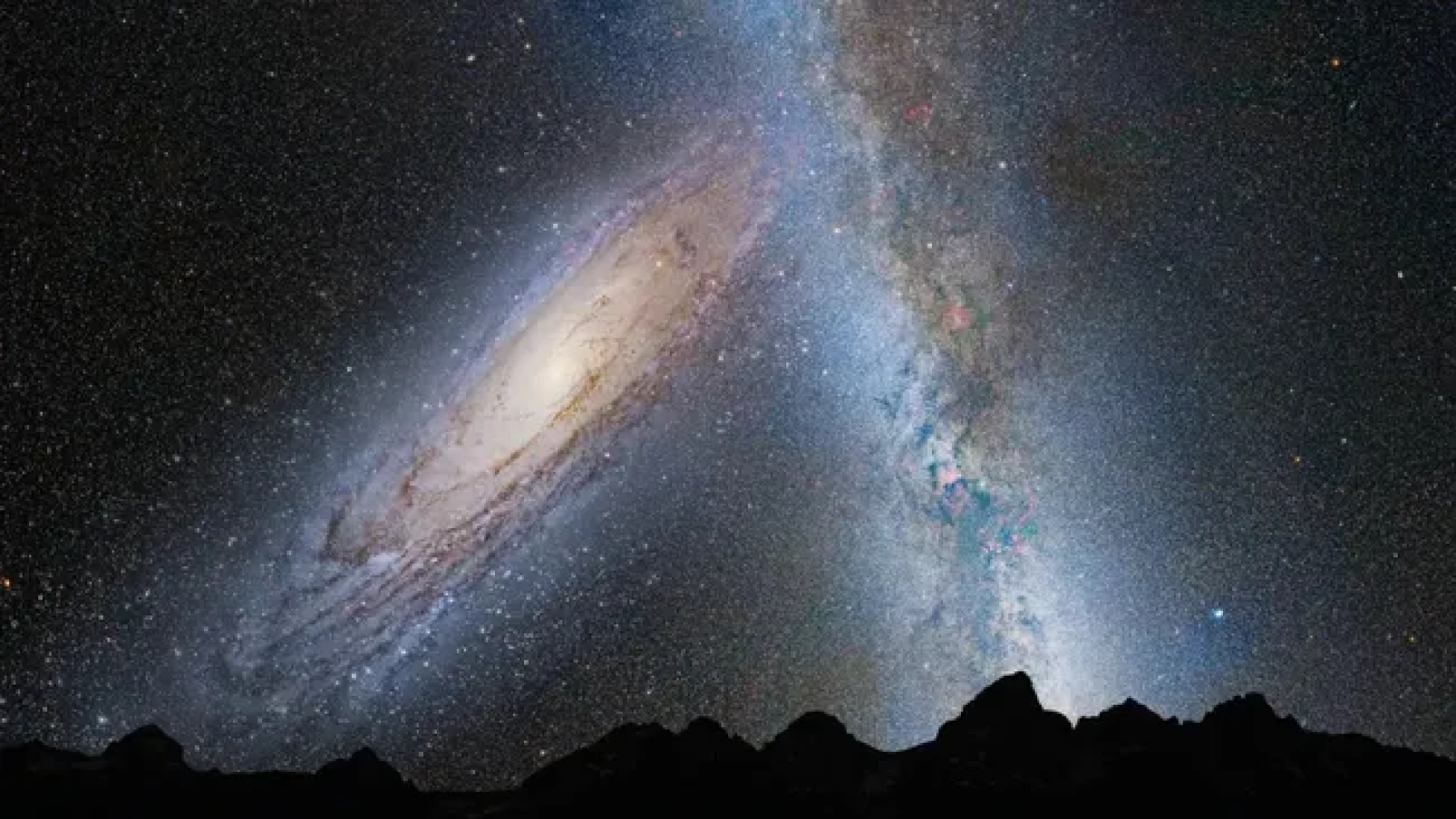
For more than a hundred years, astronomers have been convinced that the Andromeda galaxy is on a collision path with the milky way, this is projected to occur in around 5 billion years. However, a fresh simulation indicates that this event may not be inevitable as previously believed. In fact, there is a fifty percent likelihood that it might not occur at all.
Andromeda and milky way galaxies: Cataclysmic encounter in slow-motion
The Andromeda Galaxy, which is referred to as Messier 31, is approximately 2.5 million light-years from the earth and the nearest galaxy to the milky way that is moving towards it at a speed of 68 miles per second. The observations pointed out the fact that there is going to be a collision between the two galaxies, in a slow but certain manner, since the year 1912. Scientists have speculated that in a faraway future they would guess the cosmos would have formed a giant ameboid galaxy forming which has been called egg-Milkomeda.
The mergers of these galaxies occurred frequently about 6 billion years to 10 billion years in the past and are extremely fundamental to the current configuration of the universe. Nevertheless, it is indisputable that the Andromeda galaxy and the milky way galaxy are going towards each other, but how exactly they are moving has always been a little vague. Newer readings suggest that this possible collapse is not as simple as expected, especially as the presence of other smaller galaxies close by may significantly affect the trajectory of both the colliding galaxies.
Will the milky way and Andromeda galaxy intersect? Recent research indicates that possibility is 50/50
A research study undertaken by Till Sawala, an astronomer at the University of Helsinki, investigated potential developments of the Local Group, including the milky way and Andromeda galaxies, employing data from Gaia and Hubble Physicsatheques.
Such galaxies included the Triangulum Galaxy, therefore increasing the odds of a merger between both milky way as well as Andromeda. Nonetheless, the course of the Large Magellanic Cloud which is in a direction that is perpendicular to their collision plane gives them a fifty percent chance of not colliding at all. This, however, lessens, but does not completely do away with the hope of a future collision, emphasizing the intricate nature of gravitational interactions.
Approaching cataclysm: The effects the milky way and Andromeda collision will have on the night sky
Even if the galaxies do manage to avoid a complete collision, they could still approach each other enough to affect the outer parts of each other. This could cause a draw of stars, gas, or both from their peripheries creating tidal tails or streams that could be observed in the sky.
That’s why Lingam believes that even if the two galaxies would collide face to face, the solar system would remain mostly intact owing to the large emptiness in between stars. There is a chance, however, that the sun would reside in the arm of the newly created galaxy, far away in a non-threatening region.
Nevertheless, triggering the fresh wave of star births might be possible during close approaches when gas clouds become not just pressurized but also driven towards each other. With the ongoing innovative mapping of the milky way through the Gaia mission, new mass, motion, and gravitational field data of the surrounding galaxies could help in improving the predictions of astronomers. If Andromeda and milky way galaxies merge, it would certainly signal the dawn of a new galactic time frame with the new galaxy Milkomeda becoming the only galaxy humanity will see provided we still are present in it.