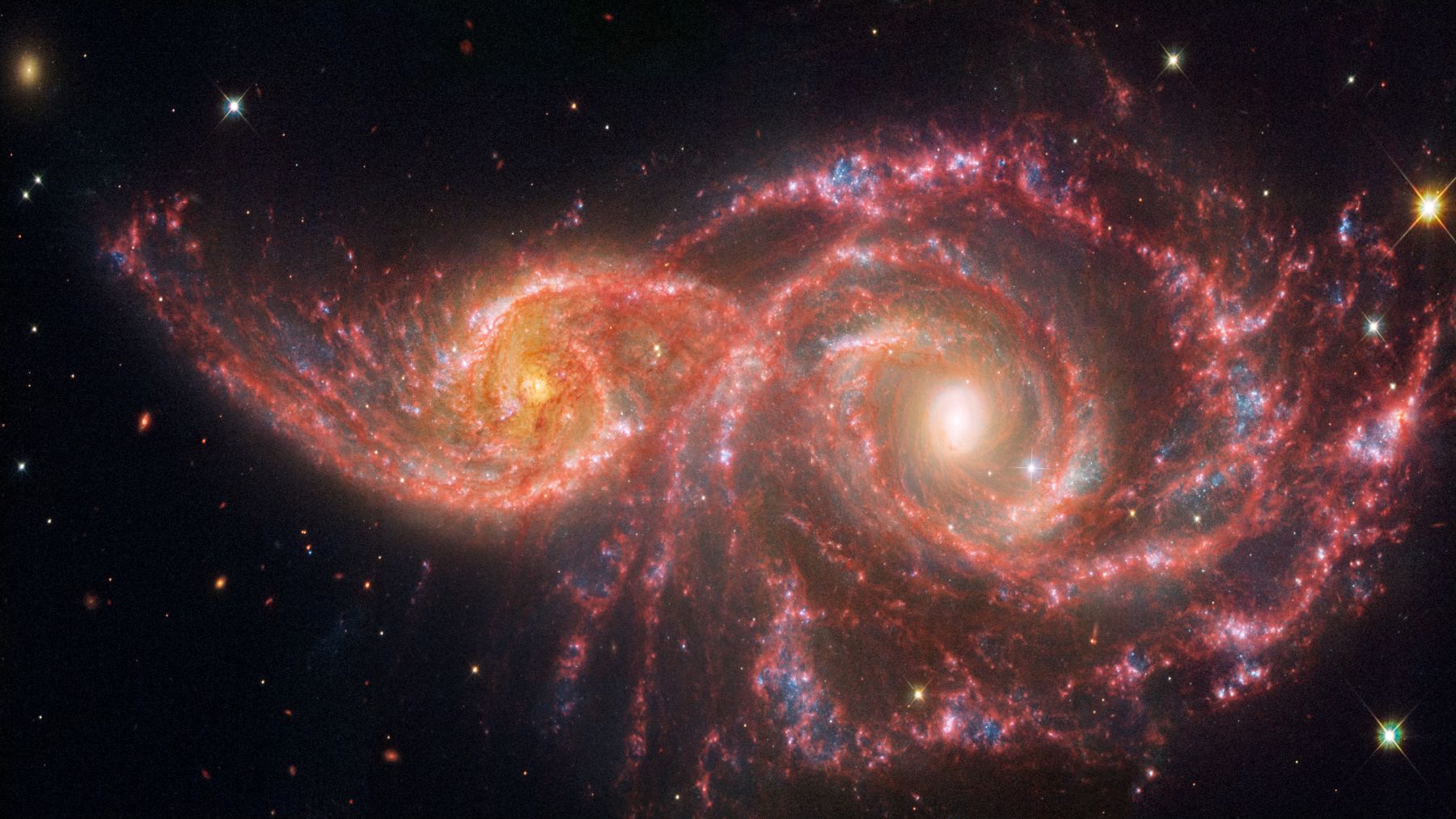
Galaxies are not shy about bumping into each other in spectacular fashions, remodeling one another through cosmic collisions. The James Webb and Hubble Space Telescopes recently recorded an encounter with IC 2163 and NGC 2207, showing their blood-soaked, eye-like cores. Their distorted shape and color represent the memory of near-miss millions of years ago, and they make us think of the dynamic evolution of the universe under the grip of cosmic action.
Gravitational forces transform spiraling galaxies
IC 2163 and NGC 2207, two spiral galaxies, are slowly bumping into each other. IC 2163 lags behind its bigger sibling, and this first event is the beginning of other gravitational encounters. The impact between them has already produced observable marks in the form of tidal forces elongating their arms into long structures.
Webb’s mid-infrared images reveal red shock fronts and “eyelids” circumscribing IC 2163, which expose the galaxies’ extreme gravitational force and incredible shape deformation. As time progresses, they will continue to develop through repeated exposures.
Galactic collision drives rapid star formation
The spectacular yield in this galactic coin toss is the increased rate of star formation. Accumulated, IC 2163 and NGC 2207 generate an estimated two dozen Sun-like stars per year, much more rapidly than the Milky Way’s average of two to three stars per year.
The enhanced star formation is a direct outcome of the gravitational forces owing to the collision, which compresses and collapses the gas and dust of galaxies, thereby initiating new star formation. Hubble ultraviolet imaging and Webb mid-infrared data show cool cores of star formation.
Blue areas observed by Hubble represent the stars and birth of new stars, while pictures taken by Webb show regions of high activity in shades of pink and white. These stellar nurseries are superstar clusters in the upper spiral arms of NGC 2207 and mini starbursts randomly distributed across both galaxies.
These are the sites where stars are being formed in spectacularly rapid succession, as if the galaxies are competing to create an ever-increasing number of new stellar objects. In addition to these active star-forming regions, at least seven supernovae have occurred in the galaxies over the past few decades, a relative frequency much higher than the one-per-50-year rate found in the Galactic Milky Way on average.
Every supernova has been central to the evolution of galaxies (just like this Sombrero galaxy, which has a mysterious glow). Explosions create space in the galactic arms, redistributing the nearby gas and dust and spatially confining the new star formation in the gaps left behind. These stellar eruptions play a critical role in the ongoing evolution of these galaxies.
Dynamic beginnings and quiet ends: The lifespan of galaxies
The story of IC 2163 and NGC 2207, however, is far from finished. As they continue to interact with one another, their gravitational interactions will continue to shape their arms, cores, and shapes. Over time, their shapes may merge, leaving a unified galaxy with a luminous core-an even brighter “eye” than we see today.
Nevertheless, the stellar formation rate will steadily decrease with the depletion of gas and dust residuals. The resulting exhaustion of stellar-forming gas will indicate a reduction in the rate of galaxy growth. The roaring of stellar formation will die down, and the formerly energetic galaxies will settle down into more quiescent, less dynamic structures. This transformation is an inherent part of the evolution of galaxies that have experienced strong gravitational interactions.
The beautiful images of IC 2163 and NGC 2207 obtained by the James Webb and Hubble telescopes, respectively, show the universe’s beauty and intricacy. These galaxies’ blood-dripping “eyes” calls on the eternal cosmic waltz, in which dying meets living in the creation of the cosmos.
Through advanced telescopes, we see a glimpse of the forces of gravity, star formation, and supernovae at work, crafting the destiny of galaxies. This cosmic play continues to unfold, providing rich opportunities for examining the universe’s secrets (like the historic find found by the JWST on Question Mark Galaxy).