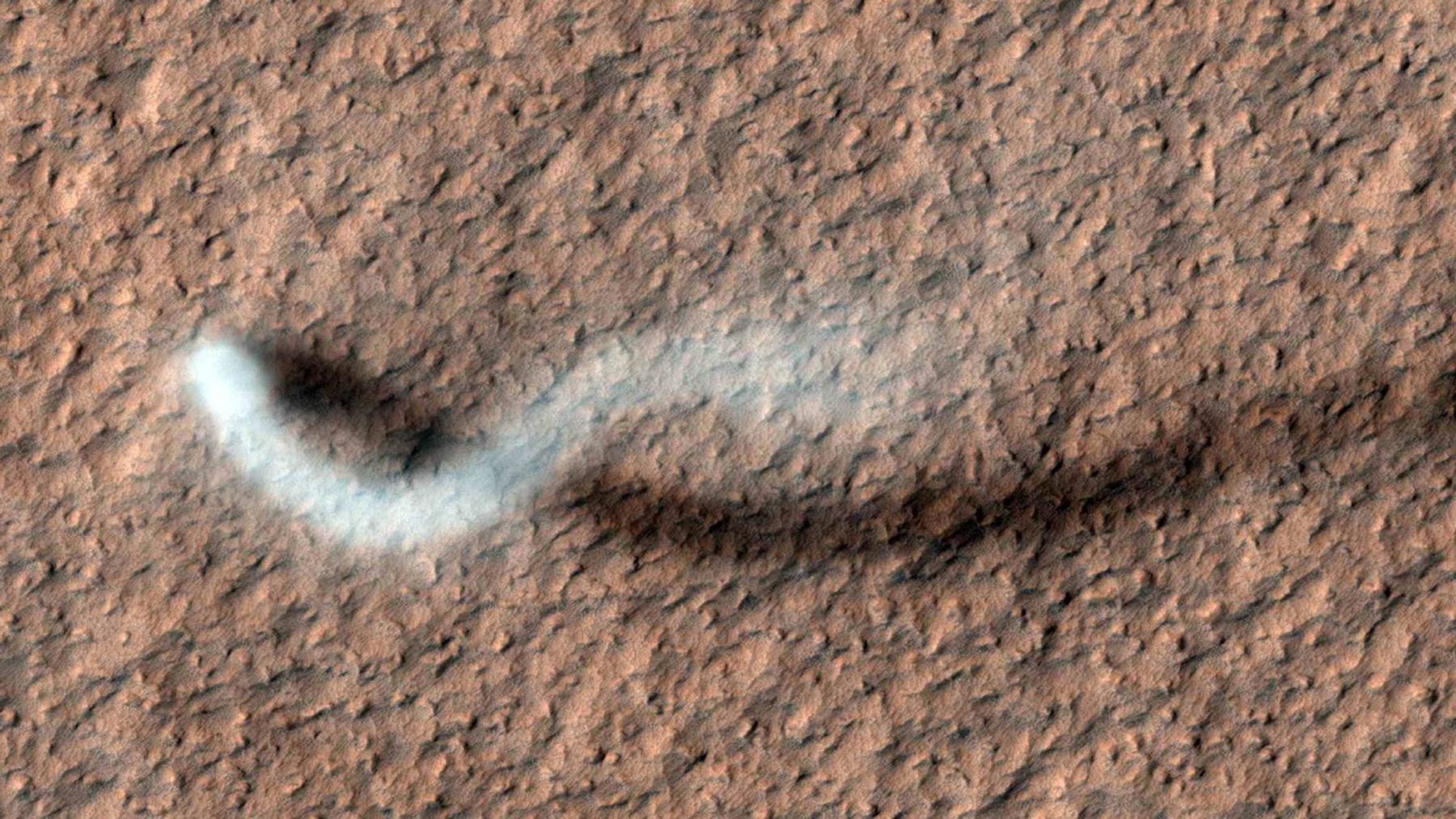
The Perseverance rover’s new observations attracted scientists and space enthusiasts. A massive dust devil captured by the rover’s cameras absorbed and swallowed a smaller dust devil as it carried out its survey. Scientific studies at the Jezero Crater enabled researchers to study Mars’ weather changes.
You won’t believe what happened when 2 Martian dust devils collided
Mars features dust devils due to temperature difference-driven warm air columns, which simultaneously rise while spinning circularly. Ground temperatures that rise make the air above it move upward through the surrounding dense and colder air. The rotating motion appears as the warm air increases in elevation.
The advancing air velocity increases while collecting dust, creating a developing dust devil. Dust devils on Mars serve dual purposes as visually captivating vortexes that allow scientists to monitor atmospheric conditions. They are essential for researchers to monitor Martian atmospheric behaviours by collecting information about wind patterns, temperature shifts, and dynamic weather patterns.
Dust devils function as an unexpected tool that helps preserve the operational capability of Mars rovers. The spinning air formations help remove accumulated dust from rovers’ solar panels while simultaneously extending their operational duration. Scientists have documented this natural dust-cleaning effect multiple times, especially during the Spirit and Opportunity rover missions, when power surges became apparent after encountering dust devils.
What NASA’s Perseverance rover is doing when it’s not filming alien whirlwinds
Researchers consider the latest Persistence observation crucial because of several essential aspects. The observation gives scientists a unique opportunity to study the interaction dynamics of dust devils since it shows either the merging or elimination of vortices. The observation revealed a large dust devil consuming a smaller one, providing scientists with vital information about vortex dynamics throughout their cycle.
A study by Perseverance confirms that dust devils serve as a significant source that transports substantial dust quantities into the Martian atmospheric domain. Studies of dust devils remain vital to understanding Martian environmental conditions because this atmospheric material creates climate and weather alterations on the planet. According to project scientist Katie Stack Morgan of Perseverance, the studies of dust devils remain essential. Morgan explains that these atmospheric vortices create approximately half of the Martian atmospheric dust.
Since its triumphant arrival in 2021, Perseverance has functioned as a principal tool for Mars scientific research. Thanks to its sophisticated scientific tools, the rover researches Mars’ geological aspects combined with climate features and examines the evidence for the existence of previous life. The recent detection of dust devils represents part of the Mars atmospheric dynamics exploration studies that continue in progress.
NASA scientists had one shot to capture this dust devil in action
Perseverance serves a mission objective that extends past meteorological observations. The rover has a dual purpose: to identify evidence of primitive microbial existence while gathering Martian samples of rocks and soil materials. Returned Earth-based analysis of these samples will grant humans vital knowledge about Mars’s history and potential for sustaining life.
Obtaining images and videos of Mars’ dust devils depends on strategic planning conditions. Scientific teams at NASA cannot forecast the timing of dust devils on Mars because Perseverance runs automated landscape surveys. Scientists aim to photograph events when patterns indicate particular daily times and wind directions where dust devils occur.
Mark Lemmon, who works on Perseverance science research, observed when the smaller dust devil merged into the larger one. Martin dust devils typically survive for only 10 minutes maximum; thus, the larger dust devil died near instantly. The Perseverance rover reached an important scientific achievement when it filmed a larger Martian dust devil swallowing a smaller one during observations on the Martian surface. Researchers learn about Martian dust devils’ visual properties and atmospheric impacts through scientific observations of this exceptional phenomenon.