For eons, Mars has captured the interest of scientists in their search for a haven for microbial life. Though evidence for life has not yet been found, recent discoveries suggest new venues for searching for signs of life beneath the surface or in the hitherto unknown places of the Red Planet. From the possibilities of finding some form of microbial life under Martian ice to the discovery of massive volcanoes on the planet, findings have opened new exciting possibilities for further investigation and exploration.
Microbial ecosystems within its ice: New study proposes probability of Mars having life
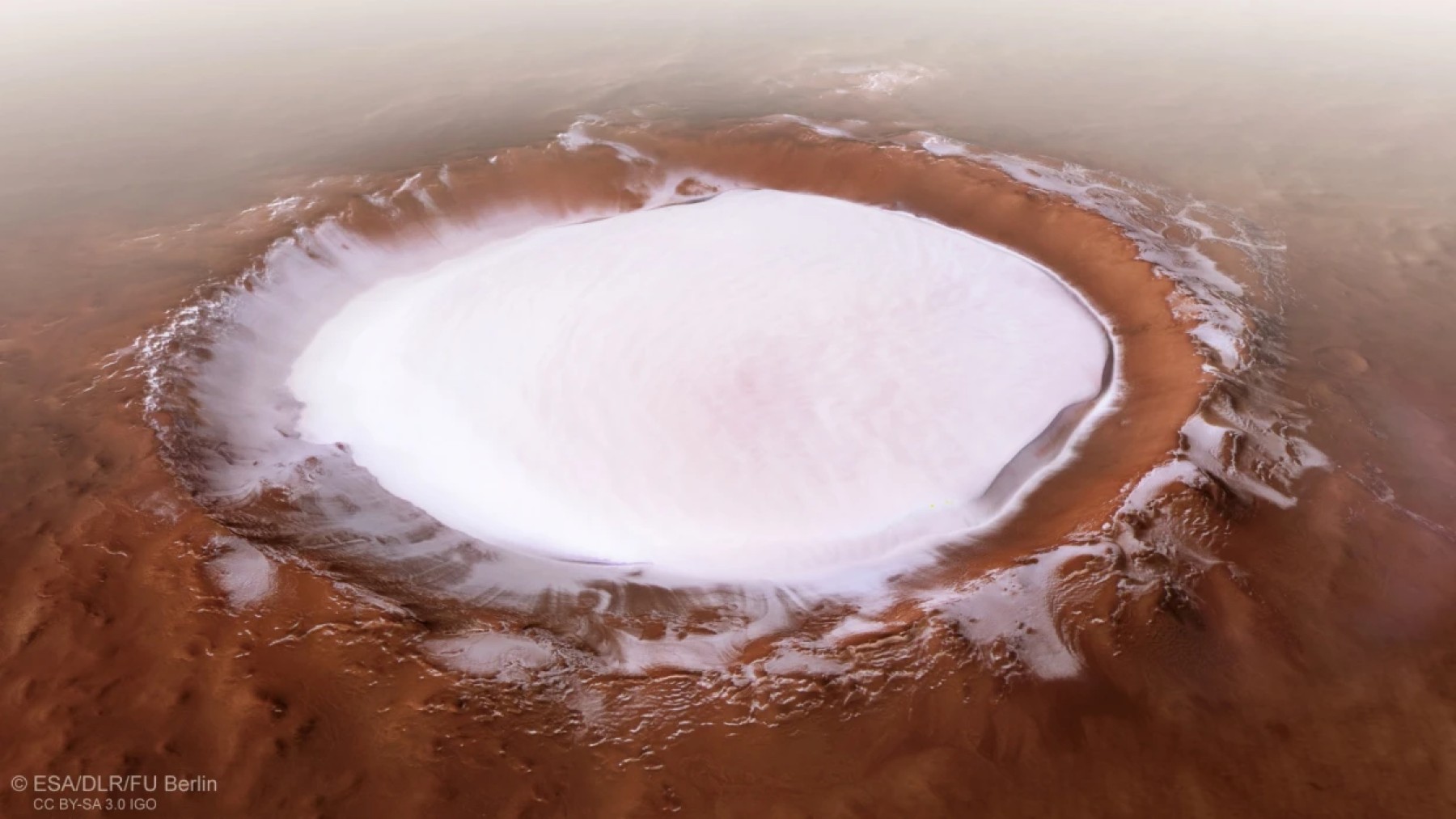
New studies have indicated that underneath Mars’ icy surface, there could be microbial ecosystems beneath its frozen waters. NASA’s latest computer modeling suggests that perhaps enough sunlight penetrates the ice to allow photosynthesis to occur in shallow meltwater pools.
Such associated pools of algae, fungi, and cyanobacteria exist today in ice on Earth and could potentially exist under the ice on Mars. Cryoconites, which are pockets of water in ice formed by the absorption of sunlight by a dust particle, cause finely developed small niches that house thriving ecosystems in Earth.
Such subsurface pools may also be formed by Martian ice providing shelter against the harmful effects of radiation, one of the critical issues on Mars, where the absence of a magnetic field renders the surface exposed to radiation. The study suggests that the Mars tropics, between 30-degrees and 60-degrees latitude, could be the best areas to search for those environments hidden from view while still supporting life.
The unveiling of Noctis volcano as a major discovery on Mars by hidden in plain sight
An incredible discovery lately made by brilliant scientists was the revelation of the Noctis volcano, an ancient feature concealed near the imaginary line of Mars. It stretches 280 miles and rises 29,600 feet but is not visible all this while since it was in a deep-eroded state.
It is the point at which two of the Mar’s geological wonders-Valles Marineris and the Noctis Labyrinthus-intersect and is thought to have once been very active, shaping the land around it. What makes this finding particularly exciting is the possibility of some ice being buried underneath the volcano. The volcanic deposits of the area, coupled with hydrated mineral evidence, suggest the need for glacial ice to be vaulted in the region.
Such hidden ice may be advantageous to future explorations since it can be used as a water resource for astronauts, or even for evidence of ancient lives by microbes. Heat, water, and ice combine quite interestingly at the Noctis volcano, identifying it as an attractive target for future missions and Mars’ geological history and life potential insight.
Mars has concealed secrets: The hidden subsurface microbial colonies and ice reveal a potential for life
Recent findings associated with subterranean microbial habitats under Martian ice and hidden within the Noctis volcano have proved excellent for redefining the Red Planet. Mars, with its inhospitable surface conditions, appears completely alien, except that some meltwater channels beneath ice and the existence of volcanic territories within suggest that life may have survived-and perhaps even dwells today in submerged pockets beneath the surface.
For potential future exploration, these discoveries are extremely useful. They indicate not only areas that can be investigated for scientific inquiry, but also ways in which to sustain life for humans on Mars. Subsurface water resources-from melt or buried ice-could form the basis of future expeditions’ most essential resources: water to drink or to convert into rocket fuel.
The possibilities that future explorations would uncover on Mars have tremendously expanded with the discovery of what could be potential microbial habitats lying beneath Martian ices and Noctis volcano’s hidden ice sheets.
Such discoveries have not only made Mars a far more tantalizing location in the search for life, but also provided vital clues into the planet’s geological past. As NASA and other space agencies continue to explore Mars, these new targets might prove pivotal in either opening or nullifying the biggest question of them all: Was Mars ever home to life?