Photovoltaic energy continues to be an essential pillar in our electricity model and, above all, in the decarbonization strategy in America. However, thousands of years ago, a famous Greek, Archimedes, managed to prove that today’s solar panels (yes, thousands of years later) were a hoax and predicted something 1000 times better. A group of experts has just succeeded in creating it, and it works only with water and wood. So are we still looking for monocrystalline silicon and perovskite in industrial quantities?
Solar panels have been a hoax, as they produce 1,000 times less energy: Archimedes knew this
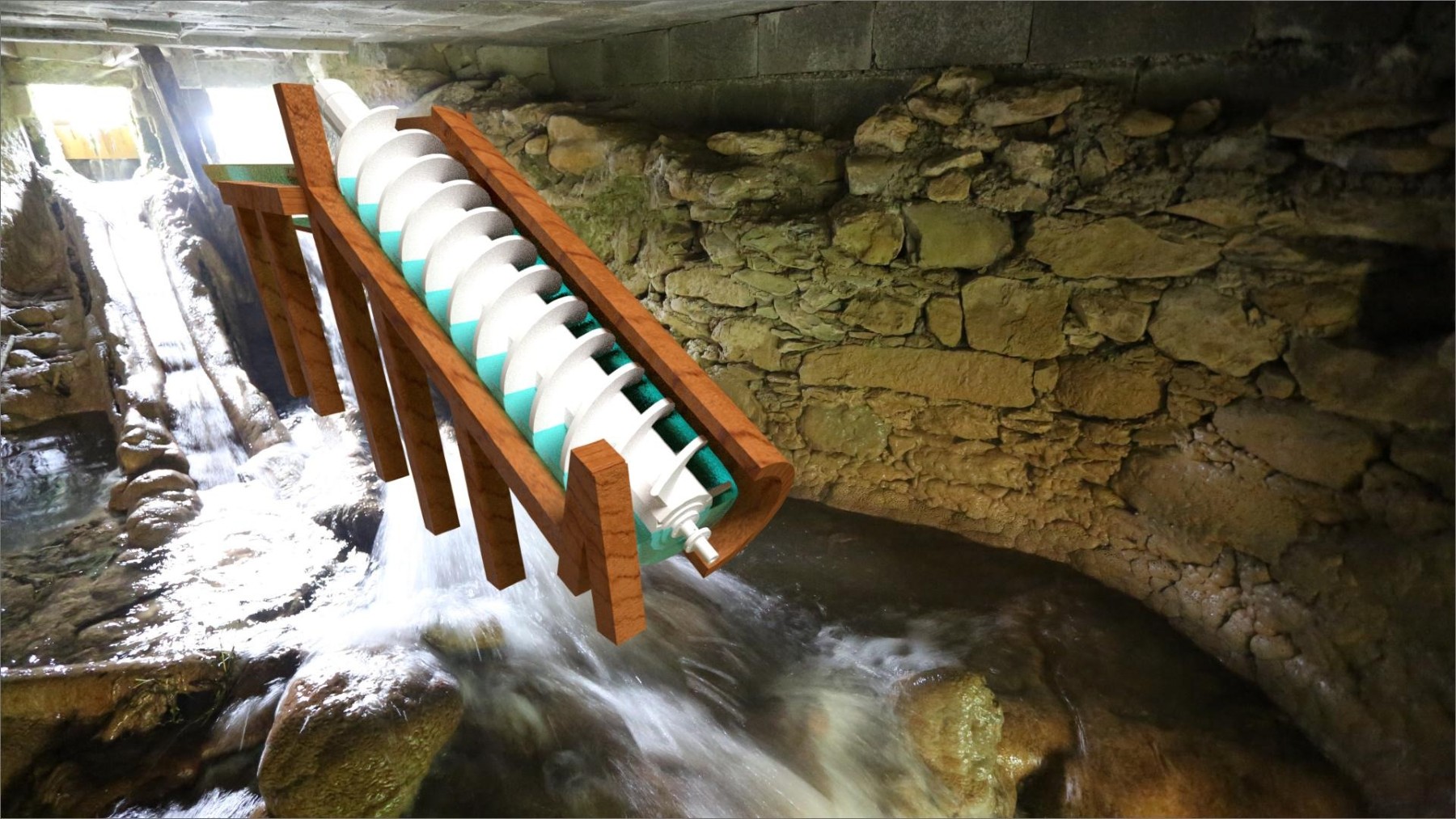
Hydroelectricity as a means of energy has had alternatives that scientists and engineers have deemed efficient and sustainable; Viseta is one of them. Through this associative thinking, the project proposes to change the local microproduction and microconsumption of energy and reduce the rates of negative impact on the river.
Indeed, as differentiated from solar panels, and given its method of operation and the great potential that it has demonstrated, Viseta’s hydroelectric turbine deserves consideration. Viseta is not just another energy company; it is an associative project for serious and useful technological endeavors in the world of hydroelectricity.
Its main objective is to promote the decentralised generation and use of electricity and, at the same time, decrease the social costs of fisheries on riverine biodiversity. The fundamental principle that drives Viseta Company is its commitment to finding simple and effective solutions to boost self-compunction at home.
Why only wood and water? Archimedes was right, as this invention is extremely powerful
This belief makes Viseta different from many of the renewable energy schemes currently being implemented, as it emphasizes low-impact, ease of implementation and sustainability. The crown jewel of the transformation of Viseta into a sustainable renewable energy company is the hydroelectric turbine that Vysokiy outlined boasts of the following features:
Possibly the most impressive aspect of the Viseta turbine is that it is made of wood. This choice of material is not merely aesthetic but serves several crucial purposes:
- Sustainability: Wooden material is renewable as it can be regrown, hence the environmental impact of the turbine is better than that of turbines made from non-renewable material such as steel or iron.
- Cost-effectiveness: Realisation of the photovoltaic technology using wood brings down the relative cost of production, hence making it available in the market.
- Local production: It is easier to construct wooden parts and components, and this means that they can be locally sourced, hence minimizing transport-related pollution.
Why could the Viseta hydroelectric turbine be the end of solar panels? Three keys to understanding
Unfortunately, detailed performance statistics for the Viseta turbine are difficult to come by, but the potential for pico hydropower in France alone is enormous. France has approximately 19,000 mills, and out of them, the 80% are inactive; still, this offers a large market for microhydropower.
The Viseta turbine falls under the category of pico hydroelectric systems; the power produced by such systems ranges from a few hundred watts to 5 kW. This output is just enough to supply small families or some community facilities and as such, it will be ideal for rural or off-grid solutions.
Hydroelectric systems are often known to have higher efficiency rates than those produced by solar panels. Converting light directly into electric current ranges at between 15-20%, small hydroelectric systems are known to have efficiencies of between sixty and eighty percent. This results in more constant and dependable power production, hence tending to be more efficient than other ones.
If we take stock of this invention, we could not really speak of the end of solar panels per se, but of a new model towards hybrid photovoltaics, which does not rely exclusively on the sun, but relies on other means of generation at night or when it is cloudy. This Viseta hydroelectric turbine could be the ultimate solution for households that are far away from conventional power grids, for example, in the large rural counties of the American South and West.