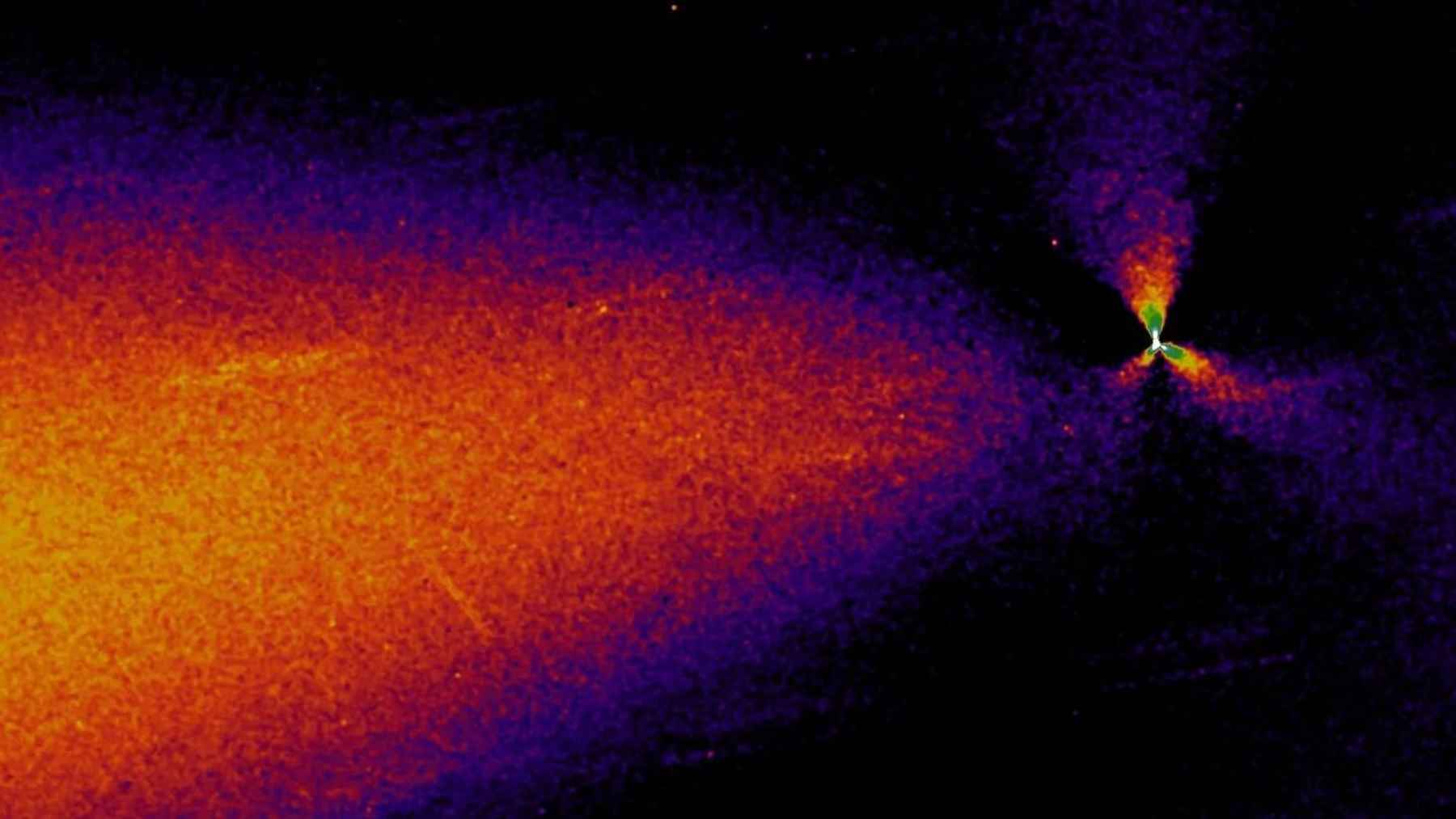
A team of astronomers uncovered new universal information through their groundbreaking discovery. Data acquired by the Herschel Space Observatory revealed a hidden population of galaxies that traditional observatories cannot see. Cosmic dust obscures these galaxies, which produce far-infrared spectral radiation. The observed galaxies can resolve persistent energy-related and galaxy evolution mysteries. The research discovery may oblige scientists to reevaluate current astrophysical cosmic models.
Current space models might collapse under the weight of this discovery
These hidden galaxies create substantial challenges to all existing models of galaxy evolution. Modern models fail to correctly predict the occurrence of numerous faint galaxies that become hidden through dust obscuration. These newly found galaxies will change our current understanding of galaxy origin and development in the universe. Due to new findings, scientific knowledge about cosmic expansion may need modifications.
According to Dr. Thomas Varnish, a co-author from MIT, the study analysis is essential. The statistical procedure uncovered hidden patterns of entire galaxy clusters that might have remained undetected. Such objects remained undetectable to traditional observing methods. The discovery prompts doubts about the usefulness of conventional astronomical detection devices and space models.
Why seeing in infrared might be the only way to understand our universe
Infrared observation technology exposes the concealed half of the universe, which traditional optical telescopes cannot detect. Starlight is one portion of emitted radiation, whereas dust absorption produces the rest of the light energy as infrared emissions. The researchers created SPIRE as a dedicated instrument for performing this study. The SPIRE instrument is a detector for galaxies that conceal themselves behind substantial interstellar dust.
The SPIRE Dark Field image has surpassed all previous surveys by delivering five times greater depth, which allows researchers to study dust-shrouded galaxies. Such locations experience robust star-making processes. Experts used the gathered information to understand the relationship between galaxy quantity and their measured brightness values. Scientists use the SPIRE instrument findings to predict the share of universe energy production that galaxies contribute to the cosmic balance.
Infrared astronomy is indispensable for tracking the complete stages of galaxy development. This particular method of astronomical investigation makes studies of cold gas and dust ingredients required for star formation possible. Scientists achieve excellent cosmic timelines through infrared data and information from various observation bands. Through this combination method, scientists better understand the mysteries concealed within the universe.
A billion-dollar NASA mission could be the final piece of the puzzle
More research must be conducted to verify these galaxies’ presence alongside studies to determine their actual characteristics. PRIMA represents the Probe far-Infrared Mission for Astrophysics, which fills a crucial observational area between existing observatories such as JWST and radio telescopes. Using a 1.8-meter telescope, PRIMA operates as a specialized tool for obtaining detailed infrared imagery.
NASA is preparing to launch the PRIMA space probe among two spacecraft competing for the agency’s upcoming $1 billion probe project. The far-infrared imaging capabilities of PRIMA would directly verify the presence of this new galaxy population as well as its effects on cosmic space.
How could new missions finally uncover the universe’s hidden secrets?
Galaxies require additional research to prove their existence, while scientists need to ascertain their properties. The Probe far-infrared Mission for Astronomy, PRIMA, functions as a bridge that connects observations between JWST and large radio telescopes. The 1.8-meter telescope equipped with PRIMA specifically focuses on infrared high-resolution imaging.
NASA is evaluating PRIMA as one of its two final mission candidates to secure $1 billion in funding. The mission would verify a new galaxy population and expose its space-changing characteristics using its far-infrared imaging technology. The mission approval process is predicted to be finalized in 2026. The operational approval of PRIMA will trigger an innovative period in stellar research and theoretical model advancements.