Archaeologists in Sweden have uncovered a Stone Age dog burial that brings humanity and ritual into sharp focus. At the bottom of a vanished lake near the town of Järna, they found a five-thousand-year-old dog carefully laid to rest beside a polished bone dagger. The discovery suggests that people in Neolithic Scandinavia did not see dogs only as working animals but also as companions with a place in ceremonial life.
A rare farewell beneath a vanished lake
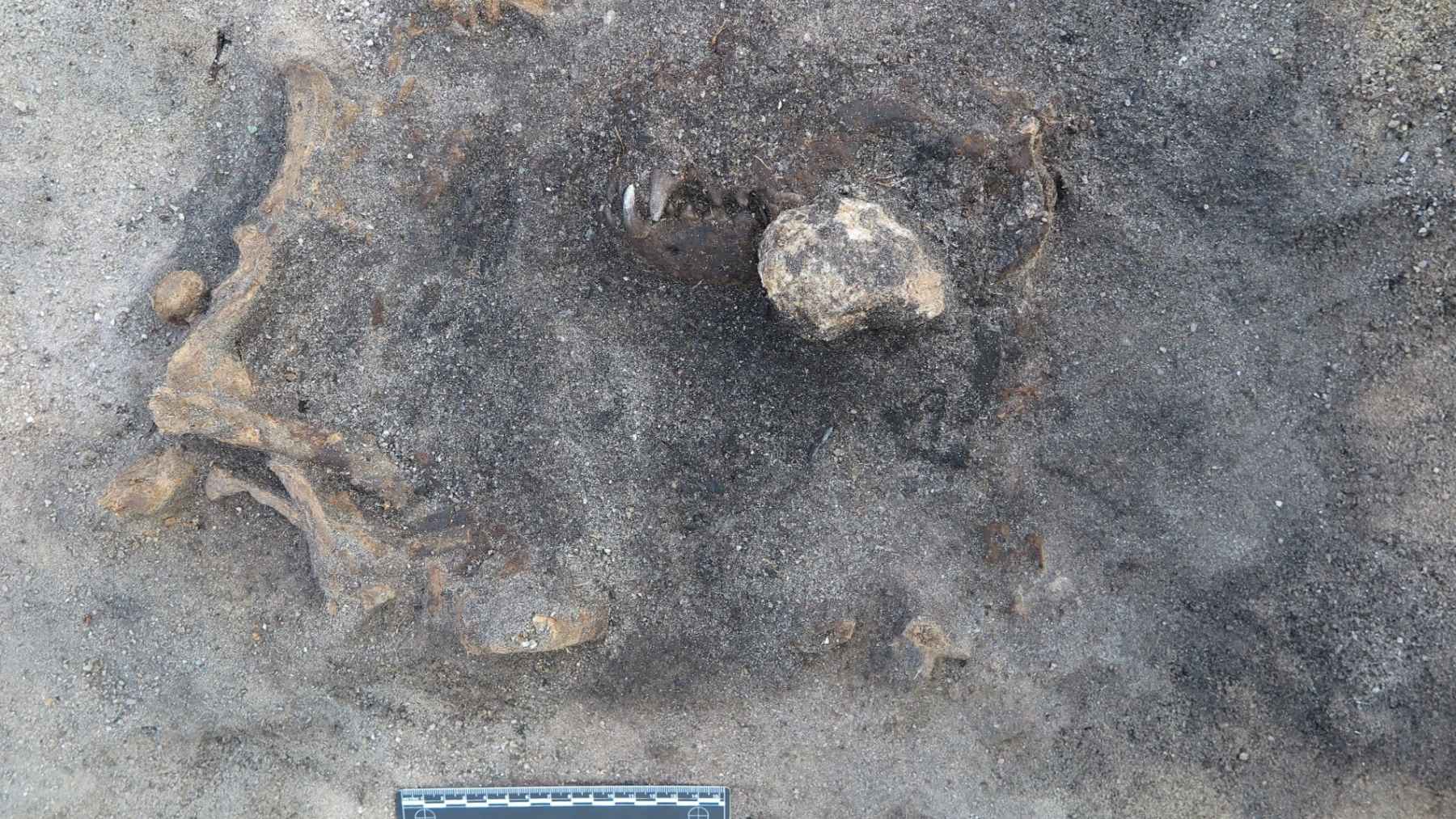
The grave lies in Logsjömossen, a peat bog that was once a clear shallow lake used for fishing. During work on the Ostlänken high-speed railway, archaeologists from Arkeologerna, part of the Swedish National Historical Museums, excavated waterlogged sediments and uncovered an almost complete dog skeleton about one and a half meters below the present surface and roughly thirty to forty meters from the old shoreline.
Analysis shows the dog was a large male, about fifty two centimeters at the shoulder and three to six years old at death, probably wrapped in a hide or bag and weighted with stones so it would sink to the lakebed. Marks on its bones point to an active working life, and although its skull was crushed, the careful way it was deposited points toward a deliberate farewell rather than disposal.
At the paws of the dog lay a finely crafted bone dagger about twenty five centimeters long, carved from elk or red deer bone and polished to a smooth sheen.
“Finding an intact dog from this period is very rare, and the fact that it was deposited together with a bone dagger is almost unique,” says project archaeologist Linus Hagberg. He notes that the animal and dagger had been deliberately lowered to a depth of around one and a half meters, not simply thrown into the water.
Dogs, wetlands and Stone Age beliefs
Archaeologists already knew that people in northern Europe often chose wetlands for offerings, and lakes and bogs across Scandinavia have yielded weapons, tools, pottery, animal bones and even human remains placed there over thousands of years. In that context, the Logsjömossen dog fits a broader pattern at a lake that clearly mattered for survival as a fishing ground.
Here the animal is tied directly to a symbolically-charged object and to a working shoreline, where the team recorded wooden structures from roughly 3300 to 2600 BCE, including stakes driven into the lakebed, a two-meter-long woven fish trap and trampled patches in the mud where people once stood to check their nets.
What the dog can still tell us
What can one buried dog tell us about the people who lived beside this lake five thousand years ago? Scientific work on the remains is only beginning, and planned radiocarbon dating, isotope studies and DNA analysis should refine the age of the burial and reveal what the dog ate and where it grew up.
Anyone who has ever lived with a dog knows how quickly daily routines form, from walks to quiet moments by the door. The care invested in this burial suggests that connection mattered and that the dog was given a role in a ritual sequence rather than simply discarded.
A wetland that stores both carbon and memory
Logsjömossen is more than an archaeological site because, as a peat bog, it is part of an ecosystem that stores large amounts of carbon in waterlogged soil, locking away plant material that would otherwise decompose and release greenhouse gases.
Globally, peatlands cover only a small share of Earth’s land surface yet they store roughly as much carbon as all the world’s forests, making them quiet but powerful allies in climate mitigation.
That double role as climate buffer and cultural archive is easy to overlook until a construction project cuts into it. Drainage, agriculture and infrastructure can shrink wetlands and turn some peatlands from carbon sinks into carbon sources when they dry out, while oxygen and microbes break down fragile organic remains and erase traces of ancient lives.
In Sweden, the railway project that sliced into Logsjömossen might easily have destroyed this fragile burial. Instead, cooperation between engineers and archaeologists allowed the team to document a rare glimpse of Neolithic life before construction moved ahead.
It is a reminder that protecting wetlands is not only about birds, biodiversity and climate models but also about stories, relationships and the quiet companions who walked beside us even five thousand years ago.
The press release was published on Arkeologerna.
Image credit: Carl Persson/Blekinge Museum.