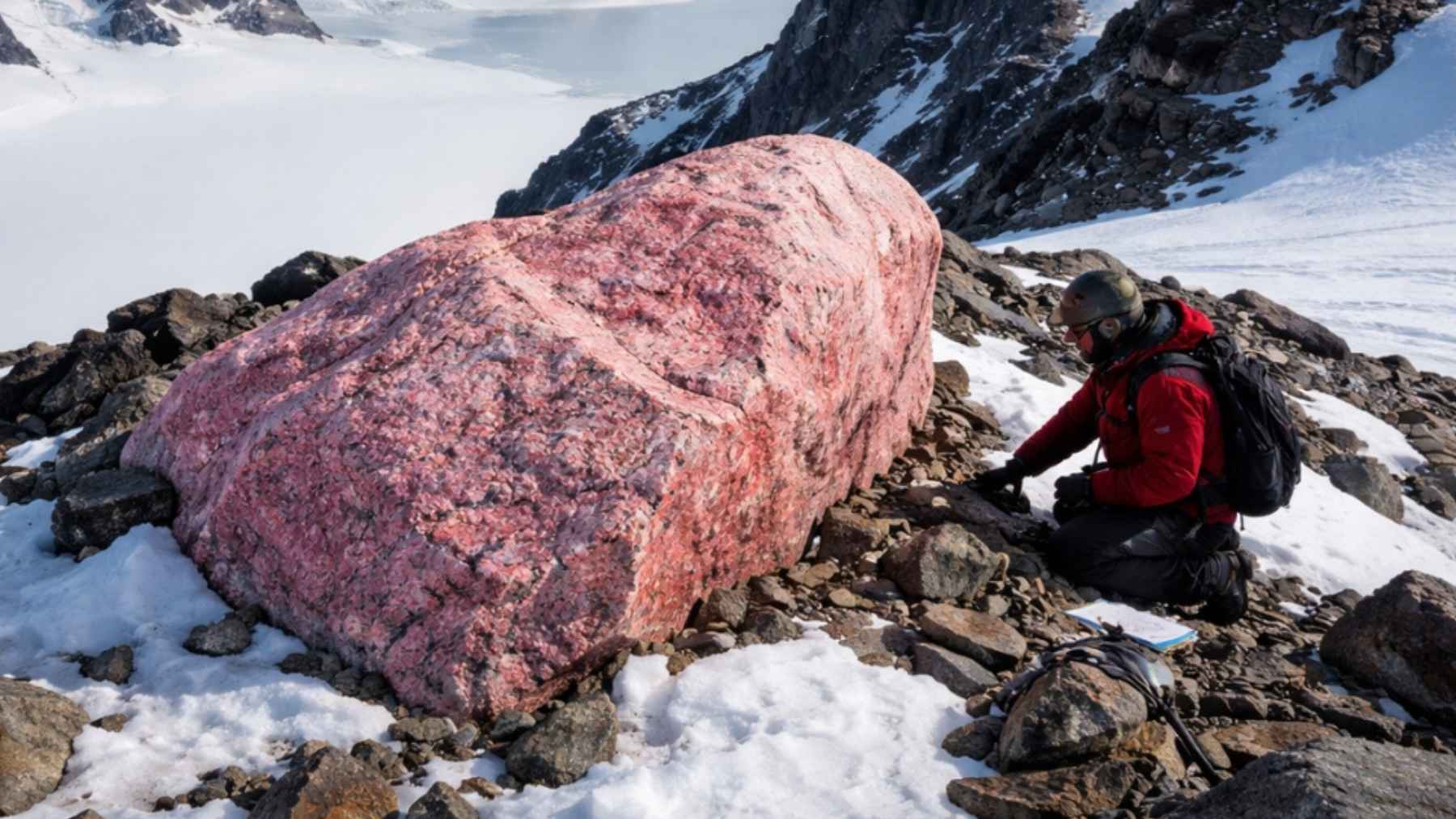
Pink granite boulders perched on the dark volcanic peaks of the Hudson Mountains are helping scientists redraw the map beneath Pine Island Glacier, one of Antarctica’s fastest-thinning glaciers and a major contributor to sea level rise in recent decades.
What can a handful of pink rocks in a frozen desert tell us about future floods along warm, crowded coasts? Quite a lot, it turns out.
A team from the British Antarctic Survey combined detailed chemical dating of these “glacial erratics” with airborne gravity and magnetic surveys flown over the region.
Their work, published in Communications Earth & Environment, shows that the boulders are fragments of a hidden granite body beneath Pine Island Glacier that formed about 175 million years ago during the Jurassic period.
Pink granite clues on the surface
Glacial erratics are cobbles and boulders that were plucked from the bed of an ice sheet, carried for many kilometers, then left behind as the ice thinned and retreated. Around the Hudson Mountains, the local bedrock is dark volcanic lava, yet the peaks are littered with pale pink granites and other exotic rocks.
By dating tiny zircon crystals inside twelve of these erratics, the researchers found a dominant age cluster near 175 million years with supporting evidence from their cooling histories. That age matches Jurassic granites exposed on nearby islands and helps tie the boulders to a common, much larger source deep below the ice.
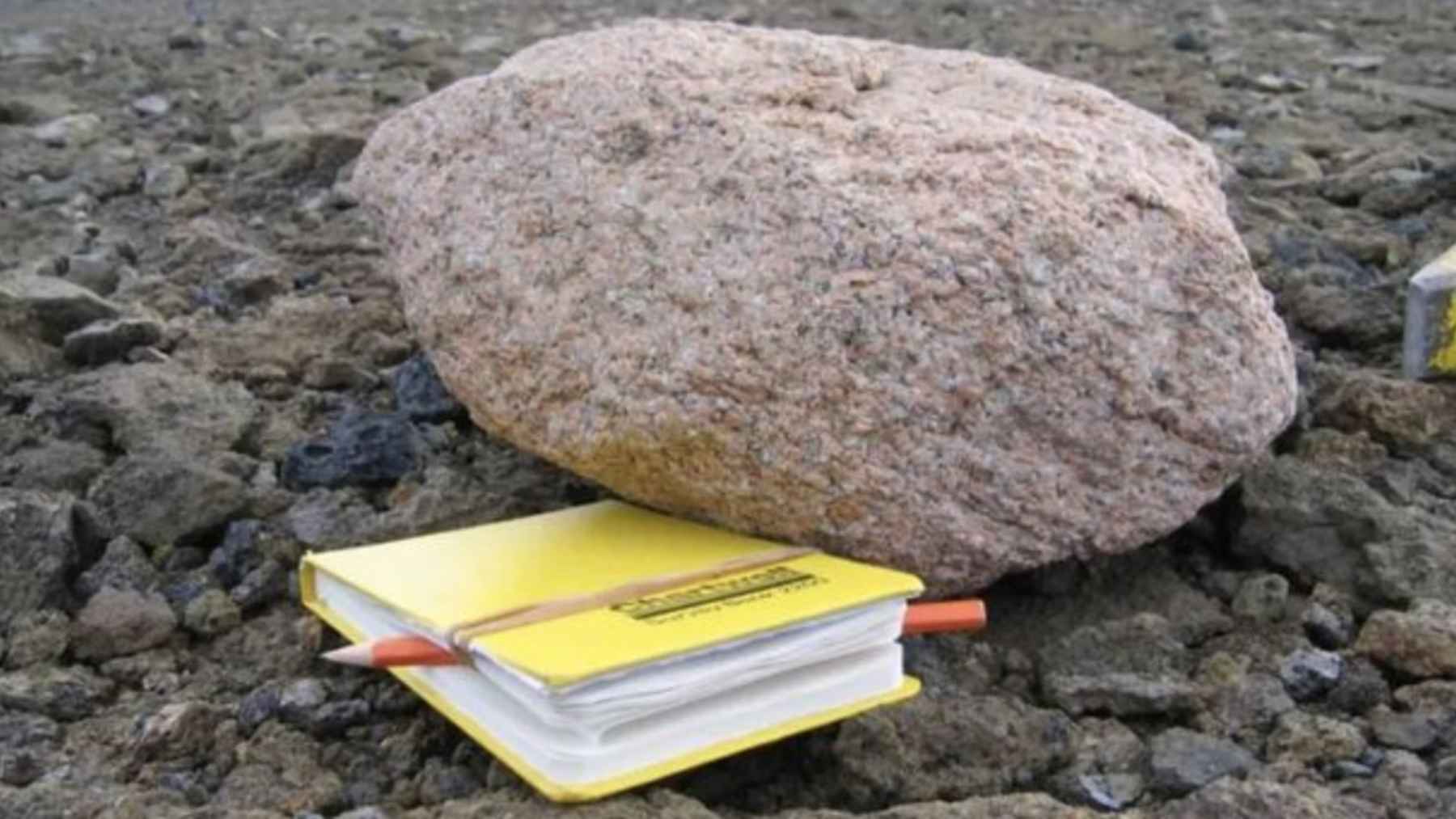
Pink granite boulders in Antarctica are helping scientists uncover a massive hidden structure beneath Pine Island Glacier.
A Jurassic giant under Pine Island Glacier
When the team compared the rock ages with high-resolution gravity and magnetic data collected from aircraft, a striking pattern appeared. The signals fit a buried granite body nearly 100 kilometers wide and up to about 7 kilometers thick, roughly half the size of Wales, sitting beneath Pine Island Glacier and extending toward the Hudson Mountains.
Jordan explained that “pink granite boulders spotted on the surface have led us to a hidden giant beneath the ice”. Hard crystalline bedrock like this behaves very differently from a soft, sediment-filled basin. It affects how easily the glacier can slide, how meltwater is routed, and how much the bed can deform when ice thins.
Rewriting ice flow and sea level forecasts
The same study also uses scratches on exposed rock and model simulations to show that, at the height of the last ice age about twenty thousand years ago, thick ice once flowed north across the Hudson Mountains before turning seaward. Today, most flow is funneled along deep troughs instead.
That shift in pathways matters. Pine Island Glacier has contributed more to global mean sea level rise in recent decades than any other glacier in Antarctica, and its future behavior is one of the biggest uncertainties in sea level projections that coastal planners and insurers worry about.
Co-author Joanne Johnson noted that “boulders like these are a treasure trove of information about what lies deep beneath the ice sheet, far out of reach”. Similar erratics are scattered across many Antarctic mountain ranges, which means scientists can repeat this approach without drilling through kilometers of ice.
In practical terms, that means better grounded computer models of how the West Antarctic Ice Sheet might respond to continued ocean warming and how quickly seas could rise for the rest of us checking tide charts and flood maps.
The study was published in Communications Earth & Environment.