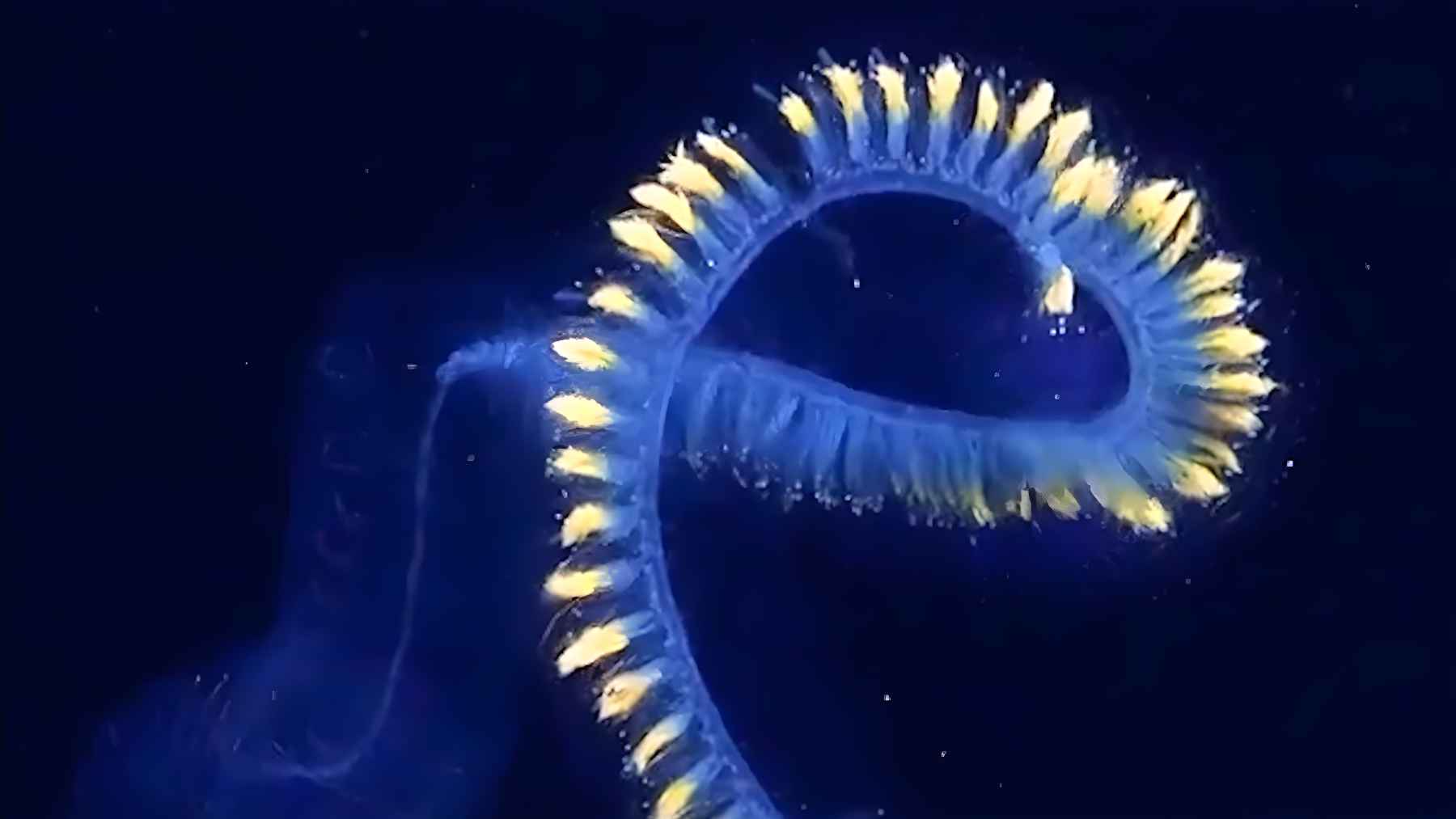
In 2020, a deep sea robot working off the coast of Australia drifted through total darkness and filmed something few humans ever imagined seeing with their own eyes. On the screens aboard the research ship, a thin, ghostly ribbon appeared, coiling across the water column.
Later analysis showed it was a siphonophore, a colonial animal stretching for tens of meters and with one section estimated at about 15 meters in size.
Scientists already knew about this record-setting specimen from earlier reports that put its spiral ring close to 47 meters long, possibly making it the longest animal ever documented. What the new coverage has done is bring the focus back to a simple but unsettling question. If this “living rope” can hide in plain sight for so long, what else is out there in the dark?
A robot’s quiet encounter in the deep
The discovery happened during a campaign that used remotely operated vehicles, or ROVs, to probe unexplored submarine canyons. Their cameras can work under crushing pressure and in complete darkness, reaching depths on the order of 4,500 to 6,000 meters, far beyond any human diver.
On one of those dives, a long, translucent figure drifted slowly through the midwater. Researchers later linked the footage to an expedition that sent the ROV SuBastian from the research vessel Falkor, as part of a project led by the Western Australian Museum and supported by Schmidt Ocean Institute.
Over twenty dives, the team explored the Ningaloo Canyons in the eastern Indian Ocean and recorded some of the deepest fish and invertebrates ever seen in that region.
Among those observations sat the star of the story, a giant siphonophore from the genus Apolemia, arranged in a huge feeding spiral that looked almost like a galaxy drawn in light.
One animal that is actually thousands
At first glance, the siphonophore seems like a single enormous creature. In reality, it belongs to the same group as jellyfish and corals and has a very unusual body plan. Siphonophores are colonies of hundreds or thousands of tiny units called zooids.
Each zooid is specialized for a different task such as propulsion, feeding, or reproduction, yet all stay physically connected and share nutrients.
MBARI scientists like to compare them to “living commuter trains,” with swimming bells at the front pulling long chains of feeding and defensive segments behind. The deep sea environment helps explain their extreme size. Because their bodies are mostly water and match the density of the surrounding ocean, they do not need heavy skeletons or a lot of energy to stay afloat.
That lets them stretch their tentacles over many meters to capture scarce prey in a food-poor world.
Recent studies show that siphonophores are not just curiosities. They are abundant predators that help shape food webs in open-ocean ecosystems and occupy several different feeding niches, especially in deeper waters.
Why this matters for the deep ocean and for us
Stories about a giant “string animal” are eye-catching, but scientists see something deeper in the footage. It is a reminder that, by many estimates, more than 80% of the ocean remains unmapped and unexplored in detail, and less than 0.001% of the deep seafloor has been visually observed.
At the same time, interest in activities like deep sea mining is growing, even though experts warn that disturbing these little known habitats could cause widespread and possibly irreversible damage to fragile ecosystems.
So this delicate colony, floating silently in the dark, is not just a curiosity from the abyss. It is a snapshot of an enormous, mostly hidden ecosystem that helps regulate climate, moves carbon, and supports life far above the waves.