The mysteries hidden in the night sky is numberless, the worthiest of awe among them being the sudden flare of a nova. One such event, whose brightness would set it apart from all other stellar flares, will be the imminent outburst of T Coronae Borealis (T CrB)-a binary star system, located 3,000 light years away. With an eruption last recorded in 1946, astronomers are currently anticipating this once-in-a-lifetime phenomenon that may grace the night sky in some years to come.
Celestial fireworks: How a white dwarf and a red giant can create it
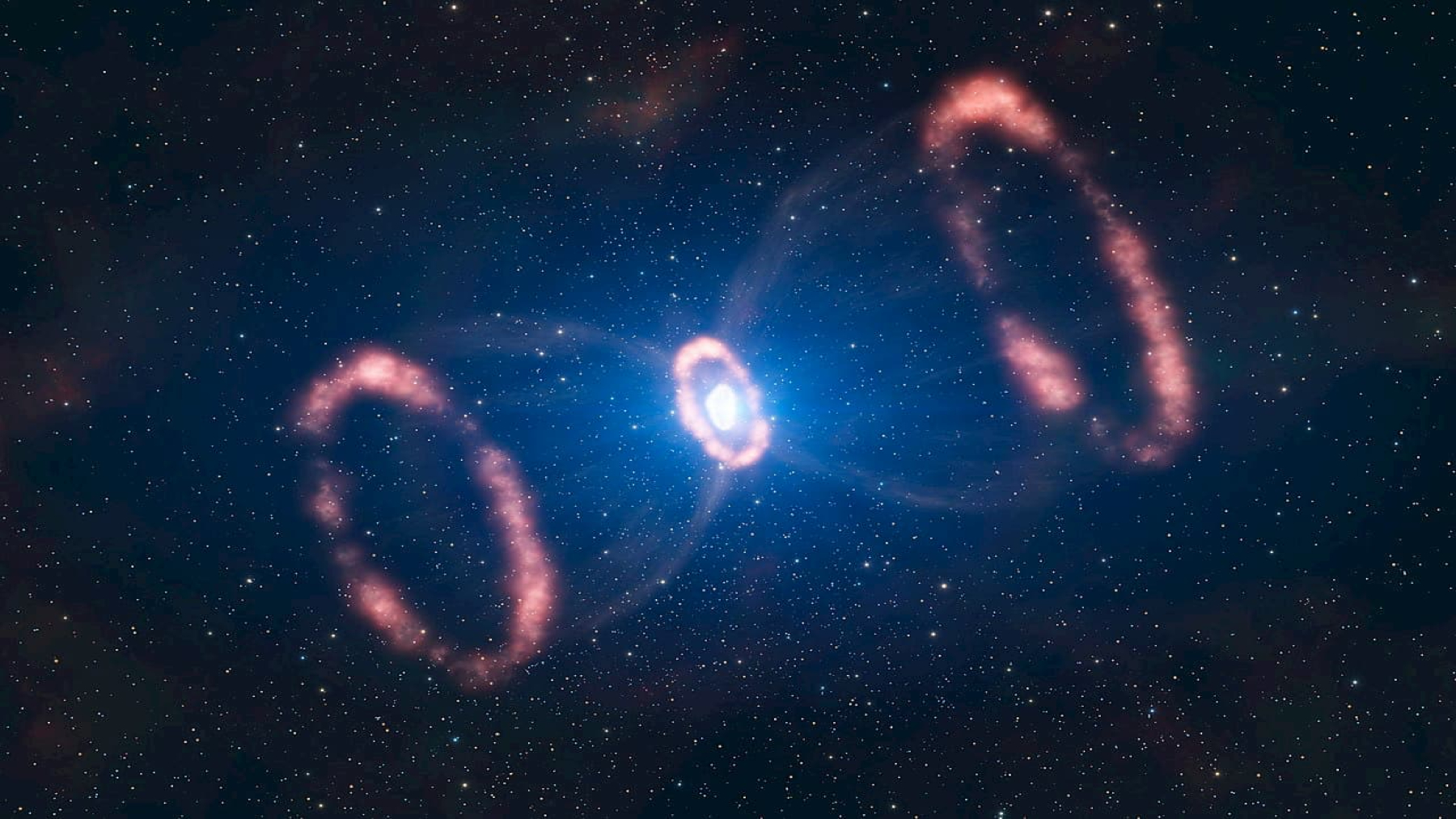
NOVA, in an astoundingly weird way, occurs because a white dwarf star draws gas from its companion star, with this instance being the red giant. After tens of years, it begins to pile up in great amounts on the white dwarf’s surface, provoking a massive thermonuclear explosion.
The bright star thus temporarily transforms into a bright spectacle visible from Earth while retaining its star intact. Unlike supernovae, which mark the end of the lives of a star, novas are explosions that recur in time. T CrB is one among only 10 known systems of recurring novae. Only five of them are in the Milky Way.
But at the end of its long cycle of 80 years, astronomers can watch the two stars – red giant and dense white dwarf – dance an intricate tango. The next bang, according to Sumner Starrfield, an astronomer at the University of Arizona, could occur anywhere between now and 2026. It promises many new astral physics.
Gaze into the Northern crown: The amazing performance of T CrB
Nova T CrB will appear on the well-known southern constellation of the Northern Crown, which is also called Corona Borealis. This tiny little semicircular arc lies somewhere in-between the bright Arcturus star and the constellation of Hercules.
When it exploded (just like this one which was the most powerful explosion since the Big Bang), this nova is expected to be as bright as the North Star, or Polaris, and will remain visible to the naked eye for about a week. Binoculars give stargazers the chance to enjoy its light for perhaps a month.
While astronomers will not specify any date, they can say that the binary system’s performance looks very much like the period of its activity just prior to the explosion in 1946. “Tonight, this fall, or in several years,” says Starrfield.
Fortunately, with state-of-the-art instruments such as the James Webb Space Telescope now available, scientists will carefully follow the development of this nova and thus solve some mysteries that could not be approached several decades ago.
Stellar explosions unveiled: T CrB nova
Astrophysicists would have a chance to learn from the coming eruption of T CrB, which offers a single learning opportunity. This is the most distinctive aspect: one partner, the massive red giant, and the other, the very dense white dwarf.
The white dwarf passes around its companion and orbits the latter every 227 days, sucking off gas from the latter, which later ignites to blow off an explosion. The thermonuclear process results in a white dwarf surface temperature soaring to a staggering 392 million degrees Fahrenheit in mere seconds.
The explosion could give answers to some very interesting aspects of how stars explode. How much material is expelled from the star into space? Does it form one big cloud or many smaller ones? Such are some of the linked secrets that Starrfield’s team hopes to discover, with most likely revelations regarding origins of the solar system itself.
For instance, it’s speculated that lithium found in our solar system was produced in prior nova explosions before our solar system’s formation. While we wait to enjoy the ineffable display of T CrB, let us just familiarize ourselves a bit about the Corona Borealis constellation as astronomers would say.
It is not only an event that shall be thrilling for stargazers but also will consume further academic oil in the machine about the physics of stars and the birth of our universe (such as this one which was going to set the atmosphere on fire). So, lock in those dates, find a pair of binoculars, and make all preparations for a wonderment at the brilliance of a star’s rebirth – a once-in-a-lifetime experience indeed.