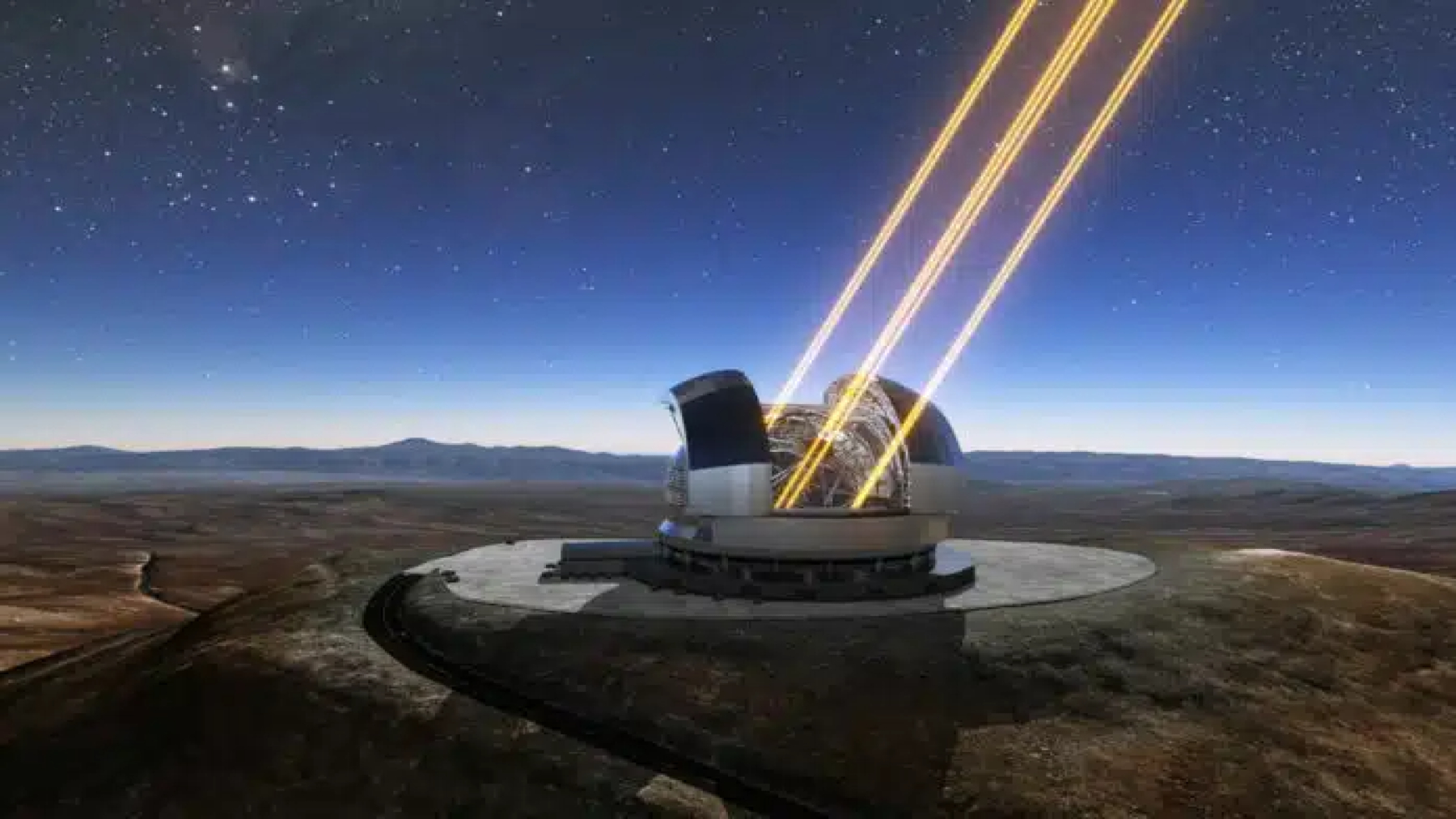
The UK Astronomy Technology Centre has been tasked with developing the first scientific apparatus for the Extremely Large Telescope, a vast observation facility being built in the Atacama Desert in Chile. This new telescope owned by the European Southern Observatory, endeavors to investigate many enigmas of the universe, such as the existence of extraterrestrial life and the birth of faraway galaxies.
The ELT: An instrument for exploring the secrets of the universe
An individual segment of the Extremely Large Telescope is approximately as big as the Roman Colosseum, and this highlights the size of the telescope. Galilean satellites braced construction progression has been communicated especially towards the need for the first scientific instruments to be developed, with the UK ATC / Science and Technology Facilities Council overseeing this.
The ELT is designed to travel to the very end of the universe, only that it is furnished with assets to detect numerous interactions occurring in space. Its main function is to find planets that have similar characteristics to planet earth located in different galaxy systems and find life.
Furthermore, it will also study youngest colonies of galaxies in the universe that has ever existed, making its historical studies cutting edge. Due to improvements in technology, people are now more willing to go further and investigate the workings of the universe including areas that have not yet been explored.
METIS: Advancing new perspectives on the evolution of planets and their cosmos
The Mid-infrared ELT Imager and Spectrograph has recently completed its final design review and is the first among the scientific instruments of the ELT to be manufactured and thus heading towards scientific operations in 2028.
This highly sophisticated device will study gas and dust discs that are present around the forming planets, which will provide important details about the processes responsible for forming and evolving galaxies. For astronomers, METIS holds considerable merit. The system receives mid-infrared rays from outer space, which can get through the clouds of dust that restrict the view in the optical range.
This feature permits a careful study of the disks dispersing space debris for accrediting planets as well as cold bodies like planets, whose majority of the emission is in the mid-infrared range. The gained knowledge from METIS is thought to play a major role in the process of finding other habitable exoplanets.
World participation is the key to METIS development: A paradigm shift in astronomy
The progress made in creating METIS shows that astronomy as a science can progress with global dynamics. The instrument is being conceived and built up by the METIS Consortium which unifies more than 10 top rank astronomical research organizations.
UK ATC shares its rich experience owing to its previous endeavors on the designing the Mid Infrared Instrument for the James Webb Space Telescope. Hence METIS which is being developed will even exceed the performance of MIRI since its spectral resolution will be over thirty times more and spatial resolution six times more.
Particularly, the European Southern Observatory (ESO) is of utmost importance in this partnership as it brings together 16 countries to build, fund, and maintain all the world best ground telescopes. The UK, through STFC, is a major partner of the ESO and the second largest financial contributor, sharing its expertise and services in support of scientific activity. All these efforts can still be justified for the purpose of new knowledge generation and broadening the frontiers of the mission of humanity in space exploration.
The very large telescope is, quite literally, a tool of hope for our astronomers exploring the universe. Equipped with instruments such as METIS, the ELT will make a turning point in the way people comprehend the universe and their place in it.
Throughout the construction period whereby the project is nearing the scientific operations, there is an increasing sense of anxiety for the yearning of this ambitious endeavor, which brings forth the advanced discoveries in the field of astronomy and the vastness of space.