Imagine what your home would gain in self-consumption if you installed solar panels, but let’s go even further: what if you transformed your garden into a domestic “plant” of energy generation? This is what you can achieve with a revolutionary invention coming to America: a wind fence that produces 2200 kWh and will give you electricity almost for free, something you would never get with conventional photovoltaic cells. Isn’t it impressive?
No more solar panels with this wince fence. You can have it in your garden to produce energy
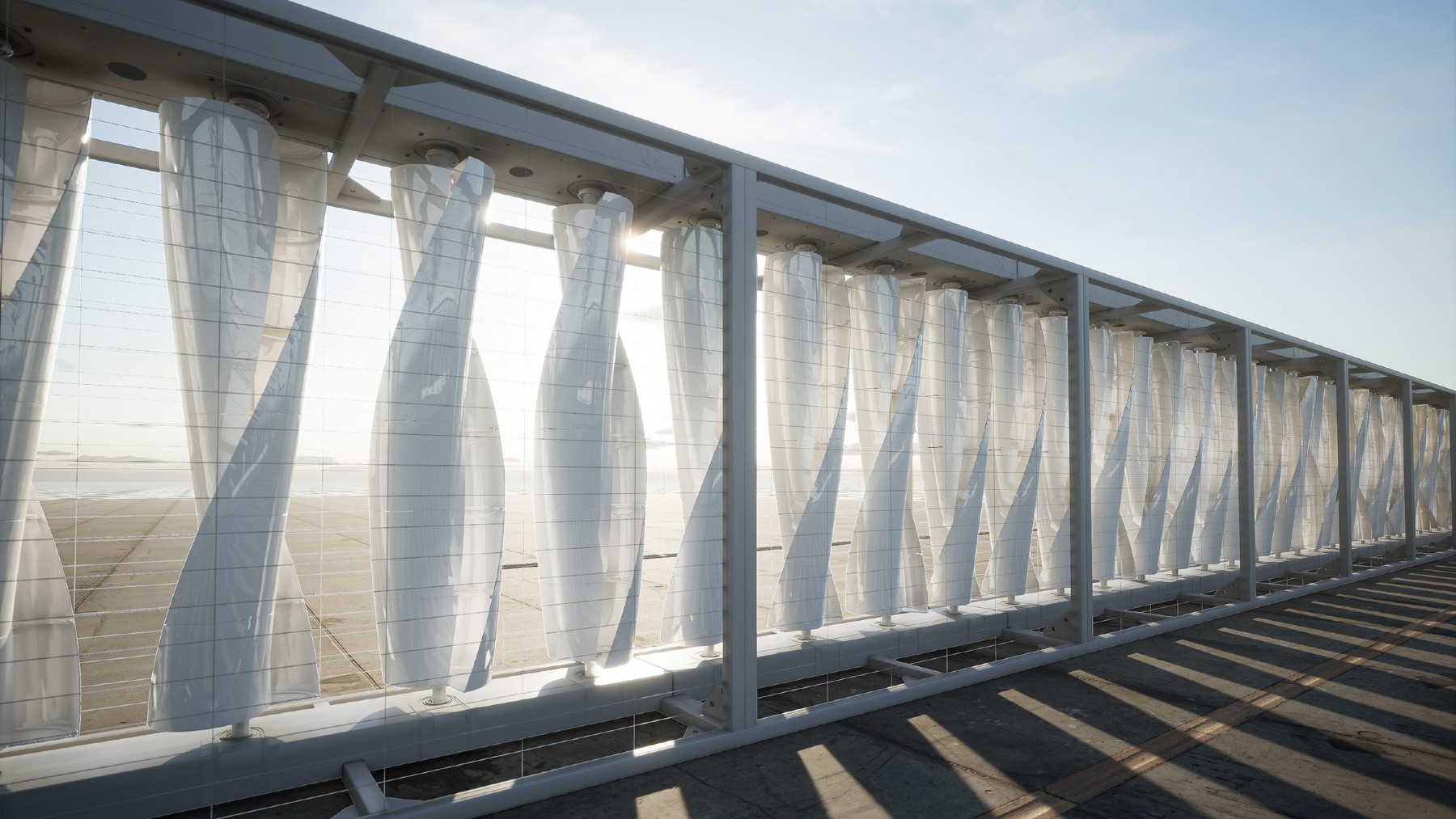
This wind power system has been designed by Joe Doucet, and it provides nice aesthetics along with good functionality and is designed to be incorporated into the urban environment. Sometimes called Airiva, it is a type of wind turbine that is attractive to the eye and can be assembled together with other modules for placing in urban streets and constructing buildings.
The key elements of product design are actually two vertical turbines, which have a height of two meters each and sculptural helix form; they differ from a standard blade propeller turbine. Lavishly illustrated with pictures of these blades in action, Doucet stresses the intriguing sight of these blades, insisting that the rolling will make Airiva an attractive fixture on buildings and roadsides.
The higher conceptual contribution is critical in adoption and participates in unobtrusively fitting into the milieu of our urban and suburban lives to introduce cleaner power to where we live and operate out of, as mentioned by Doucet. The system is planned to be as modular as possible and as scalable as required.
Unprecedented performance and 2200 kWh at home: Why do we need solar panels?
The unit blade clamps consist of four blades mounted in square block walls that can be interconnected to form units of virtually in-line length. As a result, this modularity enables Airiva to be implemented effectively across various domains that include airports, commercial buildings, and the rest as well.
From ideaception to execution, tremendous care has been taken to make the idea a reality with the help of engineering and experimentation. This approach is shown in the various grooves present in Doucet’s invention of the helical blade shape that underwent wind tunnel tests to increase efficiency, outshining previous similar designs.
The concept that was presented in January 2021 foresaw the construction of a wall consisting of 25 vertical axis turbines, each linked to a generator; thus, at peak, it could generate 10 kilowatts. However, it is important to note here that the current Airiva system has an even more developed turbine system; each of these turbine units is even larger and is made up of two five-meter-long segments.
Airiva wind turbines to get free electricity for homes: the detail that has experts on edge
And even if Airiva’s units may not have the same output as industrial turbines do, they’re custom-made for distributed energy systems. Based on the first assessment, each set of four walls contains at least 1,100 kilowatts per hour of AEP. Using the total energy requirement of the average US home, it takes ten segments, or 40 turbines, to generate enough energy.
However, it should be noted that Airiva is an auxiliary energy solution that can be used in coordination with other energy solutions such as grid electricity, and the company regards its systems as making a strong contribution to addressing the energy demands of buildings in the urban environment.
At this point, a wind fence like this one is going to revolutionize the way you produce electricity at home, not only because of its 2200 kWh, but also because of its versatility. No space to use solar panels? No need to worry; now you can turn your garden into a self-consumption plant that disconnects your home from the grid, something you will finally achieve thanks to this invention (no wonder it has been so awarded).