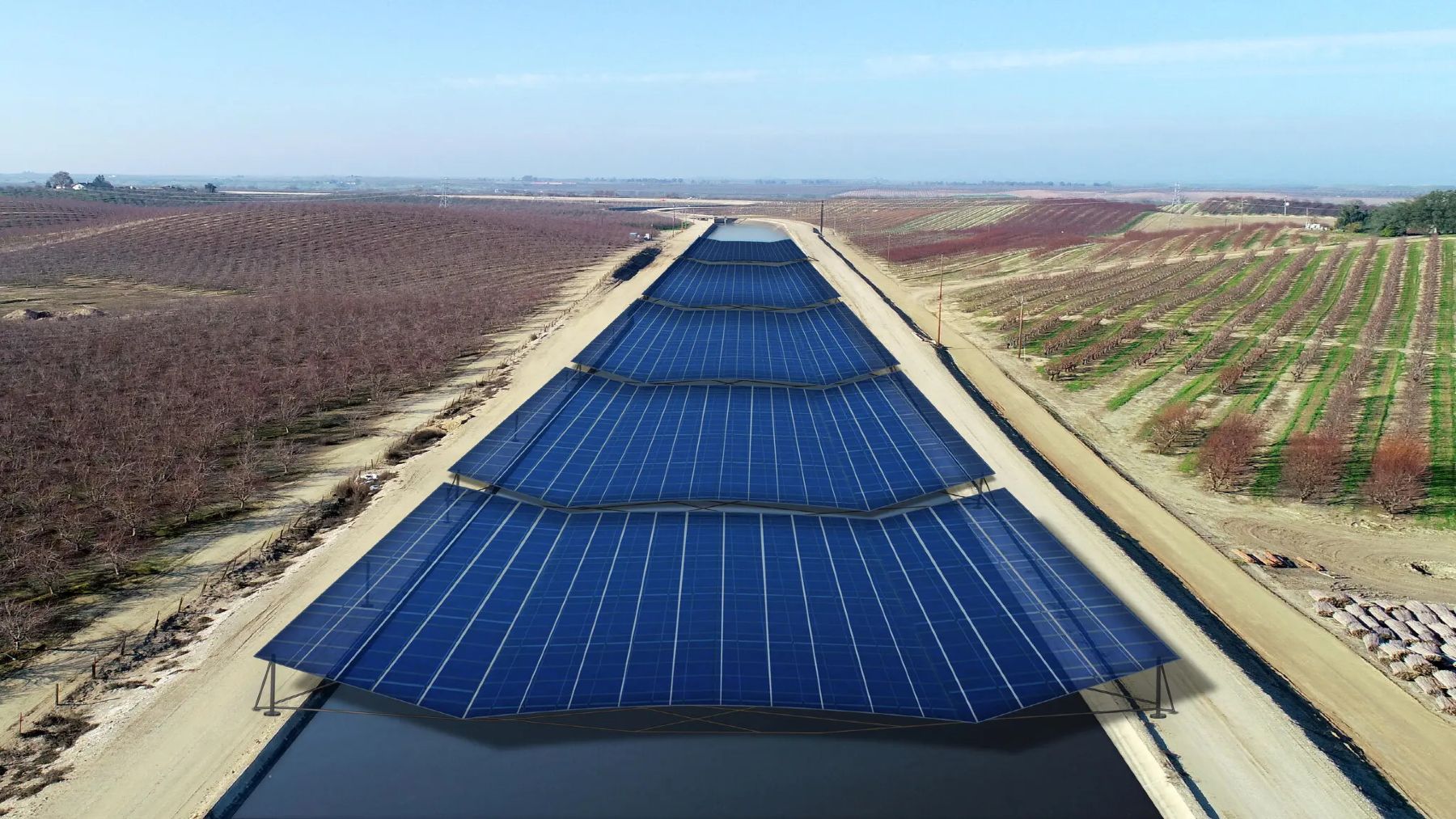
California has created a groundbreaking renewable energy achievement through its pioneering solar canal project. The project represents a transformative innovation which plans to cloak California’s canal networks with solar panels to produce substantial clean power supplies and retain water reserves. The following discussion provides an in-depth examination of this innovative plan and its estimated effects.
Through its solar canal initiative, California has the potential to produce 13 GW of green electricity annually.
The California Solar Canal Initiative (CSCI) represents an advanced strategy to create solar energy systems by implementing solar panels across California’s canal infrastructure. This initiative advances through the University of Southern California Dornsife Public Exchange and joint efforts with Solar AquaGrid and multiple other universities and state agencies.
Research by the University of California, Merced, in 2021 demonstrated that adding solar panels to the entire 4,000 miles of California canals would result in an annual power output of 13 GW. The analysis demonstrated how solar panel array deployment delivers three primary advantages: water conservation, decreased air contamination, and land conservation benefits. The project benefits from current systems to avoid solar farm development on agricultural soil, thus protecting 50,000 acres of valuable farmland.
The Merced County pilot project is a foundation for statewide success throughout California.
Project Nexus is the pilot phase of the solar canal initiative currently operating in Merced County. The State of California supports the $20 million project, which Turlock Irrigation District executes with Solar AquaGrid and UC Merced as its implementers. The pilot examines how solar-covered canals will work at this reduced scale to determine their larger-scale statewide rollout.
The pilot program examines canal areas with widths of 20 feet and 110 feet, respectively. Different directions have been used to implement the solar panels to find the best orientation for achieving maximum energy output. This project has established storage facilities that assist the regional electric power system during times when solar energy output falls below requirements.
Water conservation combines with environmental advantages to stand as the primary feature of solar canals.
When canals acquire solar panels as rooftop installations, they provide dual advantages in addition to power generation. The main advantage of solar canals involves saving water. The solar panels act as a shade layer that reduces evaporation, thus protecting the state’s limited water supply during its common drought seasons. The solar panels cast shade that curbs aquatic plant growth, making canal operations more efficient through lower maintenance expenses.
Environmental advantages accompany the project implementation. Solar panels that produce clean energy assist California in its mission to reach the targeted 40% greenhouse gas emission reduction by 2030. This project successfully reduces the demand for solar farms by preventing farmers from converting their agricultural land to solar facilities and maintaining agricultural production areas.
California continues developing its solar canal project to fulfil increasing power demands nationwide.
Project Nexus demonstrates the potential to enable the widespread application of solar panels across all California canal infrastructure. A UC Merced study showed that generating electricity for two million homes annually continues to be possible through solar panel coverage extending across the entire 4,000 miles of canals. The pilot program seeks to identify which channels will become optimal sites for solar panel installation, even though not all channels hold suitable conditions for solar panels.
The project implements different tools to measure possible water conservation and power generation capacity. According to initial calculations, the pilot facility should produce yearly electricity generation amounts estimated at 1.3-gigawatt hours. The pilot data gathered will optimize existing estimates to support the growth of this initiative.
The Solar Canal project in California embodies an audacious and revolutionary solar energy system. The project uses existing infrastructure to provide a long-lasting solution for the state’s energy supply and water needs. The pilot project’s development will inspire states around the world to combine solar power generation with key resource protection.