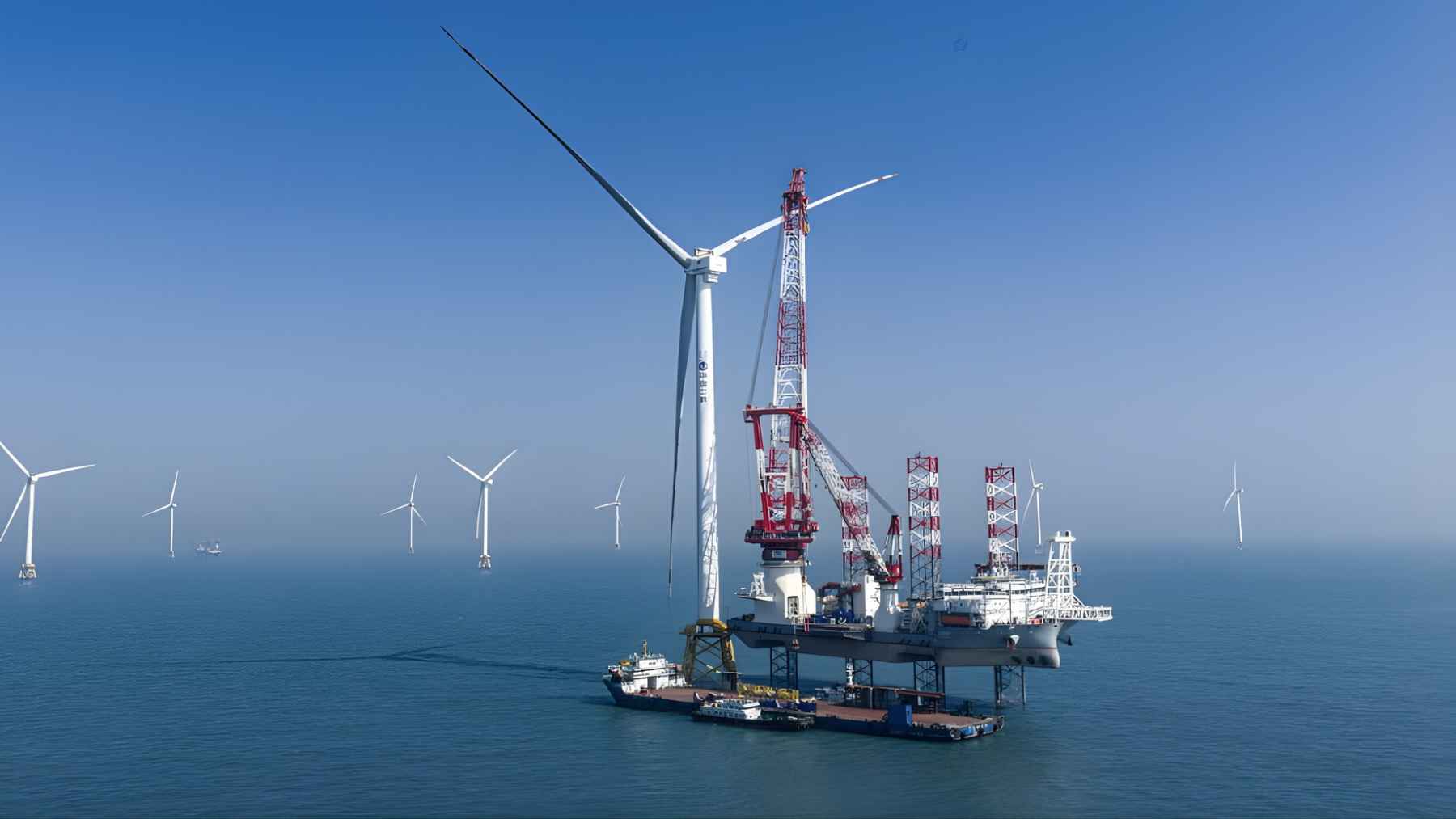
A wind turbine taller than many city skyscrapers is now operating offshore in China, and it is not just the electricity output that has people talking. The machine is rated up to 20 megawatts, a scale that pushes offshore wind into a new size class.
But the more surprising conversation is about the turbine’s side effects, not its height. Researchers have long known that wind turbines can subtly reshape the air around them, and the concern is that as turbines get bigger, those local changes could become easier to detect, and harder to ignore.
A giant turbine built for deep water and rough weather
Mingyang Smart Energy says it installed its MySE18.X-20MW offshore turbine at a project site in Hainan in the South China Sea on August 28, 2024. Industry reporting describes a flexible rating up to 20 megawatts and an enormous rotor, with a diameter range listed between 260 and 292 meters.
In plain terms, that rotor is the circle the blades sweep through as they spin, and it is where the turbine grabs energy from moving air. Mingyang has also marketed the platform as suited to high-wind regions, including areas hit by typhoons, which helps explain why the company emphasizes resilience as much as raw output.
How one turbine can nudge the “microclimate” nearby
Microclimate is a simple idea. It means the local conditions in a small area, like the slightly cooler air you feel near a shaded sidewalk, or the way coastal wind can change from one beach to the next.
Wind turbines can influence microclimate because they act like huge mixers in the lower atmosphere. As the blades turn, they leave a wake, a long trail of disturbed air downwind that can blend layers of warmer and cooler air, and also move moisture around. And yes, that can matter for the kind of “sticky summer heat” people complain about, even if the changes are usually small.
What the best measurements actually show so far
One of the clearest real-world looks at these effects came from aircraft measurements over offshore wind farm clusters in the North Sea, led by Julie Lundquist and Simon K. Siedersleben. The team found that under certain weather setups, the air in and near wind farm wakes could be slightly warmer and drier than nearby areas, and the signal could still be seen far downwind.
The key detail is the “certain weather setups” part. When the atmosphere forms a stable lid over the ocean, turbines can pull down warmer air from above that lid, changing temperature and humidity patterns in the wake. On other days, the effect can be weaker or look different, which is why researchers keep stressing that local weather conditions shape what happens.
Why this matters as offshore wind scales up
For most people, the headline benefit is simple. Bigger turbines can mean fewer machines for the same power, which can help developers reduce the footprint of a wind farm and, ideally, the cost of the electricity that ends up on your bill. Reporting on the Mingyang turbine has pointed to yearly generation around 80 million kilowatt-hours, framed as roughly enough to supply about 96,000 households.
Still, the “bigger is better” story now comes with a practical follow-up question. If very large turbines and dense offshore wind buildouts can measurably shift local wind, temperature, or moisture in certain conditions, planners may need to fold that into environmental reviews, marine forecasting, and even how nearby wind farms are spaced. A 2016 field study led by David Rajewski, for example, used direct measurements near turbine lines to connect wakes with changes in wind, temperature, and turbulence downwind, showing why the atmosphere around turbines has become its own research beat.
The main study has been published in Environmental Research Letters.