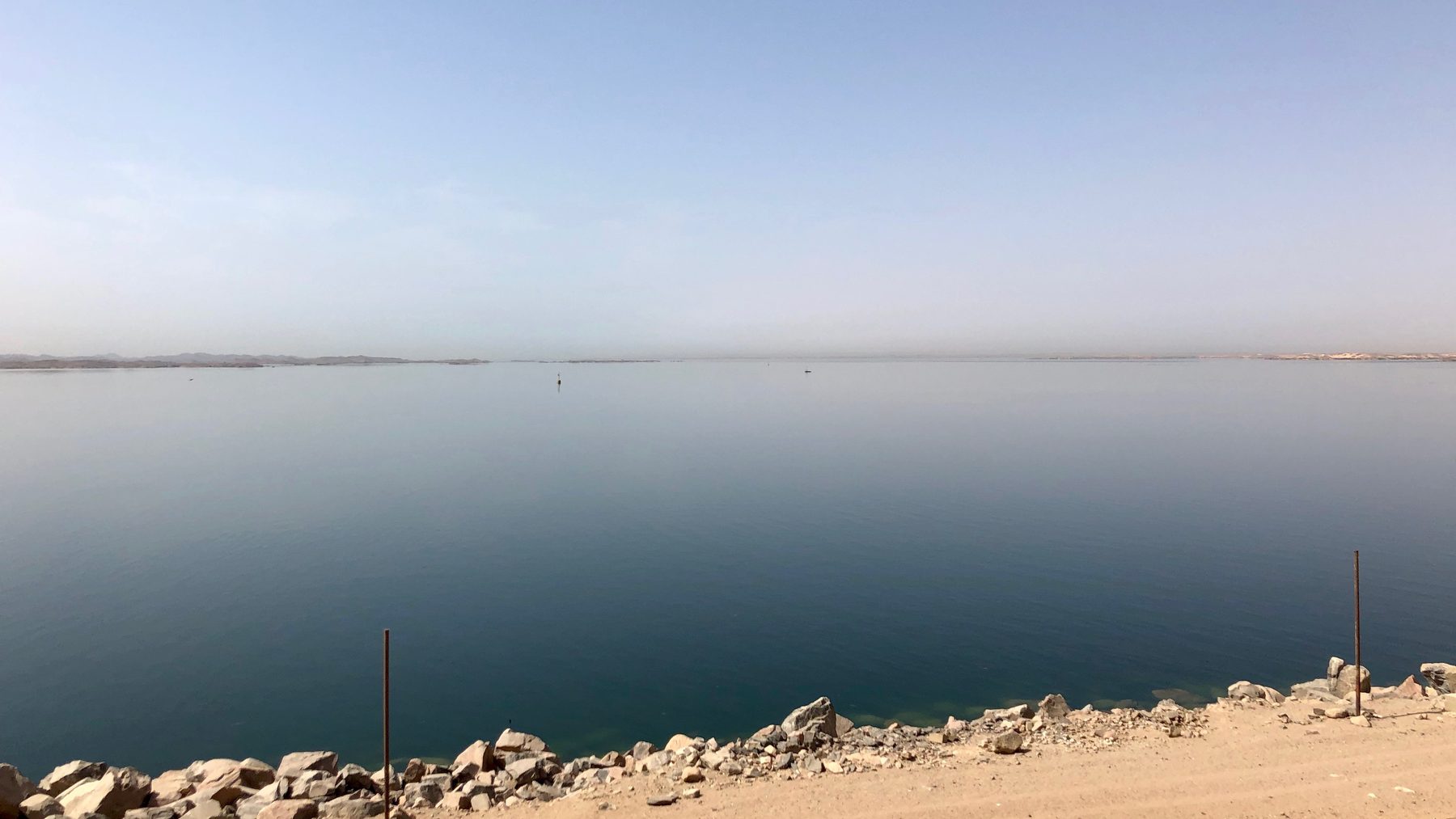
About 12 billion cubic meters of water, roughly 3.2 trillion gallons, evaporate each year from Lake Nasser, the reservoir behind Egypt’s Aswan High Dam, according to a 2021 study. That is more than the Seine carries through Paris in a year, and more than the 10 billion cubic meters, about 2.6 trillion gallons, that the 1959 Nile treaty between Egypt and Sudan budgeted for storage losses.
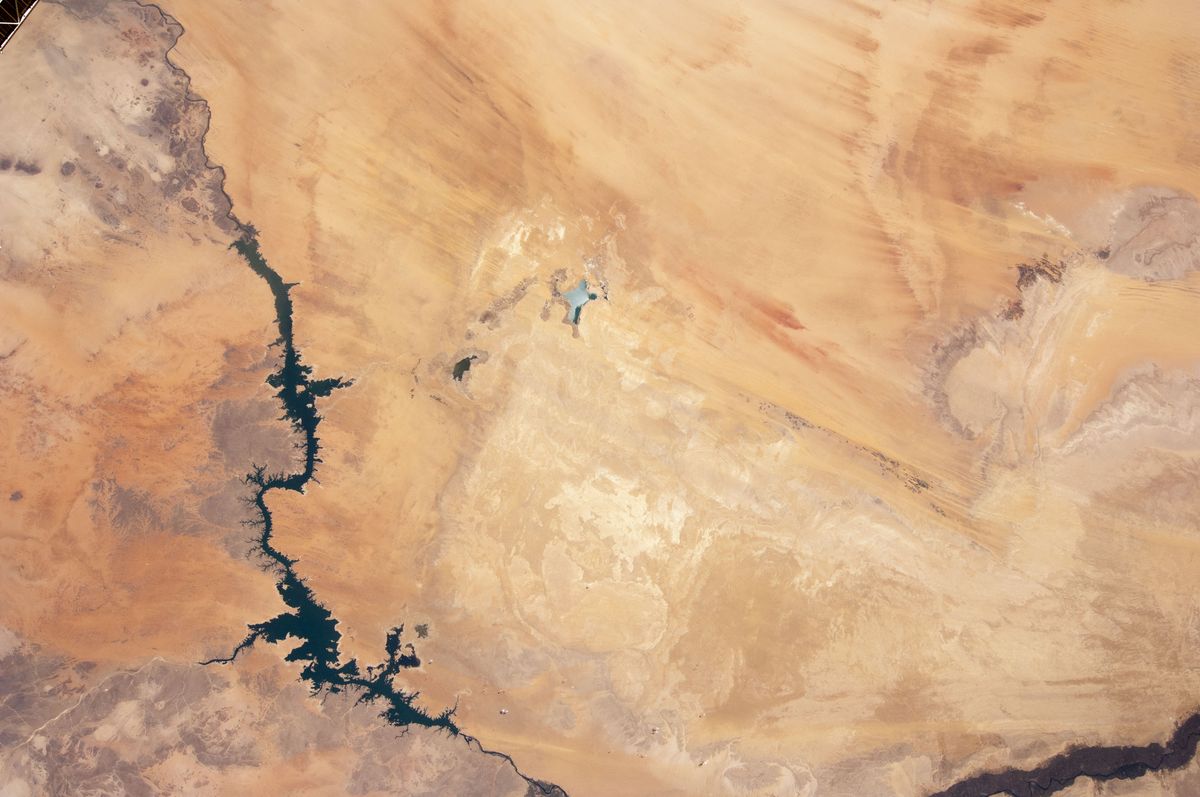
France’s HydroPortail lists the Seine at Paris at 309 cubic meters (10,900 cubic feet) per second on average since 1990, or about 9.8 billion cubic meters a year. Lake Nasser also loses water to the west, where spillover pooled in desert hollows. By June 2012, NASA reported, those lakes covered an area roughly 80 percent smaller than in 2002, mostly because of evaporation, a 2024 study found.
Why Egypt built a giant reservoir
After the 1952 revolution, an engineer of Greek origin named Adrian Daninos pitched a huge dam at Aswan to store the Nile flood and generate electricity, according to Egypt’s water ministry. The river’s yearly flow could reach about 151 billion cubic meters or drop to 42 billion, so Egypt chose to carry water over from wet years to dry ones, the same idea as storing Colorado River water in Lake Mead.
The dam was inaugurated on Jan. 15, 1971. Its rock-fill wall rises 364 feet (111 meters) over the riverbed, and at its design level of 600 feet (183 meters) the lake holds 169 billion cubic meters, or 44.6 trillion gallons, according to Egypt’s Ministry of Water Resources and Irrigation.
Egypt leaned on that store in the 1980s. The ministry says the High Dam protected the country from drought and famine during the successive low floods of 1979 to 1987, when nearly 70 billion cubic meters were drawn out.
Counting what rises off the lake
The 2021 figure comes from Hany F. Abd-Elhamid of Zagazig University in Egypt and co-authors in Egypt, Britain and Slovakia, who worked from monthly temperature, humidity and wind data for 2009 to 2020. Losses peak in August at about 1.74 billion cubic meters a month, some 460 billion gallons, and fall to about 0.3 billion in January.
In 1997, M. A. Mosalam Shaltout and T. El Housry worked from Meteosat satellite images and called Lake Nasser “the water bank of Egypt.” They put its yearly evaporation at 10 to 16 billion cubic meters, or 20 to 30% of Egypt’s income from Nile water.
The 1959 treaty priced it in
Egypt, then called the United Arab Republic, signed a Nile deal with Sudan in Cairo on Nov. 8, 1959. According to the treaty text, if over-year storage losses stayed at the estimated 10 “Milliards,” the net benefit of the Sudd el Aali Reservoir would be 22 Milliards. Sudd el Aali is Arabic for High Dam, and 10 milliards means 10 billion cubic meters.
The treaty set the river’s average yield at Aswan at 84 billion cubic meters, so the 2021 estimate of 12 billion is about 14 percent of it. Egypt’s share came to 55.5 billion cubic meters a year, and the 2021 paper says the lake’s evaporation is about 22 percent of that. The same treaty promised Sudan 15 million Egyptian pounds as full compensation for flooded property and required it to move the population of Halfa before July 1963.
The desert lakes west of Nasser
Those western lakes began with a safety valve. Since the end of 1981, the Toshka spillway has sent water to a depression in the Western Desert, about 250 kilometers south of the High Dam, whenever the level at the dam tops 584 feet (178 meters). In 2003, Egypt-born geologist Mohamed Sultan, then at the University at Buffalo, said the westward flow could, given time, “potentially create a second River Nile.”
Astronauts spotted the first Toshka lake in 1998. At their peak, the lakes covered about 560 square miles (1,450 square kilometers), according to a NASA caption by M. Justin Wilkinson. Over 90% of the water channeled west in that first event was lost to evaporation and only 10% to infiltration, according to a 2024 study in Communications Earth & Environment that called the route “a less-than-ideal solution.”
Then the lakes filled again. According to the European Space Agency, summer rain in Sudan in 2019 and record floods in 2020 refilled them quickly, and by March 2022 they were relatively salty, with visible signs of eutrophication and algae.
Sultan, now at Western Michigan University, is the corresponding author of that 2024 study, led by Hesham Elhaddad. The team counts two extreme floods since the dam was finished. The second, from 2019 to 2022, sent about 53.5 billion cubic meters (14.1 trillion gallons) west.
The team modeled releasing water from Lake 1 at 1,000 cubic meters (35,300 cubic feet) per second for 460 days into Depression II, a basin floored partly by permeable sandstone. After 2.5 years, 74.3 percent had soaked in, 20.1 percent had evaporated and 5.6 percent still sat on the surface. Water from the second flood should not be left to evaporate as it was after the first, the team argues.
Solar panels over the shallows
The 2021 team also looked at floating solar panels, which shade the water and make power, as on a reservoir outside London or over a desert canal in Arizona. Shade cuts evaporation by about 70 percent in their estimate, so covering the whole lake would save about 8.4 billion cubic meters a year, but the authors concede that Egypt is unlikely to cover even half of it.
So they looked at the shallows, where evaporation runs much faster than mid-lake. Covering water up to 3.3 feet (1 meter) deep, just 6.5 percent of the lake, could save 1.9 billion cubic meters a year, about 500 billion gallons. “Saving every drop of water in an arid country such as Egypt is a big gain,” they wrote.
What the numbers leave open
Every total here is an estimate. The 2021 run used weather data from World Weather Online, a commercial site, and a lake coefficient borrowed from earlier work, and other estimates it cites run from 10 billion to 16 billion cubic meters a year.
No panels float on Lake Nasser yet, and the Depression II plan exists only in a computer model. The Western Michigan group says more studies are needed to address the uncertainties of carrying it out over the rest of the 21st century.
The full study was published in Water.
Photo: Warren LeMay / Wikimedia Commons, CC0