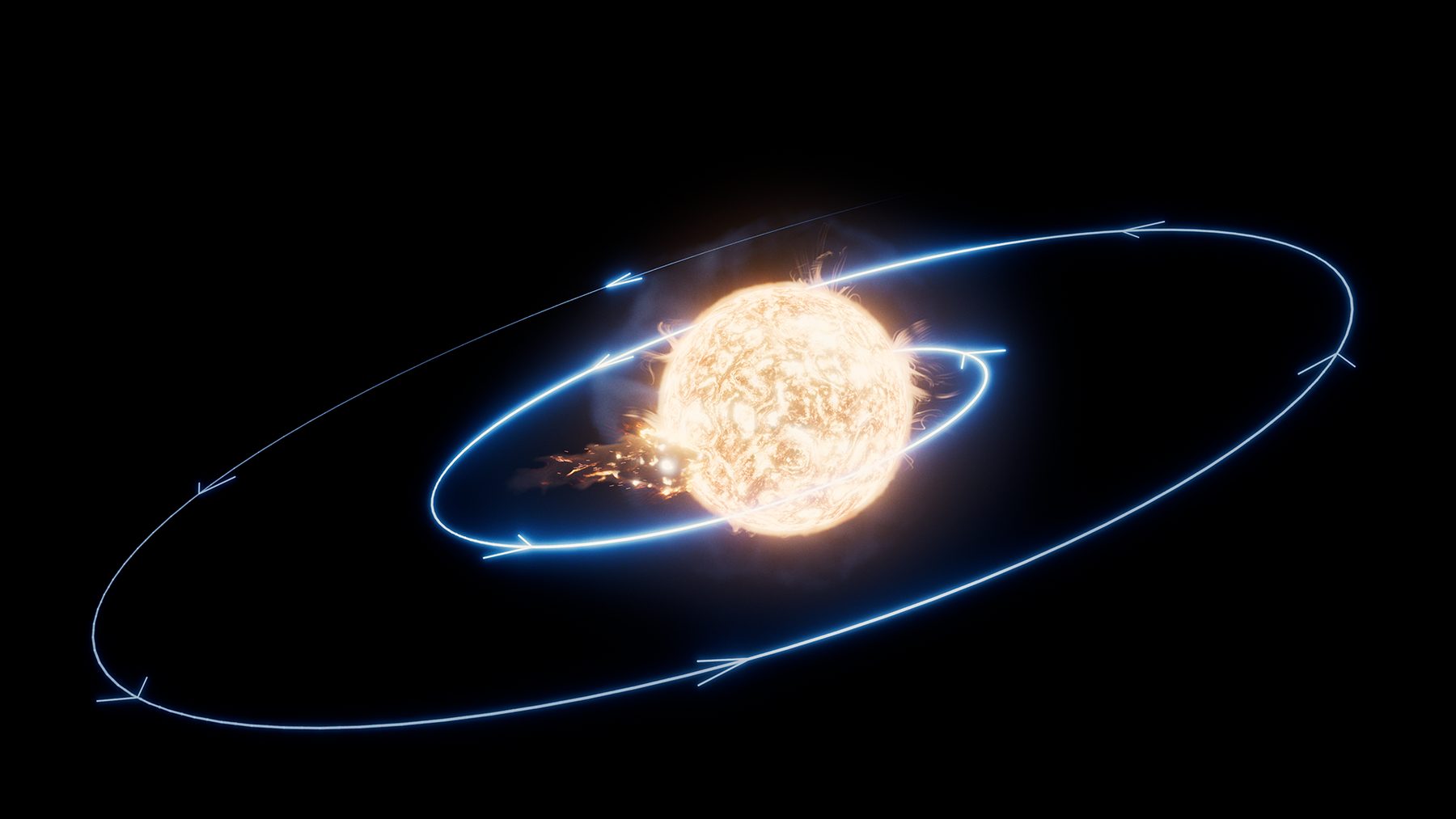
The Sun may carry traces of a planet that disappeared billions of years ago. A new study suggests that swallowing a rocky world with five to ten times Earth’s mass could help explain puzzling features inside our star.
The research, by astronomer Mutlu Yıldız of Ege University in Turkey, compares computer models with solar measurements. It predicts a possible chemical legacy of planetary engulfment, but it does not establish that the proposed planet existed or that the Sun consumed it.
A missing kind of planet
Super-Earths are common among planets discovered around other stars, yet our solar system has no confirmed example. NASA describes them as worlds more massive than Earth but lighter than Neptune, with compositions that can include rock, gas, or mixtures of both.
Despite the familiar name, a super-Earth need not resemble our home. It might lack a solid surface or have conditions entirely unsuitable for life, so the label alone tells us little about what standing there would be like. Even planets with similar masses can have different proportions of rock, water, and gas.
In this case, the proposed object is a rocky planet. The five-to-ten comparison concerns its mass, meaning the amount of matter it contains, rather than its diameter.
Listening inside the Sun
How can scientists investigate something hidden beneath the solar surface? They use helioseismology, which studies the Sun’s vibrations, much as earthquake waves help geologists examine Earth’s interior. The visible surface moves in response to sound waves generated by turbulent motions within the star.
Sound waves travel through different solar layers and produce measurable movements at the surface. Some waves pass through the center, while others turn back at shallower depths. Their behavior reveals information about temperature, density, composition, and motion far below what a telescope can directly see.
Standard solar models have struggled to match several of these measurements at once. Among the difficulties are the speed of sound below the convection zone and the depth of that outer region, where moving hot material carries energy toward the surface.
Building a model Sun
The investigation used MESA, software that calculates how stars evolve, to explore different histories of material falling into the young Sun. It also tested alternative explanations involving energy transport, the behavior of stellar material, and internal mixing.
The best-fitting model combined planetary ingestion with mixing and favored a world about 5.6 times Earth’s mass. Related successful models fell within the broader range of five to ten Earth masses.
In the proposed scenario, dissolved planetary material leaves a concentration of heavier elements below the convection zone. That changes how readily radiation passes through the region, helping the model better reproduce the Sun’s measured interior.
The lithium complication
Another clue involves lithium, an element unusually scarce at the solar surface. Its abundance is more than a hundred times lower than the value inferred for the material from which the Sun formed.
But swallowing a planet does not automatically explain that shortage. The study reproduces the lithium depletion only under particular assumptions about lithium-poor incoming material and internal mixing, so this result remains conditional.
A separate 2022 study, led by Jason Sevilla at the California Institute of Technology, illustrates why caution matters. Those models found that lithium signatures after engulfment vary with the star’s mass, internal mixing, and elapsed time. Engulfment can leave a lasting lithium enrichment in some stars, while in others the mixing it triggers can contribute to depletion.
A possible route into the Sun
The idea of a lost inner planet predates the latest study. In a 2016 study, Rebecca G. Martin and Mario Livio proposed that super-Earths could have formed closer to the Sun than Mercury, gathering material from the disk of gas and dust surrounding the young star.
Under suitable conditions, those planets could have moved inward through the gas and eventually fallen into the Sun. The earlier work suggested this could happen if the disk became sufficiently cool during its final stage of feeding material onto the star.
The authors also considered how turbulence, the irregular stirring of gas, affects where planets can form and how easily they move. The conditions needed to send an inner super-Earth into its star would not occur in every planetary system. That offers a possible explanation for why some stars retain close-orbiting super-Earths while our solar system has none, although it does not show that this particular sequence actually happened here.
Searching for stronger evidence
The next challenge is to identify the predicted chemical and structural traces independently. “The next step is to see if these fingerprints can be independently detected,” the study’s author said in the official announcement.
The distinction matters because a model can fit today’s measurements without uniquely identifying yesterday’s events. Finding the predicted pattern would strengthen the case for a lost planet, while further comparisons must establish whether other explanations can account for the same observations.
The study was published on September 10, 2026, in Monthly Notices of the Royal Astronomical Society.
Photo: NASA, ESA, CSA, Ralf Crawford (STScI)