Astronomers at the Max Planck Institute for Extraterrestrial Physics (MPE) in Garching, Germany, have found the fastest known star in the Milky Way. The star, S301, reaches up to about 15,900 miles per second (25,600 kilometers per second), or 8.5 percent of the speed of light, at its closest approach to Sagittarius A*, the black hole at the center of our galaxy, according to a paper published in Nature on Aug. 19, 2026.
Felix Mang, a doctoral student at MPE and corresponding author, and his colleagues first spotted the faint star in spring 2023, just northwest of the black hole. Its 8.7-year orbit brings it within 12 times the Earth-Sun distance of Sagittarius A*. “That is unprecedented,” Mang said in a press release from the European Southern Observatory (ESO).
Four decades around one black hole
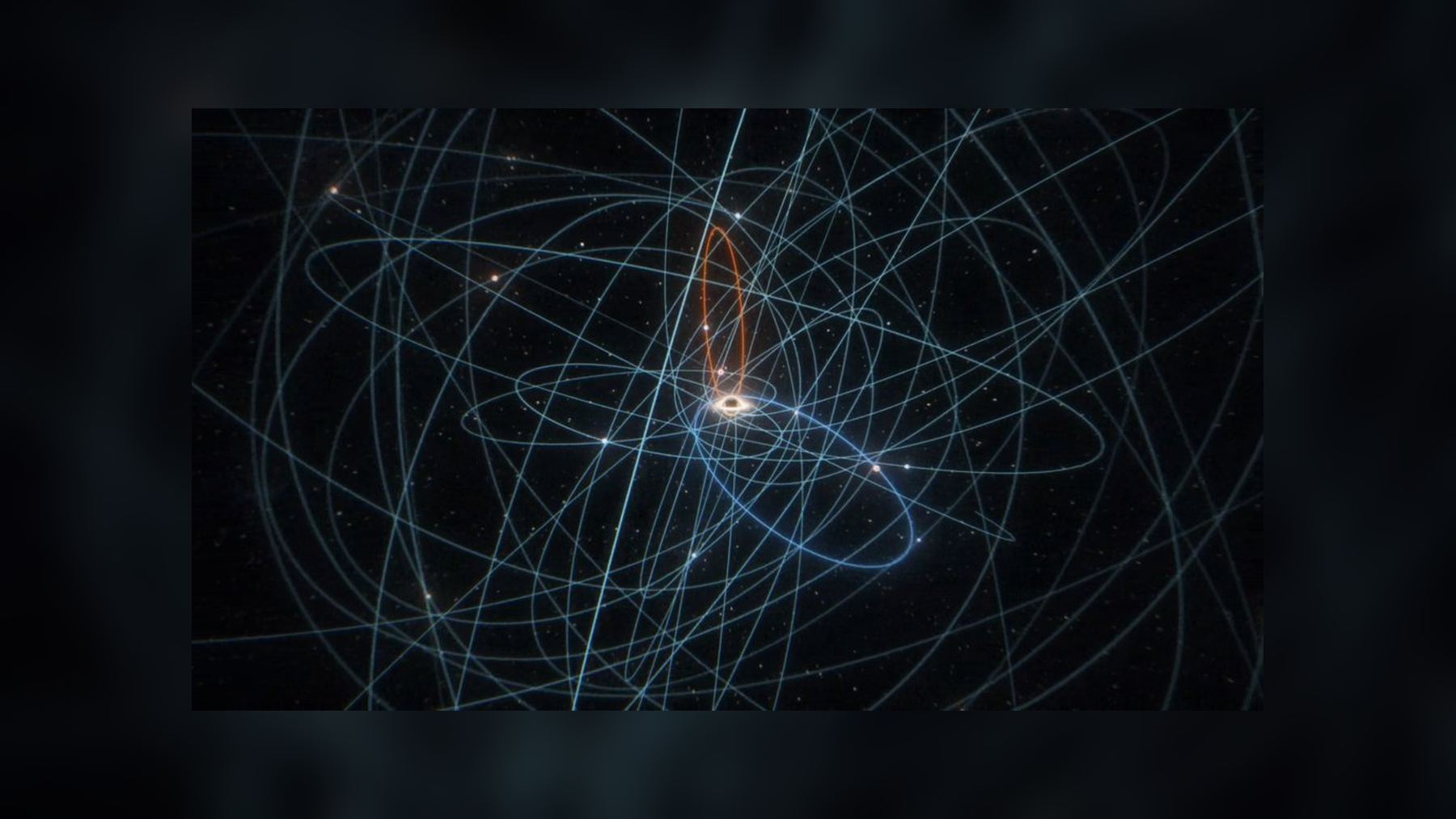
Sagittarius A* weighs about 4.3 million suns and sits some 27,000 light-years away. Reinhard Genzel, a director at MPE, shared the 2020 Nobel Prize in Physics for proving it is a supermassive black hole.
For years his group’s favorite star was S2, which takes 16 years per lap. In a statement from MPE, Genzel said S301 probes spacetime in the Galactic Center ten times closer to Sagittarius A* than S2.
The gas swirling near the Milky Way’s central black hole is messy, so the team relies on stars, which the authors describe as test particles.
Finding a faint dot
S301 looks two billion times fainter than Betelgeuse, the orange shoulder of Orion. MPE compares picking it out to hearing the buzz of a fly while a symphony orchestra is playing.
The tool was GRAVITY, on ESO’s Very Large Telescope Interferometer at Paranal Observatory in Chile, where astronomers fought to keep the skies dark. It links four 8-meter (26-foot) telescopes, and Frank Eisenhauer, a director at MPE and principal investigator of the GRAVITY+ upgrade, said no other observatory in the world can make them act together as an interferometer.
Stefan Gillessen, a senior scientist at MPE, recalls in an MPE interview video that images reconstructed from the GRAVITY data showed the expected stars plus one faint object. The authors credit their own imaging code, GRAVITY-RESOLVE, and say finding a star like S301 with a fitting code alone would be de facto impossible.
The dot moved fast, about 1,240 miles per second (2,000 kilometers per second) across the sky. By 2024 it was drifting out of the usual field, so the team pointed at it on purpose, with 8 positions that year and 5 in 2025. Working back from the preliminary orbit, they also found S301 in a 2021 pointing and, faintly, in March 2017 exposures taken for S2.
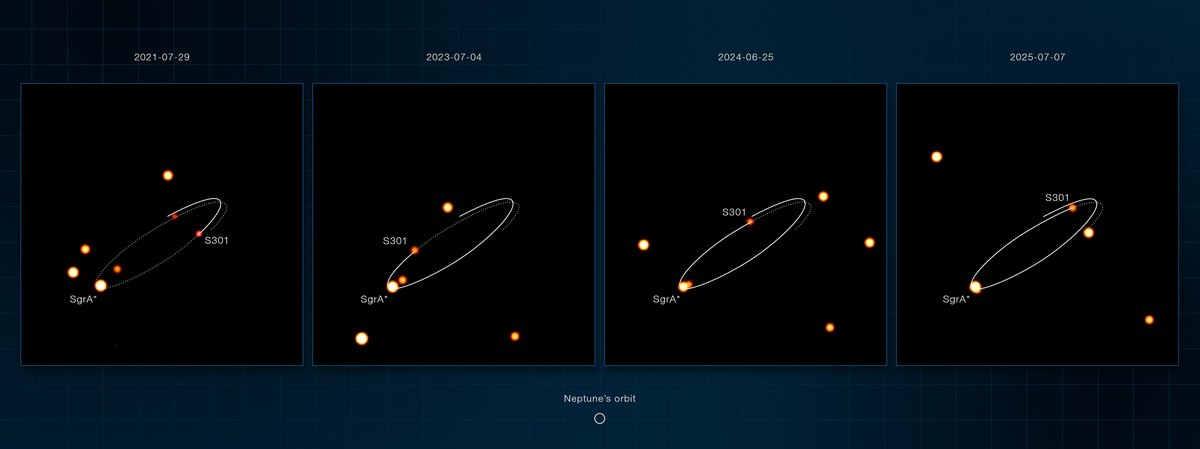
With 19 positions in hand, S301 set a new record for the shortest known orbital period around Sagittarius A*. The old record, held by S55, was 12 years. At the near end of its skinny ellipse, the star comes within about 1.1 billion miles (1.78 billion kilometers) of the black hole, roughly 20 percent beyond the sun-Saturn distance. There, ESO says, it moves about 100,000 times faster than a commercial plane.
Why the spin matters
Black holes grow by accreting material, and that matter should push them into rotation, Gillessen explains in the video. Eisenhauer adds that the spin will tell scientists how the black hole has grown over the past.
The paper admits that a spin is hard to measure. MPE compares a spinning black hole to “a rotating spoon setting the water in a cup in motion,” because it drags spacetime around. Physicists call this frame dragging, and NASA and Stanford’s Gravity Probe B once measured it around Earth.
For S301, mass alone turns the ellipse about 2 degrees per lap, and a fast spin would add 0.11 degree at most. Mang said S301 is the first star to orbit directly in the region around Sagittarius A* where the frame-dragging effect is extreme. “With this star we hope to measure, within the next 10 years, the spin of the black hole,” he added.
Juan Osorno, an astronomer at LIRA, Observatoire de Paris-PSL, in France, said that without this star, astronomers would need several more decades of measuring other stars to get close to the spin.
Captured when a pair broke up
S301 is too dim to be a giant and fits an ordinary F-type star of up to 1.5 solar masses. It probably formed elsewhere. The team’s favorite explanation is the Hills mechanism, where a black hole splits two stars locked in orbit around each other, keeps one and flings the other away.
In this case, the authors write, Sagittarius A* tidally separated a compact binary, leaving S301 on the most relativistic stellar orbit known and ejecting its companion as a hyper-velocity star. ESO thinks that companion was probably fast enough to leave the galaxy.
A 40-meter telescope for the third dimension
S301 swings past the black hole again in 2031. ESO’s Extremely Large Telescope, with a diameter of 40 meters, should come into operation in three or four years, according to the MPE video, and a consortium led by MPE is building its MICADO instrument to supply the orbit’s third dimension. ESO says at least two full orbits will pin down the spin. “That would be a dream come true,” Mang said.
Once the spin is known, Gillessen says, the team can predict how much the black hole is squashed, measure the squashing and check whether it follows general relativity or carries additional degrees of freedom.
Gravitational waves have been used in a similar spirit to test Hawking’s rule about black holes, and star motions to weigh a black hole of six billion suns. Einstein has also survived the largest test of gravity on cosmic scales.
What the study cannot say yet
The authors give it a fair chance within a decade, using reasonable assumptions, while Genzel says in the video he hopes it can be done in the next 15 years.
One number is also missing, the star’s speed toward or away from Earth, which ERIS, a spectrograph on the Very Large Telescope, could not pick up. Without it, two tilts of the orbit fit. One gives the 8.5 percent figure, the other about 15,500 miles per second (25,000 kilometers per second), or 8.3 percent. The binary origin is an inference from the orbit’s shape, and S301’s check on Einstein so far is weaker than S2’s.
The full study was published in Nature.
Image: MPE