A black hole does not need to blaze like a quasar to reveal its weight. Astronomers have measured a hidden giant at the heart of the distant galaxy MRG-M0138 by watching how its gravity changes the motion of surrounding stars.
And it is huge.
The best estimate puts it at about 6 billion times the mass of the Sun, seen when the universe was only about 3 billion years old.
The result carries a trusted local technique deep into the early universe for the first time. Data from the James Webb Space Telescope were combined with a natural cosmic magnifier that made the remote galaxy appear about 30 times larger.
That gave researchers something pretty rare. A close look at a black hole that produces almost no light of its own.
A black hole with no spotlight
Black holes themselves do not shine. when gas spirals into one, that material can become extremely hot and create an active galactic nucleus, sometimes seen as a brilliant quasar.
Those objects are hard to miss. They are some of the brightest beacons in the cosmos.
The supermassive black hole in MRG-M0138 is different. It is feeding so weakly that the team found no bright central glow, which is why researchers describe it as inactive or dormant.
So how do you find something that is basically invisible?
Like wind revealed by moving tree branches, the black hole gave itself away through the stars responding to its gravity.
How Webb weighed the invisible
Webb’s near-infrared spectrograph separated the galaxy’s light into hundreds of small regions and measured subtle shifts in the starlight.
Those shifts revealed the collective motion of stars near the center. Not individual stars, but the overall pattern.
Models without a supermassive black hole simply could not reproduce the sharp rise in stellar speeds around the core.
Lead author Andrew Newman of Carnegie Science put it simply. “We were able to detect this black hole at a distance of 10 billion light years.”
Senior author Richard Ellis of UCL said the method could support “a more complete census” of black hole growth.
the stars became the scale.
A galaxy became a magnifying glass
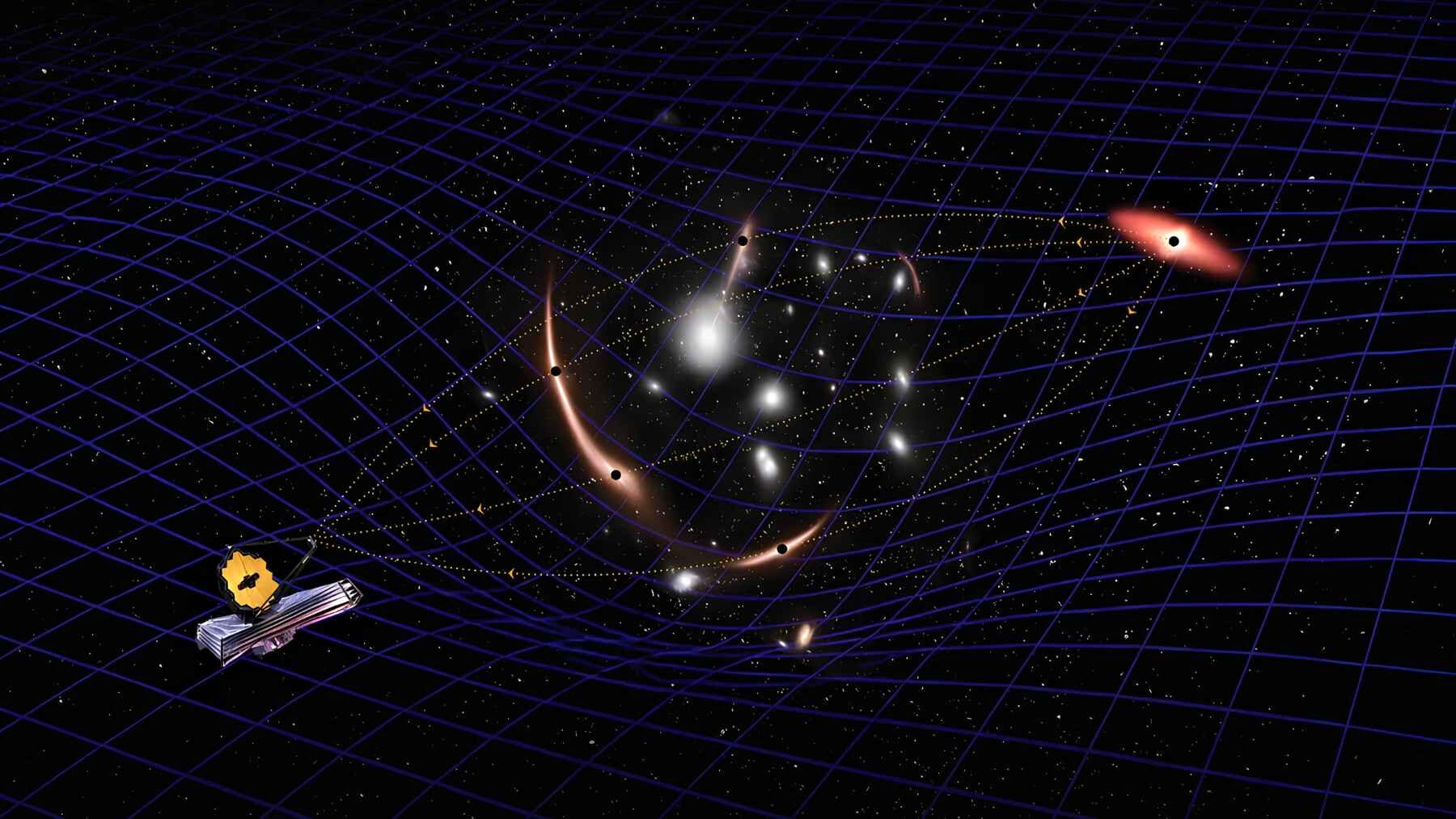
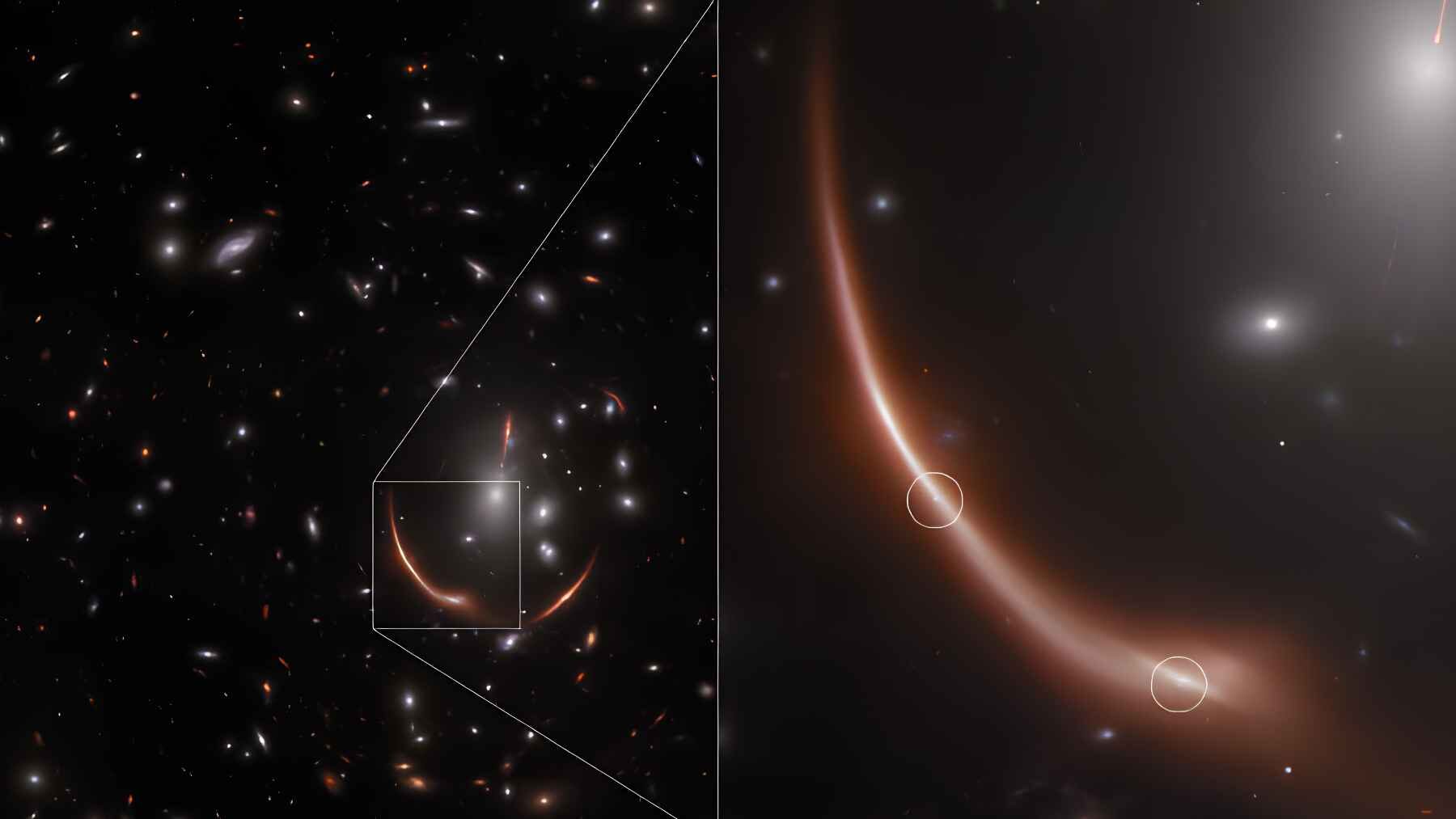
MRG-M0138 sits behind the massive foreground galaxy cluster MACS J0138.0-2155.
That matters.
The cluster’s gravity bends, stretches, and enlarges light from the background galaxy through a phenomenon called gravitational lensing.
Think of a warped glass lens. Except here, gravity itself does the bending across an enormous stretch of space.
The lens made MRG-M0138 appear in several distorted images and enlarged its fine details by roughly 30 times.
Without that boost, this measurement would have been extremely difficult.
It allowed Webb to resolve the black hole’s sphere of influence, the central zone where its pull noticeably speeds up nearby stars. The measured radius of that zone is about 535 light-years.
What the record actually means
MRG-M0138 contains the most distant inactive black hole directly weighed from the motions of its surrounding stars.
That distinction matters.
The previous galaxy measured with this stellar-dynamics method was about 700 million light-years away. The new measurement reaches roughly 15 times farther.
That is the real leap.
This does not mean it is the most distant dormant black hole identified by every possible method. A 2024 Nature study reported a quieter black hole from a much earlier cosmic era by detecting faint, broad hydrogen emission rather than resolving the motion of surrounding stars.
Different evidence. Different record.
Six billion Suns in a young galaxy
The team’s best mass estimate is 6 billion times the mass of the Sun, with a likely range from about 4.3 billion to 8.1 billion.
MRG-M0138 contains roughly 220 billion times the Sun’s mass in stars. So the black hole accounts for about two and a half percent of the galaxy’s stellar mass.
That is a lot.
Compared with nearby early type galaxies, the black hole is about 12 times heavier than expected from the mass of the galaxy’s central bulge.
Yet it agrees with the relationship between black hole mass and stellar velocity dispersion, which basically describes the spread in star speeds near the center.
What does that tell us?
One galaxy cannot rewrite the rulebook. But it hints that central density and stellar motion may track early black hole growth better than bulge size alone.
Did the black hole shut down starbirth?
MRG-M0138 is also quiescent, meaning it is no longer forming significant numbers of new stars.
The researchers think its black hole probably grew during an earlier quasar phase, when gas poured inward and released enormous amounts of energy.
That may have changed the galaxy for good.
Powerful winds from such an episode could have heated or expelled the gas needed to build new stars.
It is a bit like emptying a pantry. Once the fuel is gone, the kitchen goes quiet.
With little cold gas left, star formation would slow and the black hole itself would also lose its fuel, leaving both the galaxy and its central engine dormant.
It is a convincing possibility. But the study does not prove that the black hole caused the shutdown.
Why hidden black holes matter
Most black hole mass estimates in the distant universe come from active objects whose glare can overwhelm their host galaxies.
That creates a problem.
It is a little like trying to judge an entire city by looking only at its brightest billboard.
Measuring quiet black holes reduces that bias and gives astronomers a clearer view of the galaxies that grew around them.
MRG-M0138 suggests that the link between black hole mass and the motion of central stars may already have been in place more than 10 billion years ago.
At the same time, its unusually small bulge for such a huge black hole shows that other relationships were still changing.
For now, one example is not enough. Scientists need more.
The next cosmic census
The team is analyzing Webb observations of other distant, quiet galaxies that have been enlarged by gravitational lensing.
And there should be more of them out there.
Future surveys from the Euclid satellite and the Nancy Grace Roman Space Telescope are expected to uncover many more natural lenses, while the Giant Magellan Telescope could study stellar motions in greater detail.
Each new galaxy would add another piece to a history that is still mostly blank.
For now, MRG-M0138 shows something remarkable. An invisible black hole can still announce itself through the traffic of stars around it.
Its light began traveling toward us more than 10 billion years ago, yet the galaxy’s central motion preserved the black hole’s weight.
Gravity gave away the secret.
The official study was published in Science on June 4, 2026.