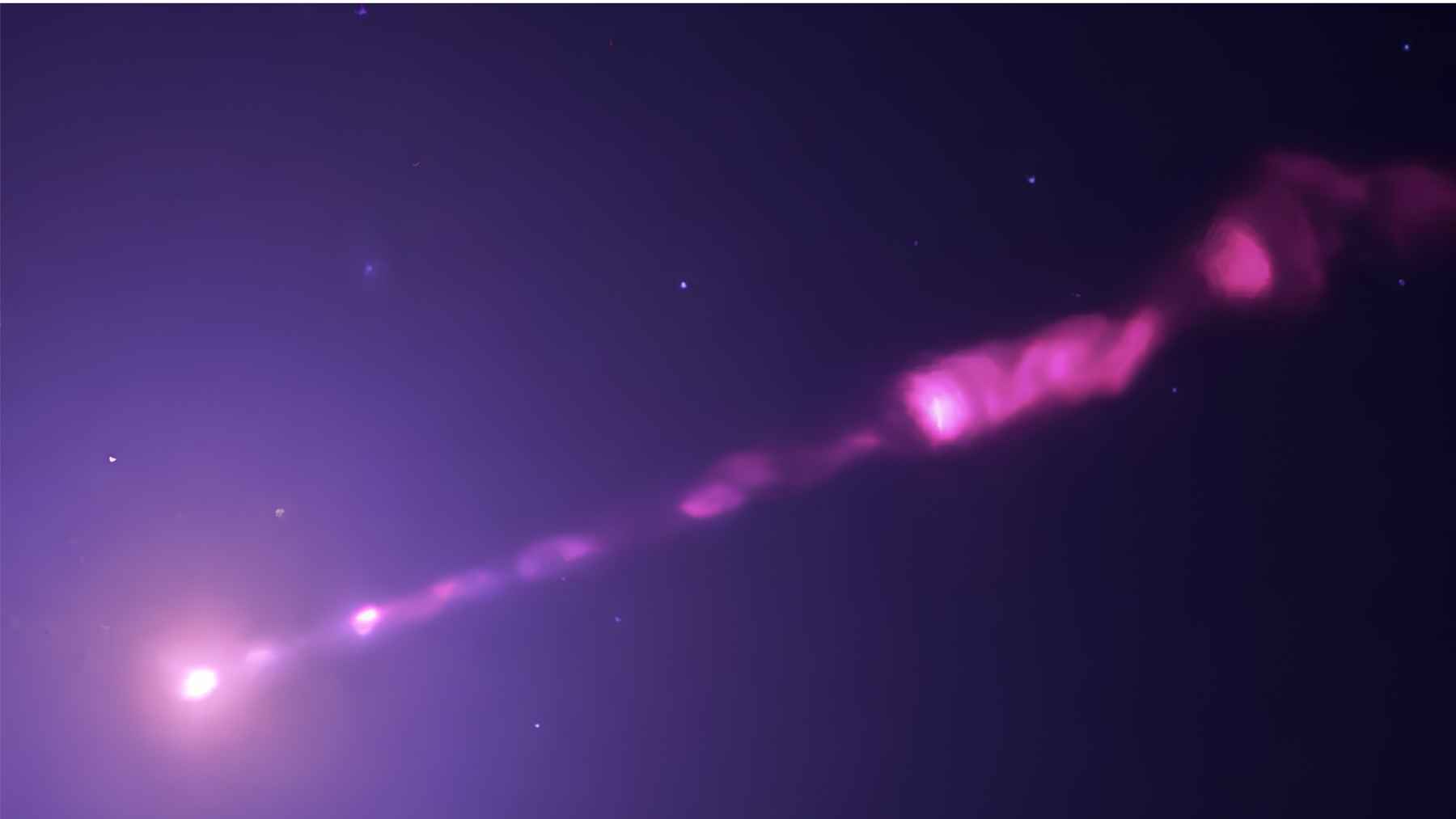
The first black hole ever photographed is no longer just a famous orange ring. New X-ray observations show that the monster at the heart of the galaxy Messier 87 is also powering a changing jet of hot gas and charged particles, giving astronomers their sharpest X-ray look yet at one of the most extreme engines in the universe.
That matters because this black hole sits about 55 million light-years from Earth and weighs about 6.5 billion times as much as the Sun. In 2019, the Event Horizon Telescope turned it into a global science icon by revealing the first direct image of a black hole’s shadow. Now, Chandra is helping show what happens around that shadow over time.
A jet from a cosmic giant
The new work focuses on a jet launched from the center of Messier 87, often called M87. A black hole jet is a narrow stream of extremely energetic material that shoots away from the region around a black hole at nearly the speed of light.
It may sound strange that a black hole, famous for swallowing matter, can also appear to blast material outward. The key is the chaotic zone around it, where gas and dust heat up, spiral inward, and interact with powerful magnetic fields before some of that energy is redirected into space.
In practical terms, it is a bit like watching steam roar from a pressure valve, except the scale is almost impossible to picture. This jet stretches across thousands of light-years, far beyond the area shown in the famous 2019 black hole image.
Chandra sees the jet change
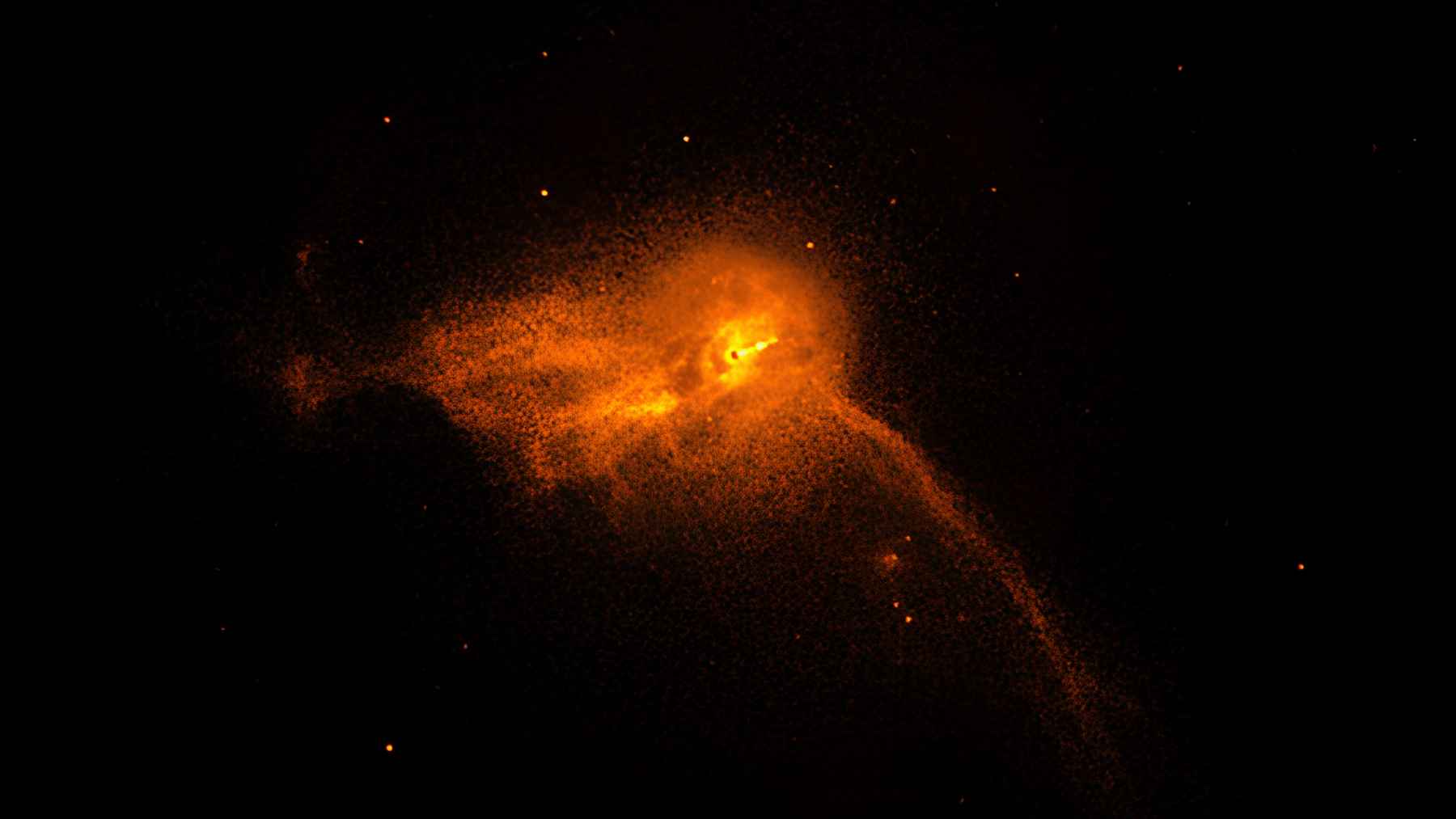
The latest view comes from NASA’s Chandra X-ray Observatory, using observations gathered between 2012 and 2025. An international team led by Camille Poitras, a doctoral student at Laval University, used advanced image processing to separate details that once looked blurred together.
“We could already see changes in the jet, but never with this level of detail in X-rays,” Poitras said. She added that structures that used to appear blended can now be distinguished, making it easier to follow the jet’s evolution across more than a decade of observations.
That long time span is important. Astronomers are not just looking at a cosmic snapshot. They are watching bright knots and features shift, fade, and behave differently over years, which is unusually useful when the object sits so far from Earth.
Faster than light, but not really
One of the most striking findings is that some parts of the jet seemed to move at nearly five times the speed of light. That sounds like it breaks physics. It does not.
Nothing with mass can outrun light. What the team is seeing is an optical illusion called “superluminal motion,” which happens when material moves close to light speed and is aimed roughly toward Earth. The timing of the light reaching us can make the motion look faster than it really is.
Think of it as a cosmic perspective trick. The material is still incredibly fast, but the universe has not thrown out Einstein’s rulebook. For readers who have ever watched a fast car seem to jump forward between glances, the idea is not so foreign, just stretched to a wild astronomical scale.
What X-rays reveal
X-rays are useful because they come from some of the hottest and most energetic places in space. In this case, they help trace particles in the jet that have been pushed to extreme energies.
The study reports that the X-ray brightness across the jet dropped by as much as 84 percent in some measurements. Scientists interpret that fading as a sign that very energetic particles are losing energy over time, a process connected to magnetic fields in and around the jet.
The team also compared the X-ray structures with views from other observatories, including the Hubble and James Webb space telescopes. Those comparisons show that the main X-ray features line up more closely than before with structures seen in visible and infrared light.
Why this matters for galaxies
Black hole jets are not just spectacular space weather. They can help shape the galaxies around them by moving energy from a tiny central region into much larger surroundings.
M87 is already known as a huge elliptical galaxy with several trillion stars and roughly 15,000 globular star clusters. Near its center, the black-hole-powered jet acts like a cosmic searchlight, sending material outward at nearly the speed of light.
That is why astronomers care about details that may sound small, such as knots, fading patches, and apparent motion. Each clue helps reveal how a supermassive black hole affects the gas around it, and that gas helps determine how galaxies grow, cool, and form stars.
A long look at an extreme object
Gerrit Schellenberger, an astrophysicist at the Center for Astrophysics | Harvard and Smithsonian, said the results show Chandra’s unusual power for tracking extreme events over long periods. He said they help scientists understand how energy released near a supermassive black hole travels through a jet and ends up in the surrounding galaxy.
The work was presented at the 248th meeting of the American Astronomical Society, which gives it a place in the current conversation among astronomers. Still, the bigger story is simple. A black hole once known to the public mainly through a single historic image is now being watched as a changing, active system.
And that is the real twist. The famous black hole photo was not the end of the story, but the opening frame of a much longer movie that scientists are still learning how to read.
The main study is available as a preprint on arXiv.