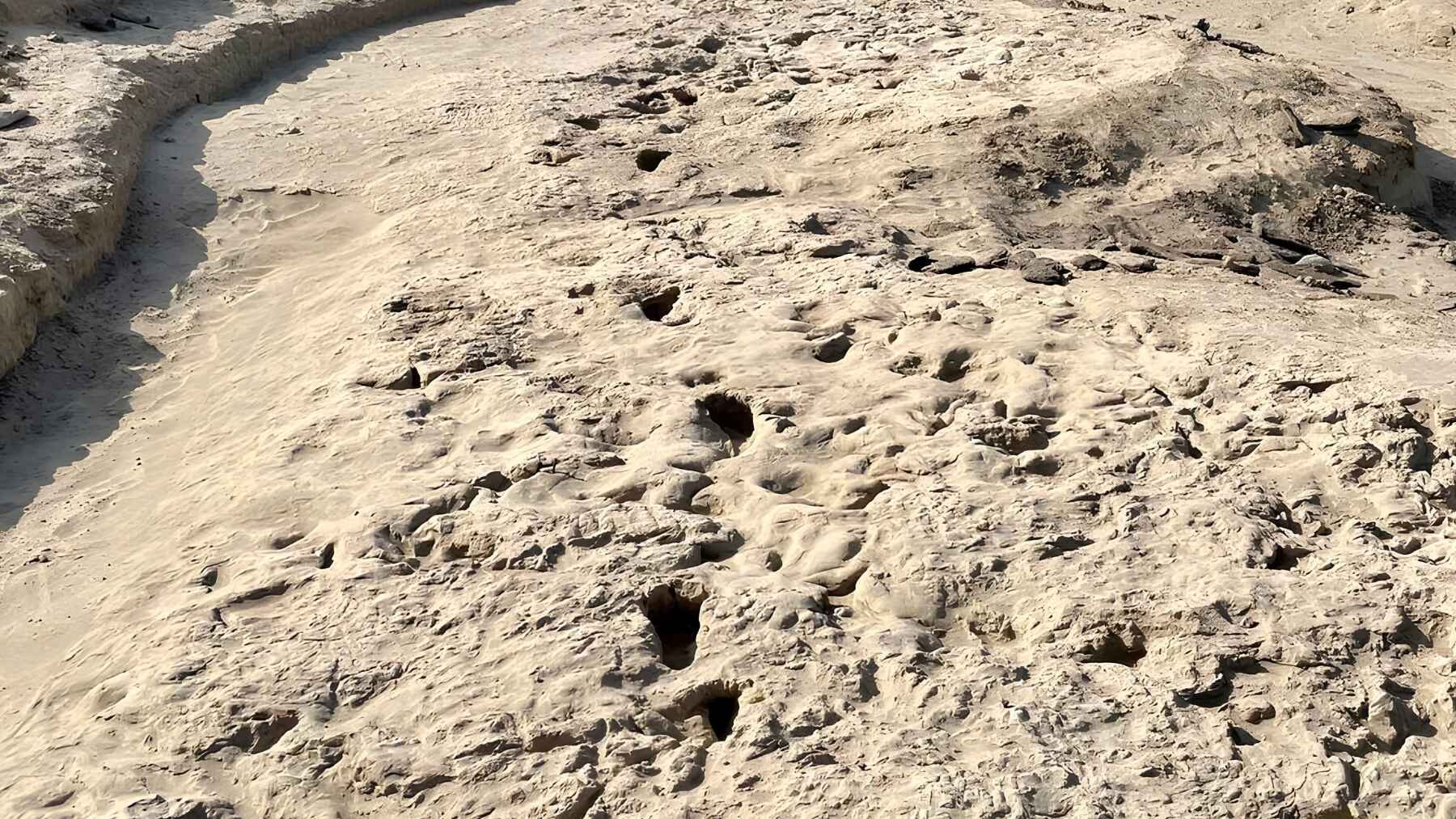
A muddy lakeshore in northern Kenya has preserved something bones rarely can, offering a narrow window into movement and company. At the GaJi10 site near Lake Turkana, 21 fossil footprints appear to record eight hominins crossing the same surface about 1.43 million years ago, with the largest individual possibly reaching about 6 ft. tall and 165 lb. (1.8 m and 75 kg).
The footprints’ internal shape and walking pattern most closely resemble tracks previously attributed to Paranthropus boisei, a human relative known mainly from skulls, jaws, and unusually large chewing teeth. Their size is so unexpected, however, that the study also keeps Homo erectus in the discussion, turning a striking discovery into a careful scientific puzzle.
An instant in ancient mud
Smithsonian geologist Kay Behrensmeyer first encountered the site in 1978 after noticing a deep, rounded hippopotamus print in exposed rock. Her team uncovered two hominin footprints, studied them, and then covered the surface with sand so it could be protected for future work.
Researchers returned in 2016 and 2023 and exposed a much larger track surface. It contains 21 hominin prints attributed to eight individuals, alongside tracks made by hippos, antelope, and other animals that moved through the same lakeside setting.
A body bigger than expected
For decades, P. boisei was reconstructed largely from its distinctive head. The species had powerful chewing adaptations, including a specialized skull, massive jaws, and exceptionally thick dental enamel, while reliable evidence from the rest of its skeleton remained scarce.
That is why the footprint estimates matter. Kevin Hatala, the study’s lead author, said the largest tracks indicate “human-like body sizes” of up to roughly 6 ft. and 165 lb., challenging the familiar picture of Paranthropus as clearly smaller than the contemporary Homo erectus.
The species question remains
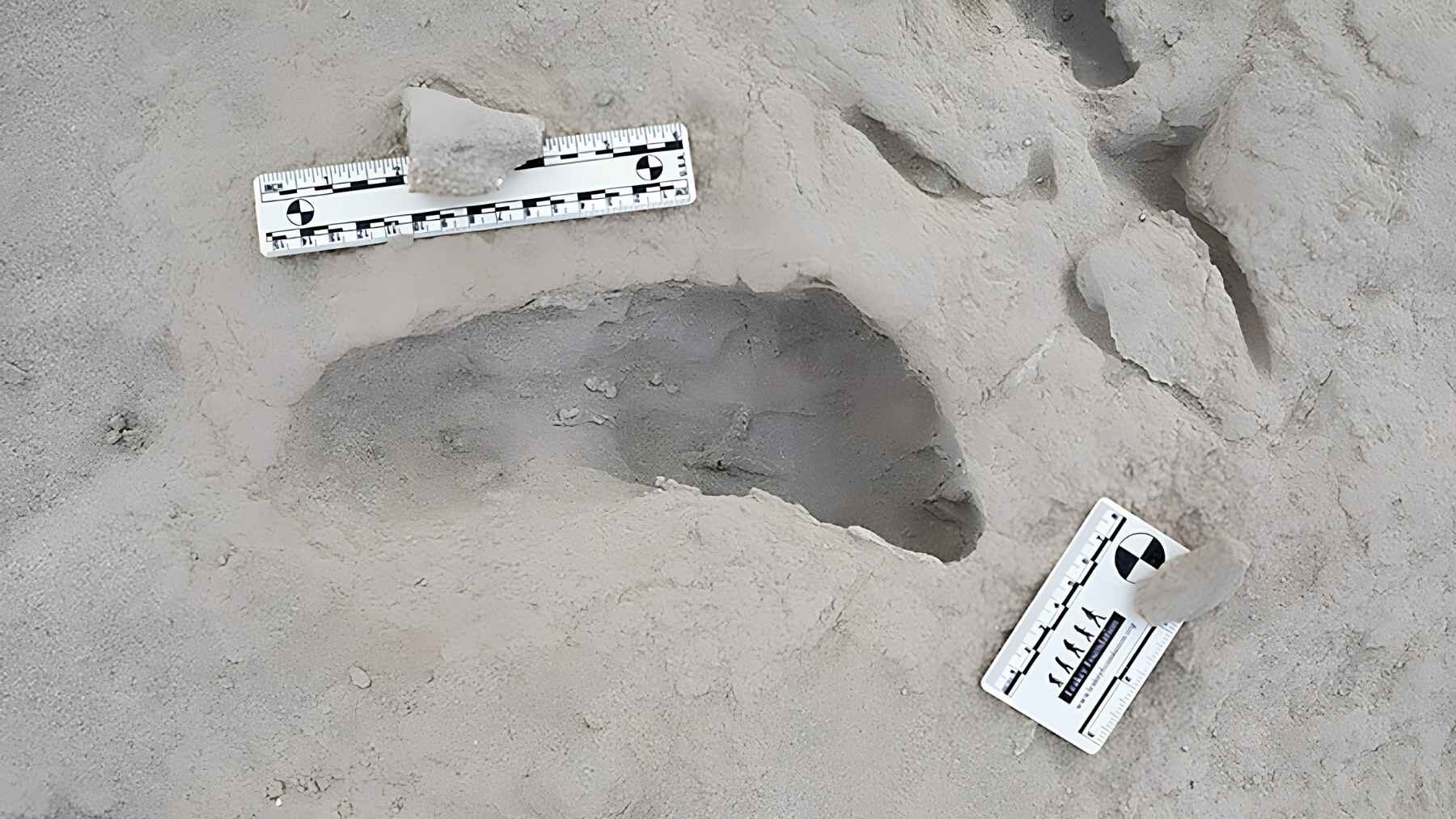
The team compared details inside the tracks, not just their length. The apparent foot anatomy and movement pattern fit other prints linked to P. boisei and suggest a style of walking that differed from modern Homo and shared features with earlier Australopithecus species.
However, big feet complicate the identification. The paper explains that the tracks could represent a larger and more variable P. boisei than scientists had recognized, or a form of anatomical and walking variation in H. erectus far beyond what has been documented so far.
A possible group of males
What were eight individuals doing on the same patch of wet ground? Based on the estimated body sizes, the researchers think the trackmakers were adults and mostly males, with no clear evidence of females or young children traveling among them.
That pattern may point to a flexible social system in which adult males sometimes moved together, perhaps for safety in a dangerous lakeshore environment. Still, the prints do not prove a permanent all-male group or reveal why they were there, so the strongest conclusion is that several large adults tolerated one another in the same place at nearly the same time.
Two relatives shared the lakeshore
The new site also fits a broader discovery around Lake Turkana. In 2024, another track surface provided direct evidence that P. boisei and H. erectus used the same lake-margin habitat, showing that these very different branches of the human family tree lived alongside one another for hundreds of thousands of years.
Hundreds of hominin footprints have now been documented across more than half a dozen sites in East Turkana. Their repeated appearance over more than 100,000 years suggests that the lakeshore was not an occasional stop but an important habitat where animals and hominins repeatedly converged.
Why footprints change the story
A jaw can offer clues about diet and a leg bone can help estimate body size, but neither shows several individuals moving across one surface. Footprints preserve what Behrensmeyer called an “instant in time,” making ancient behavior feel less like a diagram and more like a scene.
They also capture anatomy in action. Foot shape, internal contours, and trackway patterns can help researchers reconstruct how an extinct hominin walked, how large it may have been, and whether other individuals were nearby, evidence that isolated bones often cannot provide.
Lake Turkana’s irreplaceable record
Purity Kiura of the National Museums of Kenya said the find strengthens Lake Turkana’s global importance for understanding human evolution and highlights the responsibility to protect the region’s fossil heritage. That point matters because the value of GaJi10 lies not only in each footprint, but also in the geological surface that connects them.
The research team planned to return to Kenya in 2026 to investigate more track sites and, as Hatala put it, add more “snapshots of our past” to a fossil album that is still growing.
The study was published on the Proceedings of the National Academy of Sciences.