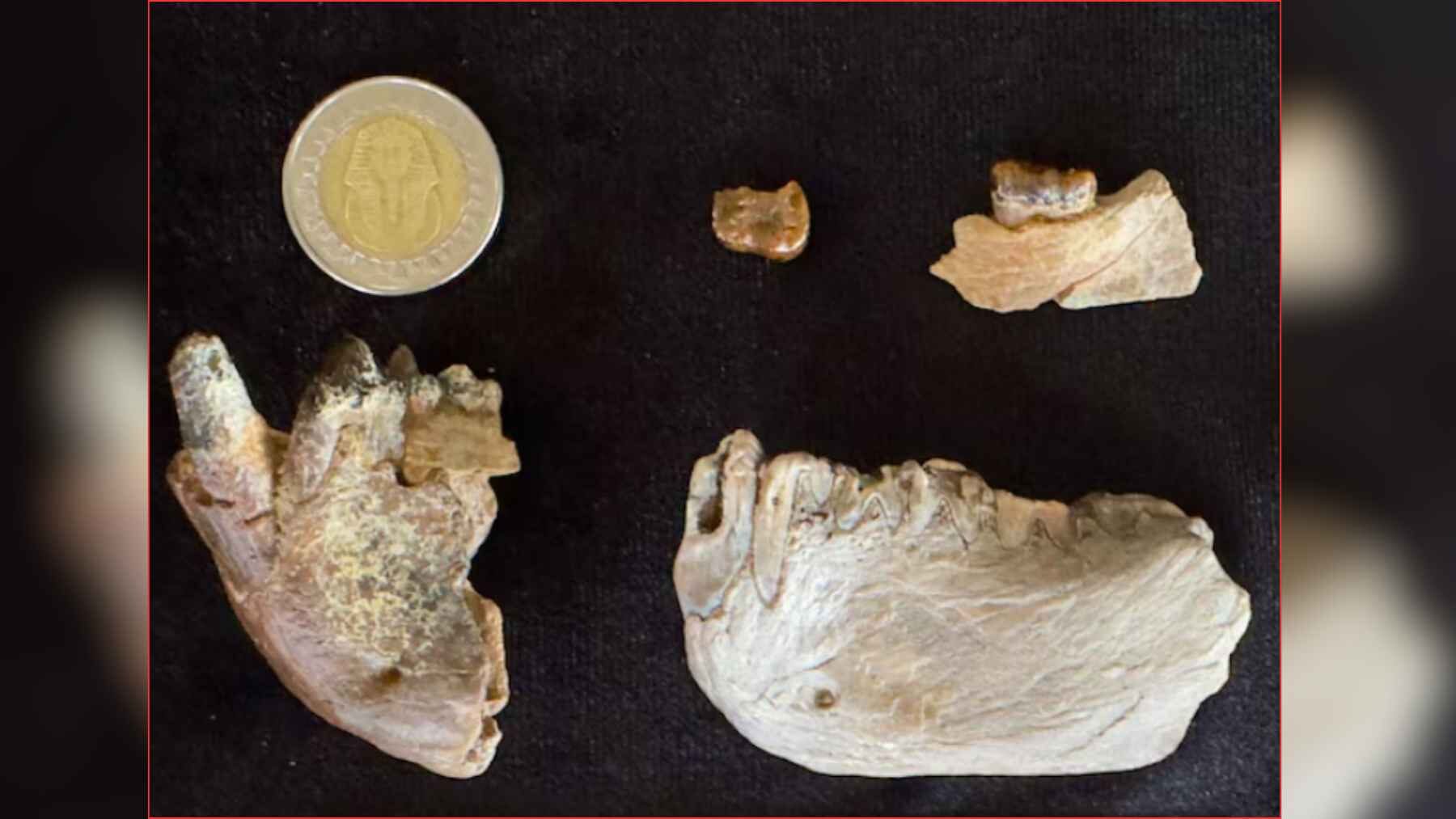
A few pieces of jaw and several worn teeth found in northern Egypt may force scientists to redraw one of evolution’s most familiar maps. The new species, Masripithecus moghraensis, lived about 17 to 18 million years ago and is the first definitive fossil ape known from North Africa. The evidence could fit in one hand.
The discovery does not prove that the common ancestor of humans and other living apes evolved in Egypt. But the research team’s analysis points to northeastern Afro-Arabia, rather than East Africa or Eurasia, as a plausible center of early ape evolution. That is a major shift built from a surprisingly small handful of bone.
A jawbone that changed the map
The breakthrough came during fieldwork at Wadi Moghra, an arid fossil site in northern Egypt, after the Mansoura University team had spent years looking for an ape. In spring 2024, paleontologist Shorouq Al-Ashqar brought a jaw fragment to Hesham Sallam and quietly said, “Dr. Hesham, we found an ape.” Sallam looked at the bone and replied, “This looks like us.”
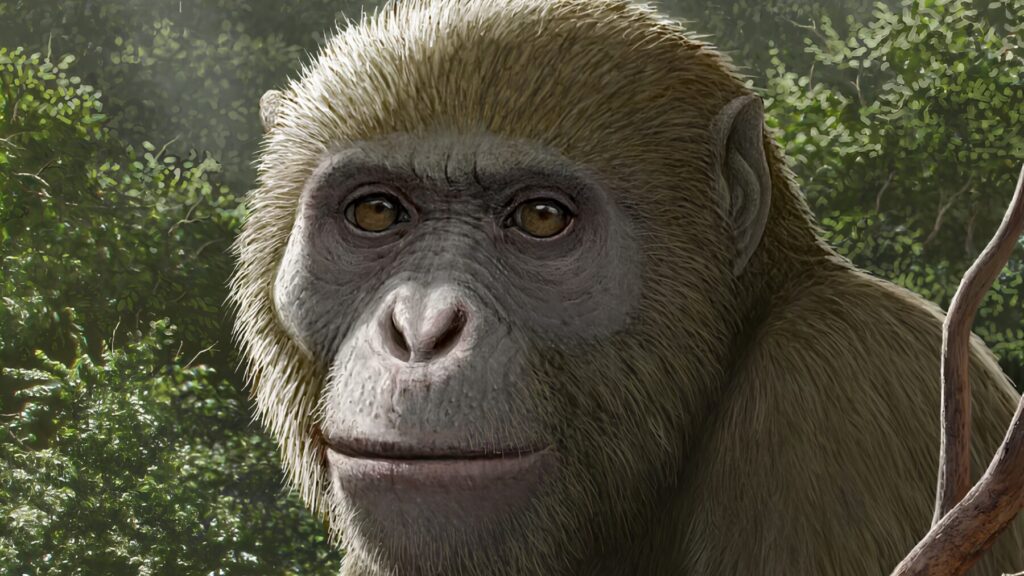
Researchers later identified two lower-jaw fragments and a handful of teeth as a new genus and species. “Masripithecus” combines “Masr,” the Arabic name for Egypt, with the Greek word for ape, while “moghraensis” recognizes the place where it was found. The remains were recovered during fieldwork conducted in 2023 and 2024.
Why East Africa dominated the story
For decades, most Early Miocene ape fossils came from East Africa. North African sites from the same period had produced monkey remains, but no definitive apes, so the available evidence seemed to place early hominoids farther south. That pattern shaped family trees and migration maps for years.
Fossils also show that apes expanded from Africa into Eurasia roughly 14 to 16 million years ago. Because Masripithecus is older, its presence in northern Egypt fills a geographic gap just before that movement. Was the old map wrong, or was it simply missing too many sites?
What the teeth reveal
The animal’s lower jaw was robust, with unusually large canine and premolar teeth. Its molars had low, rounded, heavily textured chewing surfaces and thick enamel, a combination the researchers interpret as suited to a mainly fruit-based diet with harder foods such as nuts and seeds available when softer fruit was scarce.
That kind of dental versatility may have helped the ape cope with increasingly seasonal conditions in northern Africa and Arabia. Still, scientists have no complete skull or limb bones, so details such as its face, posture, and movement remain uncertain. The teeth speak clearly, but only about part of its life.
How scientists placed it
In practical terms, the team did much more than compare the jaw by eye. Its evolutionary analysis combined about 60,000 genetic base pairs from living apes, covering 67 nuclear genes and 10 mitochondrial genes, with 268 anatomical traits from living and extinct species.
The resulting family tree placed Masripithecus closer to crown Hominoidea than any same-aged East African ape included in the study. Crown Hominoidea is the branch containing the last common ancestor of all living apes and its descendants, including gibbons, orangutans, gorillas, chimpanzees, bonobos, and humans. Al-Ashqar described the fossil as “the closest relative to the living apes and their ancestors” among known hominoid fossils.
North Africa was a crossroads
The location matters as much as the anatomy. During the Early Miocene, the African and Arabian plates were moving north toward Asia, while changing sea levels periodically reduced marine barriers. That made northeastern Afro-Arabia a natural gateway between Africa and Eurasia.
The team’s biogeographic models identify northern Africa and the Middle East as the most likely region for the common ancestor of living apes. Erik Seiffert of the University of Southern California said the results “strongly challenge that idea,” referring to his earlier expectation that this ancestor lived in or near East Africa. A corridor once treated mainly as a migration route may also have been an evolutionary center.
What the fossil does not prove
This find does not overturn the wider African origin of apes, nor does it identify a direct human ancestor. Instead, it suggests that a key stage in the shared history of humans and other apes may have unfolded farther north than researchers once assumed.
There is also plenty of uncertainty. Independent paleontologist David Alba noted that reconstructing relationships among Miocene apes has proved “very difficult,” and the fossil record remains geographically uneven. More jaws would help, but skulls and limb bones could test the proposed family-tree position far more sharply.
A small fossil with a big message
At the end of the day, the discovery is not about moving a single “cradle” from one pin on the map to another. It is about recognizing that early ape evolution may have stretched across a broader region, while scientific searches focused heavily on places already known to produce fossils.
The fossil record is a jigsaw puzzle with most pieces missing. Masripithecus adds one important edge piece, enough to change the outline without completing the picture.
The study was published in Science.