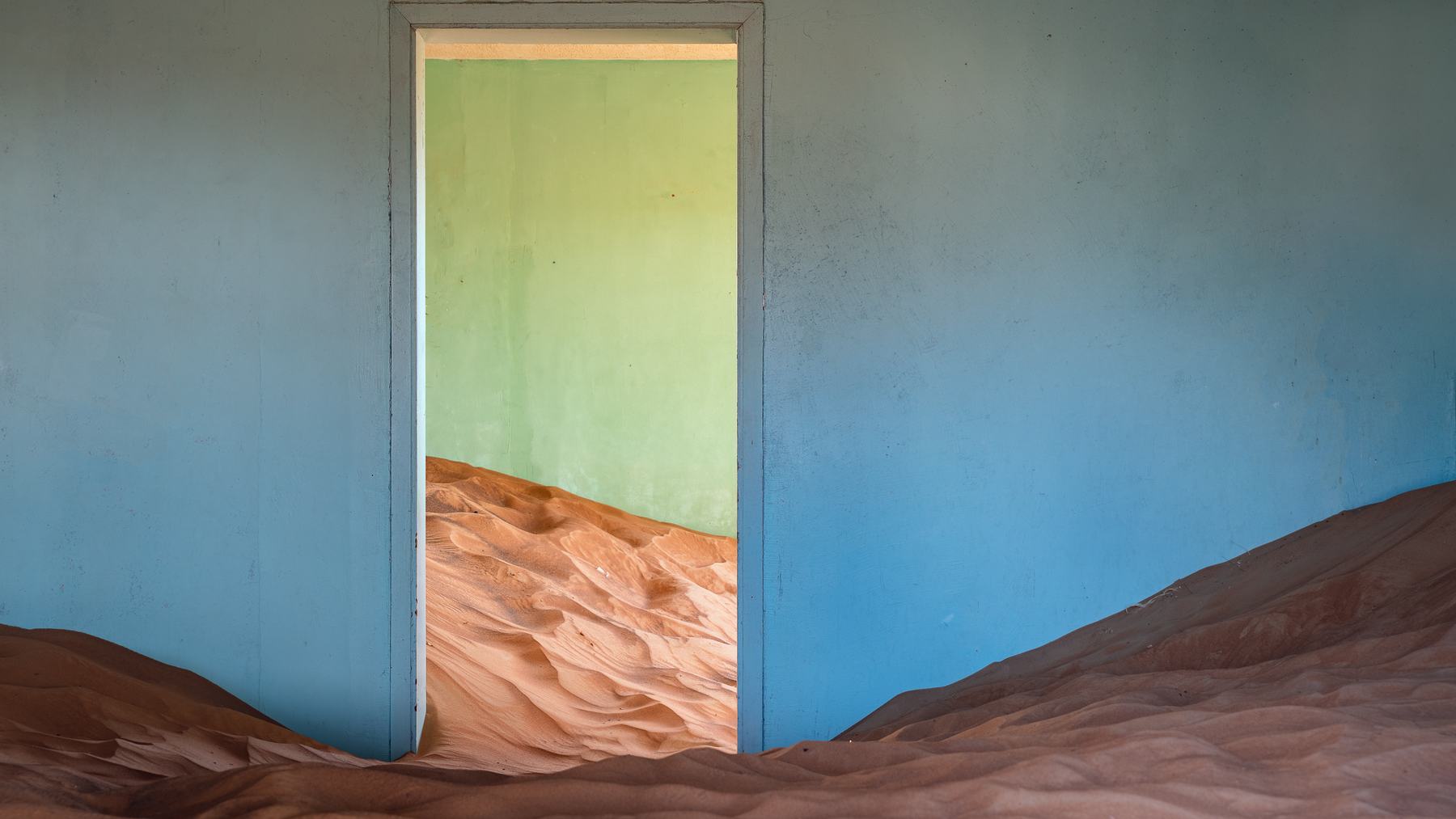
In the Al Madam ghost village in the emirate of Sharjah, about 31 miles (50 kilometers) southeast of Dubai, sand now fills houses that residents left in 1994. A 2022 study in the journal Buildings, by Mohammed Fareed Sherzad of Ajman University’s Department of Architecture and Dirk Goossens, reproduced the sand pattern around two of its buildings in a wind tunnel “even in the details.”
One of Sherzad’s photos shows a pale blue room with an orange ridge of sand running from wall to wall and spilling through two doorways into the rooms behind. Sharjah Art Foundation says the residents moved to new housing nearby, leaving their old houses to be covered slowly by shifting sands.
A housing project the desert took back
The houses have an official name, Shaabiyat Al Ghurayfah. In a 2020 announcement about The Landing, a 2019 film by the artist Akram Zaatari commissioned for Sharjah Biennial 14, the foundation describes them as a public housing project built in the early 1980s. The film, set in the houses, features audio interviews with former residents.
Sharjah’s tourism authority gives an earlier start. Its Visit Sharjah page for the Buried Village says the houses were built after the 1971 formation of the United Arab Emirates for members of a Bedouin tribe that had led a semi-nomadic existence, and that some 20 years later the residents had all left. The study dates the village to around 1970.
The accounts agree that the village came out of a government program to house the nomadic population. Sherzad and Goossens write that some of these settlements were assembled very rapidly close to active sand dunes, and that “heavy sand encroachment and sand deposition around and inside the dwellings finally forced the inhabitants to abandon them.” Visit Sharjah also points to desert winds, tumultuous natural conditions and long commutes.
Sand tested in a wind tunnel
Goossens, of KU Leuven in Belgium and Wageningen University in the Netherlands, and Sherzad wanted to know how the shape and spacing of buildings decide where blowing sand comes to rest, a real problem in the UAE, where about 80 percent of the country is desert, summer temperatures reach 113°F (45°C) and the prevailing wind blows from the west.
Most of the tests ran at Arizona State University in Tempe, in an open tunnel 41 feet (12.5 meters) long and about 3.3 feet (1 meter) wide, with wooden blocks as 1:50 scale models. The sand grains were about 125 micrometers (0.005 inch) across, and air moved at 13.4 mph (6.0 meters per second), only slightly above the erosion threshold, until the drifts settled, usually after 20 to 30 minutes. Rounded desert grains like these are also the reason Saudi Arabia imports sand for concrete.
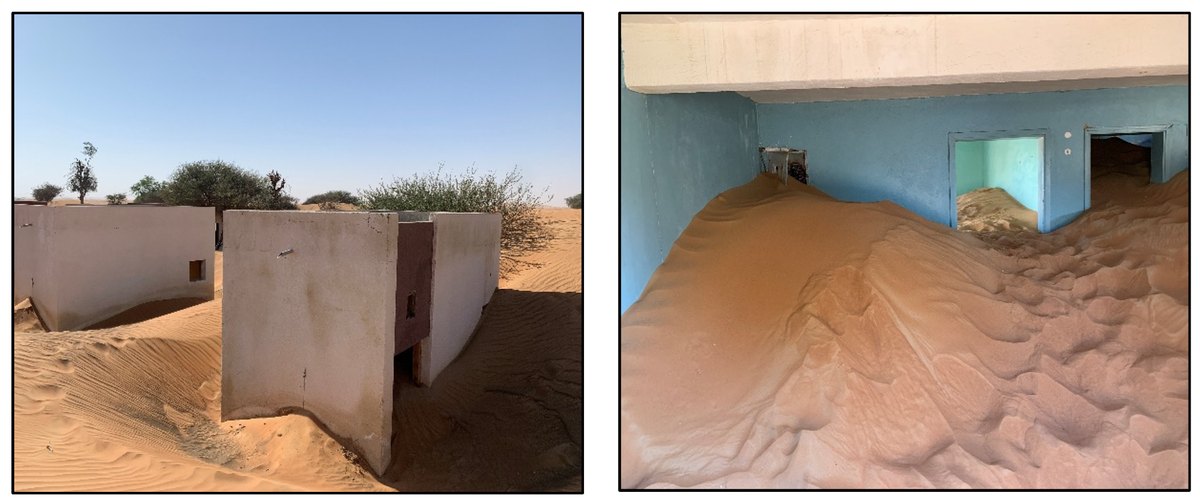
To check the method, the team compared tunnel results with real drifts. One test, run in the KU Leuven tunnel, copied the sand pattern around two cube-shaped buildings at Al Madam, and Sherzad’s own photos in the paper show sand piled between two houses there and heaped inside a dwelling.
How a house shapes its own dune
Wind hitting a building’s front pushes air over the roof, past the side walls and down, creating a reverse flow. With sand in the air, the authors write, that flow typically builds an echo dune, and around a lone building “the sand will accumulate in a symmetrical crescentic dune wrapping around the building,” leaving bare ground next to the walls.
The taller the building, the farther the dune sits from it, and wider buildings get less curved dunes. For single buildings, two floors work better than one as long as the building stays narrow, and the best mix tested was a building at least 2.5 times as tall as it was long. For neighbors, the authors recommend building close together, perpendicular to the direction of sand transport, ideally with gaps smaller than the building height.
For comparison, they looked at El-Oued Souf, a region of northeast Algeria in the dunes of the Grand Erg Oriental, where the annual average wind speed reaches up to 9 meters per second, about 20 mph. Old houses there have plaster domes or vaults to keep sand off the roofs, and the main streets run parallel to the prevailing wind. Newer buildings in sandy regions often copy designs from very different climates, so their inhabitants live in the desert rather than with it, the authors write.
Buried towns are not new to archaeology. In Egypt, excavators have been bringing the streets of the 2,500-year-old city of Imet back into view.
Singers’ voices returned to the houses
In 2025, Al Madam became one of the venues of Sharjah Biennial 16, which ran from Feb. 6 to June 15. Raven Chacon, a Diné composer born in Fort Defiance, Arizona, and winner of the 2022 Pulitzer Prize for Music for Voiceless Mass, made a sound installation there called A Wandering Breeze. It moved recordings of the Zainat Al Sharjah singers across hidden speakers in the empty houses, from one home to the next.
“It looks like a place that the desert is taking back,” Chacon says in a video released by Sharjah Art Foundation. His own account of the village differs from the official ones. On his website, he writes that the nomadic Bedouin tribes the houses were built for did not move in.
Sharjah Art Foundation, which runs an art center in Al Madam, held a free sketching tour of the Buried Village on April 13, 2025, and The Golden Light of Al Madam, a sunset photography walk, on Jan. 18, 2026. Empty villages draw that kind of attention elsewhere too, such as A Barca, an abandoned village in Galicia.
What the study does not settle
The tunnel work tested only some building shapes, and only height, width and length. It did not test buildings standing one behind another, or multiple rows of buildings, a common situation in a larger settlement.
The paper explains how sand gathers around houses like those at Al Madam. It does not reconstruct the village’s history, and its account of why people left is not based on new interviews.
Former residents speak in the interviews on Zaatari’s soundtrack, which the foundation’s announcement describes but does not quote. Until those accounts are easier to hear or read, the move of 1994 and the sand in the doorways remain the clearest record.
The full study was published in Buildings.
Photo: James Kerwin Photographic / Wikimedia Commons, CC BY 2.0