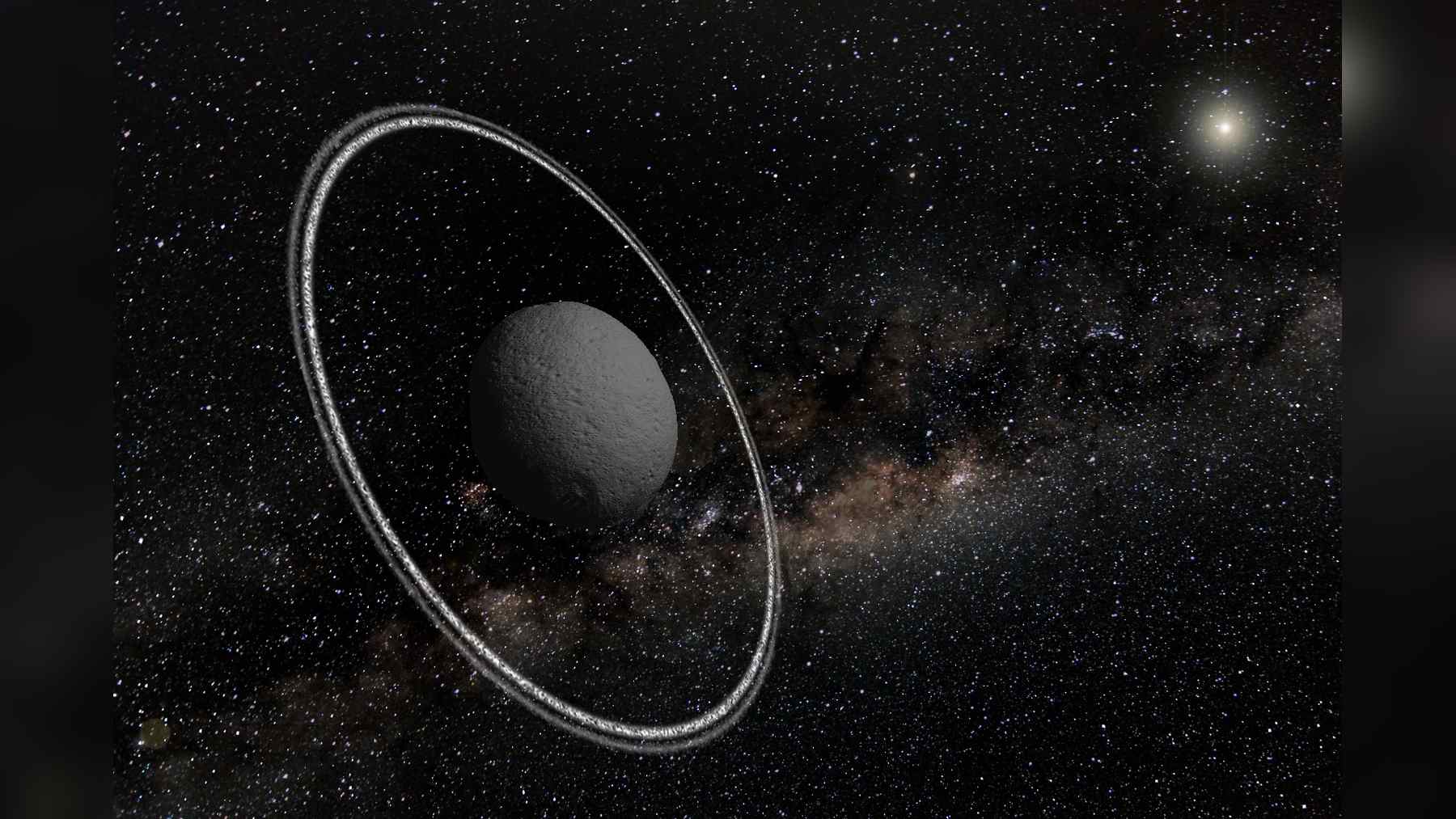
A small world beyond Saturn is giving astronomers a fresh puzzle about planetary rings. Observations from the James Webb Space Telescope show that Chariklo’s inner ring blocks more starlight than earlier measurements suggested, while its outer ring produces a much weaker signal.
The findings, published September 9, 2026, suggest that rings around small objects can change over just a few years. But there is a twist worth keeping in mind before imagining a ring disappearing into space. Some of the difference may come from how the particles interact with the infrared light Webb observes.
Two rings tell different stories
Chariklo measures about 155 miles (250 kilometers) across and travels around the sun between Saturn and Uranus. It belongs to a population of small outer solar system bodies called centaurs, and astronomers discovered its two narrow rings in 2013.
According to the Paris Observatory, the inner ring, known as C1R, appeared roughly 50% more opaque than in previous observations. The outer ring, C2R, showed an apparent opacity decrease of about 60% compared with 2017, even though both rings remained at essentially the same distances from Chariklo’s center.
What does “opacity” mean here? Simply put, it describes how effectively the ring material blocks the background star’s light. Those percentages describe differences in light blocking, so they should not be read as equivalent changes in the rings’ mass.
How Webb studied rings it cannot photograph
The key observation took place on October 18, 2022, when Chariklo’s rings crossed in front of a distant star from Webb’s viewpoint. The telescope’s Near-Infrared Camera recorded brief dips in brightness, a technique called stellar occultation. Chariklo’s solid body missed the star from that viewing angle, but its rings did not.
Think of watching a porch light through a passing screen. Even if you cannot make out every strand, changes in the light can reveal something about what is crossing your view. Astronomers use the timing and depth of these stellar dimmings to investigate distant rings.
That indirect approach matters because Chariklo’s rings are too narrow and too far away for Webb to photograph separately from the body itself. Instead of a crisp picture like the familiar images of Saturn, researchers work with a graph showing how the star’s brightness changes over time. A small dip carries a surprising amount of information.
Why darker does not always mean heavier
The team, led by Pablo Santos-Sanz at Spain’s Institute of Astrophysics of Andalusia (IAA-CSIC), considered several explanations for the differences. Material could have entered the inner ring, or collisions could have broken larger particles into smaller grains, increasing the area available to block starlight.
For the outer ring, a weaker signal could point to material being lost. But Webb observed in near-infrared light, while earlier comparison observations were mostly made in visible light, and small particles can interact differently with different wavelengths. That leaves room for more than one explanation, including a combination of physical evolution and wavelength effects.
“Our results force us to rethink how they form, how they evolve, and what mechanisms ensure their stability,” Santos-Sanz said in an official release. The measurements raise questions about how such narrow rings survive, but the physical cause of the changes remains unresolved.
A carefully timed observation in deep space
Catching the event required accurate predictions of Chariklo’s path, the background star’s position and Webb’s own movement. The European Space Agency’s Gaia mission supplied precise stellar position data, while researchers also accounted for Webb’s orbit around the L2 region, roughly 930,000 miles (1.5 million kilometers) from Earth.
During the occultation, Chariklo moved relative to Webb at about 1.6 miles per second (2.5 kilometers per second), or roughly 5,600 mph. That sounds fast enough to make highway traffic seem motionless, but it was unusually slow for this kind of observation. The slower crossing helped researchers examine finer details in the rings’ structure.
What comes next for Chariklo
Future stellar occultations, especially measurements in visible light, could help separate changes over time from differences caused by observing wavelength. They could also show whether the outer ring’s weaker signal persists and whether the inner ring continues to block more light.
For readers, the distinction is straightforward. Webb has revealed meaningful differences in the rings’ signals, while the explanation still needs testing. That makes Chariklo a useful place to investigate how rings around small worlds evolve.
The next well-timed crossing of a distant star could help clarify the picture. The study was published in Science Advances.
Photo: L. Maquet, Observatoire de Paris