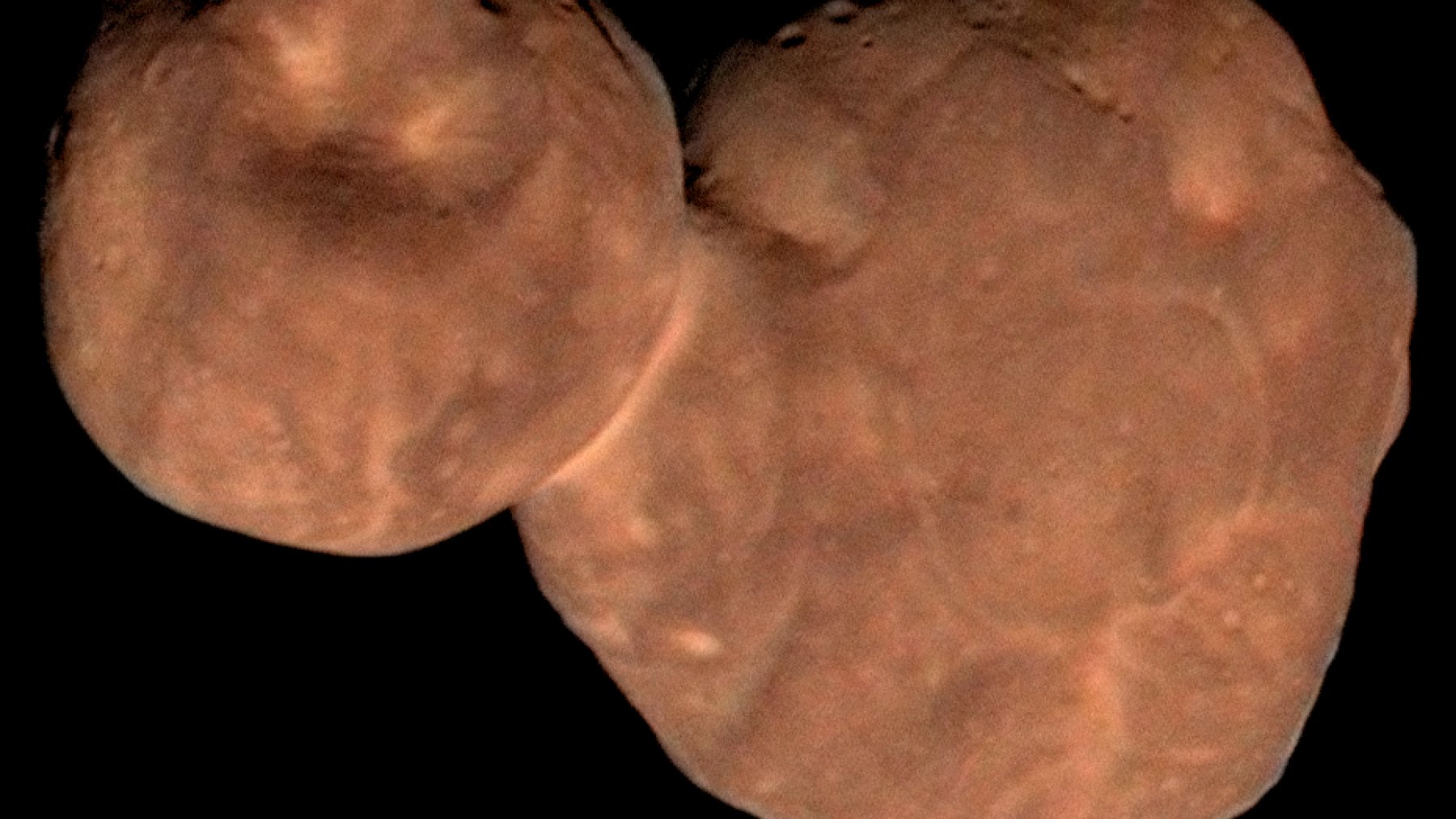
What can two ancient bodies touching in deep space tell us about how planets began? During its January 1, 2019, flyby, NASA’s New Horizons photographed Arrokoth, a small reddish world about 4 billion miles from the sun, whose joined lobes preserve clues to the solar system’s earliest years.
Those lobes remained largely intact, supporting a slow, gentle merger rather than a destructive collision. Arrokoth offers researchers a rare look at how small planetary building blocks could grow without being smashed apart.
The record depends on getting close
Arrokoth is the most distant celestial body ever explored up close by a spacecraft. New Horizons passed about 2,200 miles (3,500 kilometers) away, close enough to examine a world whose surface details could not be resolved from Earth.
This was not the most distant photograph ever taken. Telescopes observe galaxies much farther away, and the Voyager probes had already traveled farther from Earth, but Arrokoth’s distinction is a targeted encounter with another world, not simply distance traveled. New Horizons had traveled roughly a billion miles beyond Pluto to make that close-up view possible.
A destination found after launch
When New Horizons launched in January 2006, nobody knew Arrokoth existed. Pluto was the main destination, reached on July 14, 2015, after a Jupiter gravity assist helped the spacecraft along the way.
The second target emerged in 2014, when the mission team used the Hubble Space Telescope to find objects reachable with the fuel that would remain after Pluto. Arrokoth, originally designated 2014 MU69, fit that narrow window. Planning the encounter meant aiming years ahead, toward where the object and the spacecraft would eventually meet.
The snowman comparison has its limits
Early pictures encouraged the idea of two snowballs pressed together. Departure images, including views in which Arrokoth blocked background stars, subsequently revealed a flatter outline, especially for the larger lobe.
NASA’s published fact sheet describes an object about 22 miles (35 kilometers) long, 12 miles (20 kilometers) wide and 6 miles (10 kilometers) thick. In that model, the larger piece is lens-shaped while the smaller one is more rounded.
But the picture is still being refined. A May 2026 preprint by Simon Porter and colleagues proposes a significantly thicker body and a roughly spherical smaller lobe, while the larger lobe remains flattened. The snowman comparison helps readers picture Arrokoth, but it does not capture its exact shape.
A collision closer to a bike ride
Arrokoth’s narrow neck connects two distinct lobes rather than a jumble of shattered fragments. In a 2020 study published in Science, William McKinnon and colleagues described the object as the result of a “gentle, low-speed merger,” likely involving two bodies formed from the same local cloud of material. In that picture, they first orbited one another, gradually losing orbital energy until they came into contact.
Later computer simulations found that loosely assembled bodies could keep their lobes intact if the final contact was grazing and slower than about 5 meters per second (11 mph). That’s closer to an everyday bike ride than the high-speed crash we might picture in space. It is a model-based constraint, not a measurement of an event anyone watched.
A frozen record, not an untouched world
Arrokoth belongs to the “cold classical” Kuiper Belt, a population beyond Neptune with relatively undisturbed orbits. Here, “cold” describes the orderly orbits, not a thermometer reading, although the region is certainly frigid. Far from the sun, Arrokoth has experienced little heating, helping preserve features from the solar system’s formation more than 4.5 billion years ago.
Preserved does not mean unchanged. Radiation can modify the surface, and craters record past impacts, but the overall structure still helps researchers study a planetesimal, one of the building blocks from which planets grew. The important clue is that at least some early growth could involve gentle assembly, even though Arrokoth alone cannot explain how every planet formed.
New Horizons has kept going
The spacecraft did not stop at Arrokoth. In a July 7, 2026, update, NASA reported that New Horizons had awakened in good health after 321 days in hibernation, approximately 5.9 billion miles from Earth. Its signal needed nearly nine hours to reach mission controllers, a reminder of how far this once Pluto-bound mission has traveled.
Even while hibernating, its instruments continued collecting data on charged particles and space dust. The mission update also outlined plans to examine hydrogen gas in the outer heliosphere, the distant region influenced by the sun’s solar wind.
The official mission update was published on NASA Science.