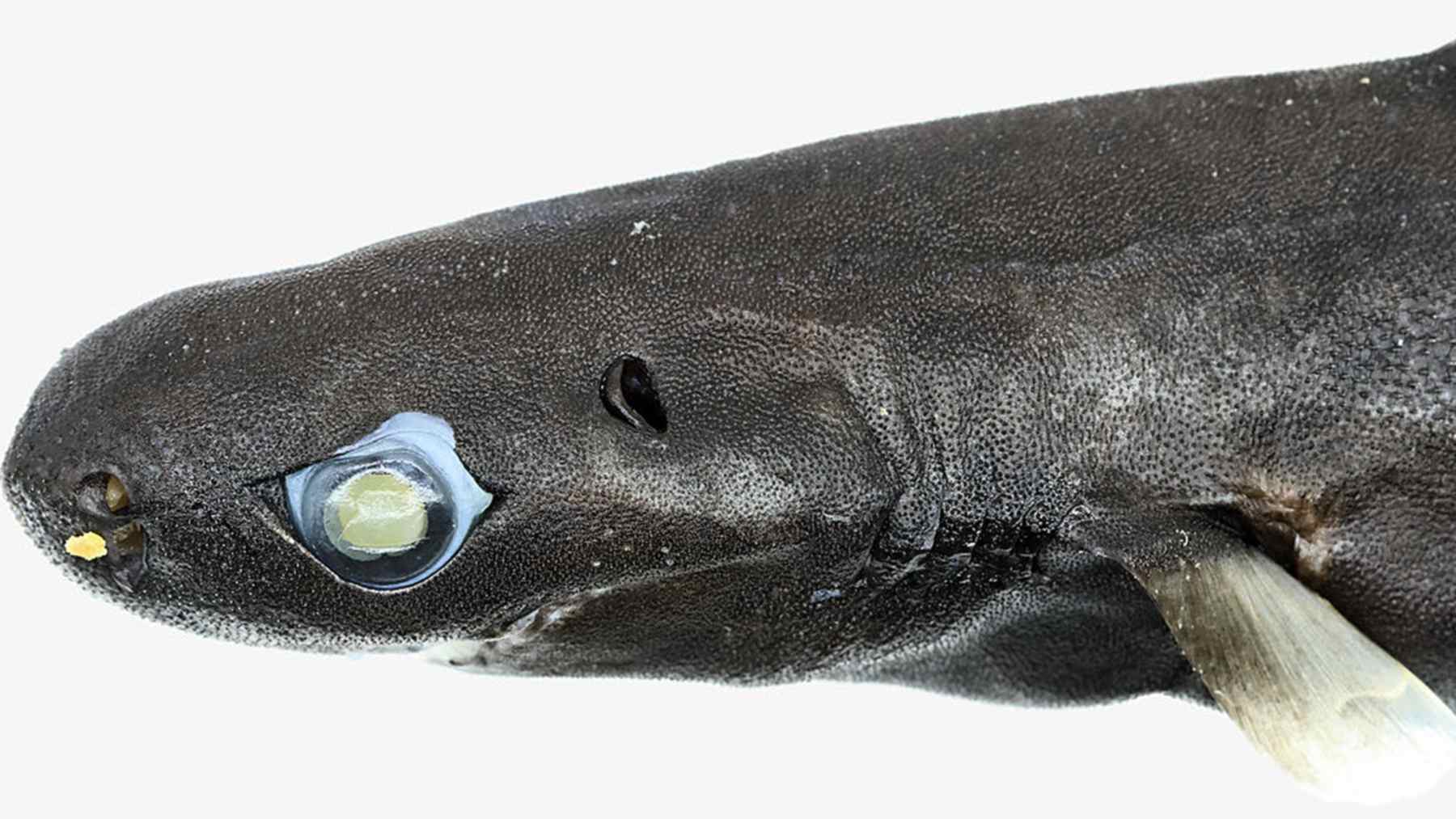
A deep-sea shark about 8.5 inches long has been named a new species of lanternshark. Scientists pulled it up in a research trawl off Mauritius in June 2025. They call it Etmopterus bulbosus, or the big-nosed lanternshark, after its rounded, bulb-shaped snout.
The species description, published on August 12, 2026, rests on a single female. The work was led by David Ebert of the Pacific Shark Research Center at Moss Landing Marine Laboratories, San Jose State University. His co-authors work in South Africa and Mauritius.
Station 5541, June 7, 2025
The shark came up during a survey by the Norwegian research vessel Dr Fridtjof Nansen. The voyage ran under the EAF-Nansen Programme of the Food and Agriculture Organization of the United Nations. Norway’s Institute of Marine Research and the fisheries authorities of Mauritius took part.
According to the paper, a midwater trawl at station 5541 caught it on June 7, 2025. The net was likely fishing at roughly 1,310 to 1,640 feet (400 to 500 meters) below the surface. Under it, the seafloor dropped steeply from about 1,840 feet (560 meters) to 3,670 feet (1,120 meters).
Sergey Bogorodsky, a research associate at the South African Institute for Aquatic Biodiversity, photographed the animal while it was still fresh. It then went to the institute’s National Fish Collection in Makhanda, South Africa. There it is catalogued as SAIAB 214299, the holotype that defines the species.
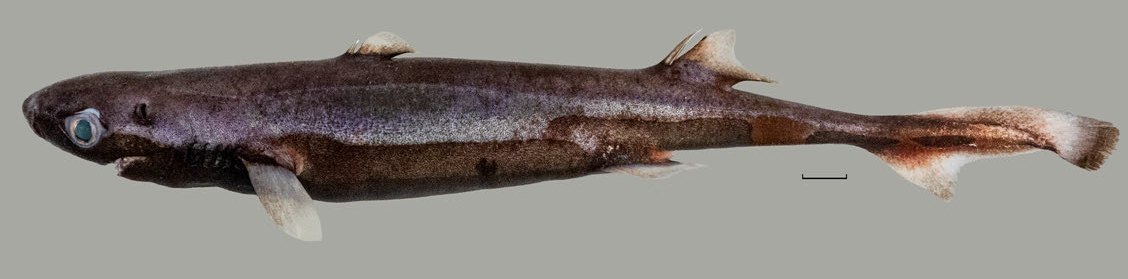
A bulb-shaped snout and thorny skin
In life the shark was dark brown, with a purplish hue along its back and sides. Its underside was a uniform black from snout to cloaca. The name bulbosus is “in allusion to the distinctive bulb-shaped snout,” the authors explain.
Like all sharks, it is covered in dermal denticles, tiny toothlike scales. This one has a patch of enlarged, thornlike denticles above the pectoral fin. The patch runs back past the first dorsal fin, and the scales in it follow no neat line.
Its closest look-alike is Etmopterus sentosus, a lanternshark found off East Africa and Madagascar. That species has a flatter head and two or three tidy rows of enlarged denticles. The markings on its flanks and tail also have a different shape.
Ten percent apart in its DNA
At Stellenbosch University in South Africa, the team sequenced part of the mitochondrial COI gene. Biologists use this stretch of DNA as a barcode to tell fish species apart. The new shark differed from every available sequence of its relatives by at least 10.29 percent.
Both the DNA and the body place it in the Etmopterus pusillus clade. That group of lanternsharks has short, thick markings on the flanks. Before this paper it counted nine recognized species, and the whole genus had 43.
Where exactly it sits inside that group is less clear. Support for the branches in the analysis was very low. The position of the new species within the clade “is unresolved,” the authors write.
Light organs along the belly
Lanternsharks owe their name to photophores, small organs in the skin that make light. “Lanternsharks are bioluminescent, with light produced by photophores located on their belly and flanks, which is where their common name comes from,” said Will White.
White, an ichthyologist at CSIRO’s Australian National Fish Collection, spoke in October 2025. His team had just described another new species, the West Australian lanternshark. The Mauritius shark has distinct luminous markings under its head and along its belly.
A glowing underside can work as camouflage, because a dark outline stands out from below. Seen against the faint light filtering down from the surface, a matching glow hides it.
One study of 21 shark species in Scientific Reports linked photophore cover on the belly to capture depth. Its authors proposed that these sharks keep a steady glow and move up or down to stay hidden. In some species, part of the pattern seems to have turned into a signal.
The National Oceanic and Atmospheric Administration places the twilight zone between about 650 and 3,300 feet (200 and 1,000 meters). Light fades rapidly with depth there. The Mauritius trawl fished right inside that band.
Bycatch logs that say only shark
All nine Etmopterus species known from southern and East African waters are listed as least concern. Most live deeper than today’s trawl and longline fisheries reach, the paper notes. They are also too small for most nets in the Western Indian Ocean.
The real gap, according to the authors, lies in the fishing records. “Species-specific identification and other information for Etmopterus sharks caught as bycatch in deepsea fisheries is rarely available due to an absence of identification guides and few trained scientific observers,” they write.
The team calls for regional guides and better training for fishery observers. That way, deep-sea sharks hauled up by accident could be logged species by species. Naming animals first, as with the deep-sea sponges NOAA described from trawl catches, makes that tracking possible.
One female, no adult size yet
Everything known about the big-nosed lanternshark so far comes from that one animal. “The size at maturity is undetermined,” the description states. Nobody knows whether this 8.5-inch female was fully grown.
The shark is known only from the open ocean off Mauritius, where an underwater photographer recently caught a ribbon eel outside its burrow. Its body shape suggests it lives between the seafloor and midwater. Its look-alike from East Africa, by contrast, keeps to continental and island slopes.
The paper documents its luminous markings, but not how a living animal uses them. The authors conclude that “additional sampling is required to evaluate its distribution, population status, and potential conservation concerns.” Other recent surveys in the Indian Ocean have also turned up deep-sea animals new to science.
The full study was published in the Journal of the Ocean Science Foundation.
Photo: R.W. Leslie / Ebert et al., Journal of the Ocean Science Foundation, CC BY 4.0