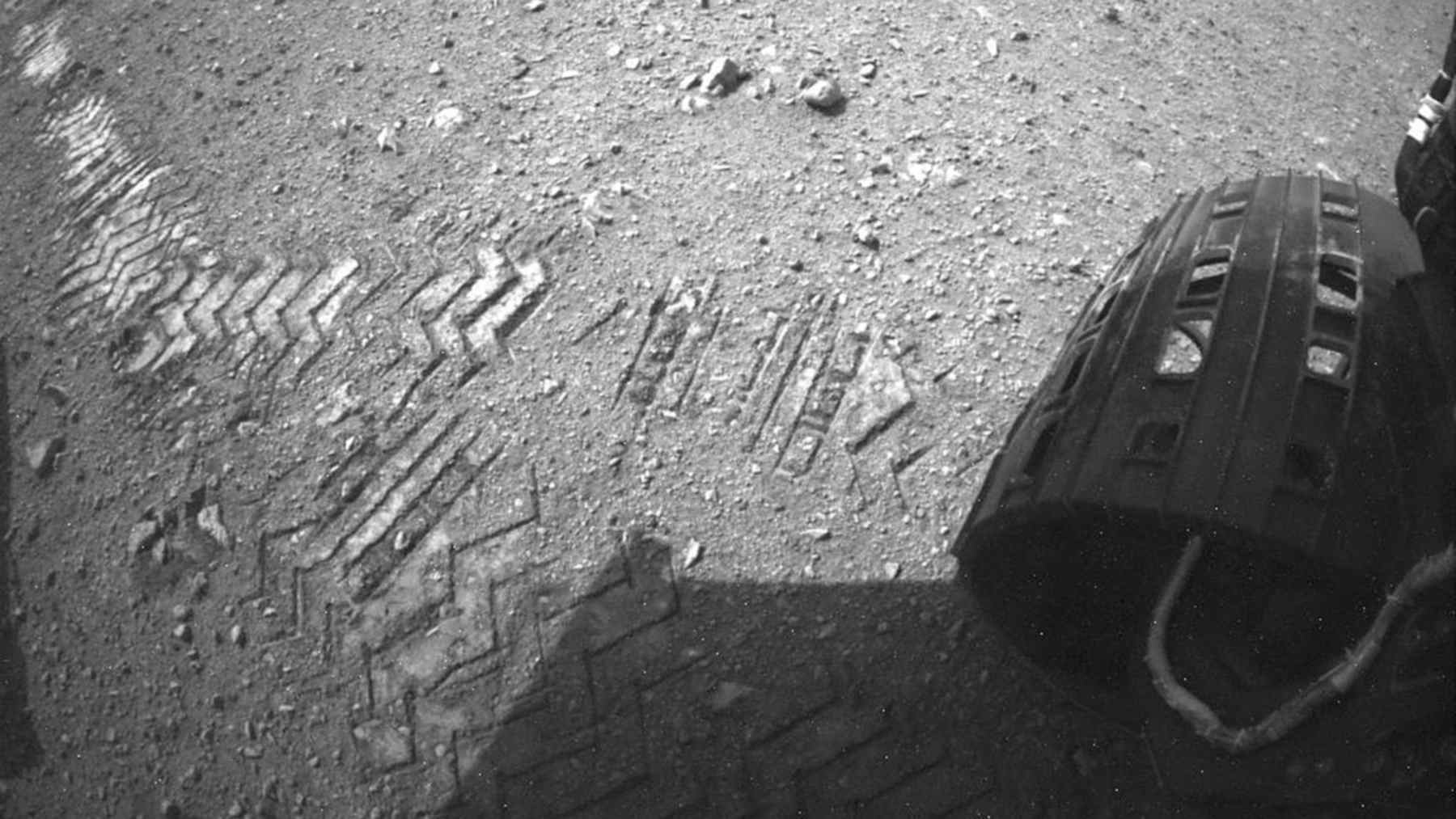
NASA’s Curiosity rover has been printing the letters JPL in Morse code into Martian soil since its first test drive on August 22, 2012. The marks come from small holes cut into its six aluminum wheels. The rover’s driving software uses them to check how far it has really moved.
NASA’s Jet Propulsion Laboratory (JPL) in Pasadena, California, built the rover and runs the mission. It explained the trick on August 29, 2012, a week after the drive. During 2013, the same wheels also collected holes nobody designed, punched in by sharp Martian rocks.
Dots and dashes in aluminum
Each wheel is about 20 inches (50 centimeters) across and 16 inches (40 centimeters) wide, according to NASA. The raised zigzag treads on it are called grousers. Cut into the metal between them is a strip of rectangular openings, some short and some long.
In Morse code, those marks spell J (dot, dash, dash, dash), P (dot, dash, dash, dot) and L (dot, dash, dot, dot). Every turn of a wheel presses the sequence into the ground.
“The purpose of the pattern is to create features in the terrain that can be used to visually measure the precise distance between drives,” said Matt Heverly, then Curiosity’s lead rover driver. He spoke in JPL’s August 29, 2012, announcement.
Rover driver Mark Maimone, who led the autonomous driving software, came up with the code. The mechanical team suggested several small holes instead of one large one, and an earlier design had spelled letters in a cleat pattern. “I proposed using a Morse code version,” he said.
A spare picket on sand
Wheels on loose soil or high slopes can turn more than the rover actually travels. JPL calls the fix visual odometry: the rover stops, takes pictures, and compares them with pictures from before each short drive step.
According to JPL’s robotics group, the software tracks features in the terrain and works out the rover’s position and tilt. That estimate is fused with gyro and accelerometer readings and with measured wheel rotations. The group calls it “the only method Curiosity has to detect slip while driving.”
Pebbles and rock shadows usually serve as landmarks. Flat sand offers few of them, and that is where the wheel marks help. JPL describes the imprint as a high-contrast visual reference for the software.
Heverly compared it to closing your eyes at a picket fence and stepping sideways. “The hole pattern in the wheels gives us one ‘big picket’ to look at,” he said.
Bolt holes on Spirit and Opportunity
Curiosity was not the first rover to sign its tracks. Spirit and Opportunity had their wheels bolted to the landing platform. The leftover holes left marks that were especially useful for Opportunity on the flat plains of Meridiani Planum, JPL said.
Curiosity’s wheels never needed bolts, yet the team kept the holes. JPL’s robotics group says that after an update in the mission’s third year, visual odometry ran on more than 90 percent of drives, and it converged in 99.6 percent of its first 20,682 attempts.
Sharp rocks tore the skins
After 490 sols, or Martian days, the team found far more wheel damage than expected. NASA says the holes and tears got much worse in 2013. At the time, Curiosity was crossing Gale Crater toward Mount Sharp over ground studded with sharp rocks.
Since then, the Mars Hand Lens Imager, a camera on the robotic arm, has photographed the wheels at regular intervals. On March 19, 2017, its pictures showed two broken grousers on the left middle wheel.
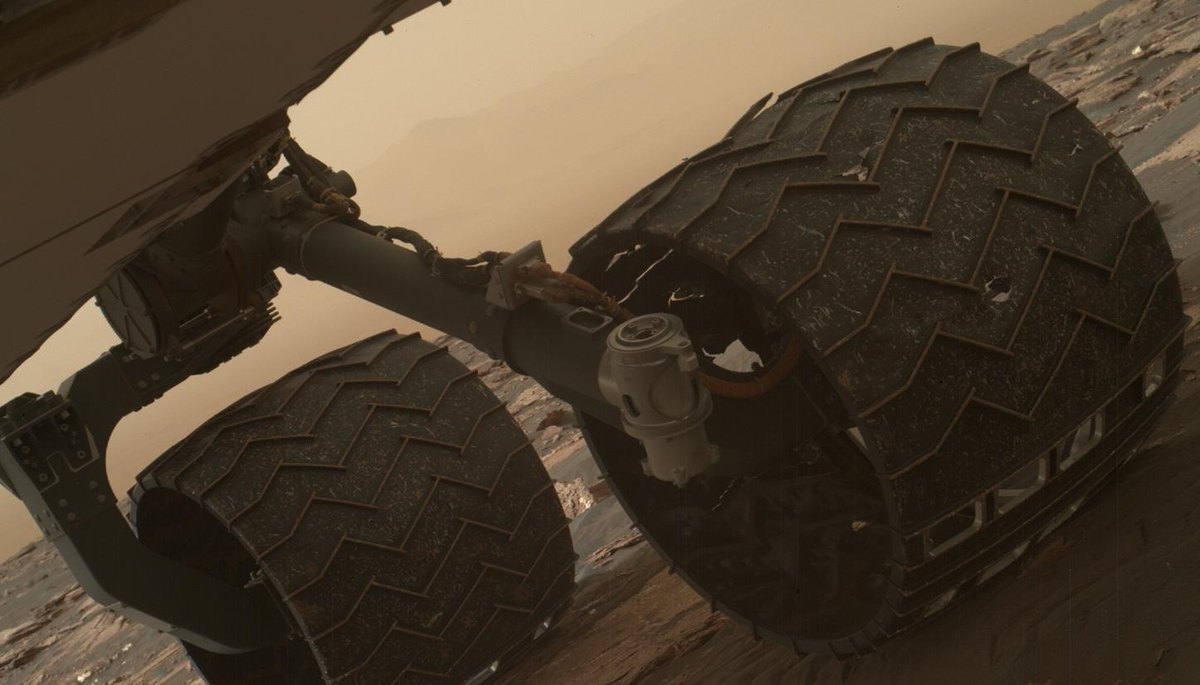
Tests with identical wheels on Earth suggest a wheel with three broken grousers has used about 60 percent of its life, NASA said. That same month, JPL uploaded a software fix called traction control. It adjusts each wheel’s speed to the rock it is climbing.
“If it’s a pointed rock, it’s more likely to penetrate the skin between the wheel grousers,” said Art Rankin, who led the software tests at JPL. Mission managers approved it on June 8, 2017. Ground tests cut the load on the leading wheels by 20 percent.
Forty-eight curved treads for Perseverance
Those lessons shaped the next rover. Perseverance, which has since driven a marathon distance on Mars, rolls on wheels 20.7 inches (52.6 centimeters) across. They are slightly larger and narrower than Curiosity’s, with skins almost a millimeter thicker.
Each wheel carries 48 gently curved treads instead of 24 chevrons. In JPL’s Mars Yard, the new treads better withstood pressure from sharp rocks, NASA said in April 2020. They also gripped sand at least as well.
Perseverance now goes beyond slip checks. In February 2026, JPL said a system called Mars Global Localization matches camera panoramas to orbital maps. It fixes the rover’s position within about 10 inches (25 centimeters) in roughly two minutes.
Deck sand findings still pending
Curiosity keeps driving, and its cameras keep a record. On April 28, 2026, NASA released a timelapse from its right navigation camera. The images run from January 2, 2020, to March 8, 2026, or sols 2,633 to 4,830.
The team is using it to watch sand grains shift on the rover’s deck. Separating grains jostled by driving from grains moved by wind could reveal seasonal changes in the Martian atmosphere. NASA has not yet published results.
The wheels’ remaining life is also an estimate from Earth tests, not a measurement on Mars. NASA has given no updated figure. Work such as the rover’s study of polygon-shaped cracks in Gale Crater still depends on those six wheels turning.
The original explanation of the Morse code pattern was published by NASA’s Jet Propulsion Laboratory on August 29, 2012.
Image: NASA/JPL-Caltech