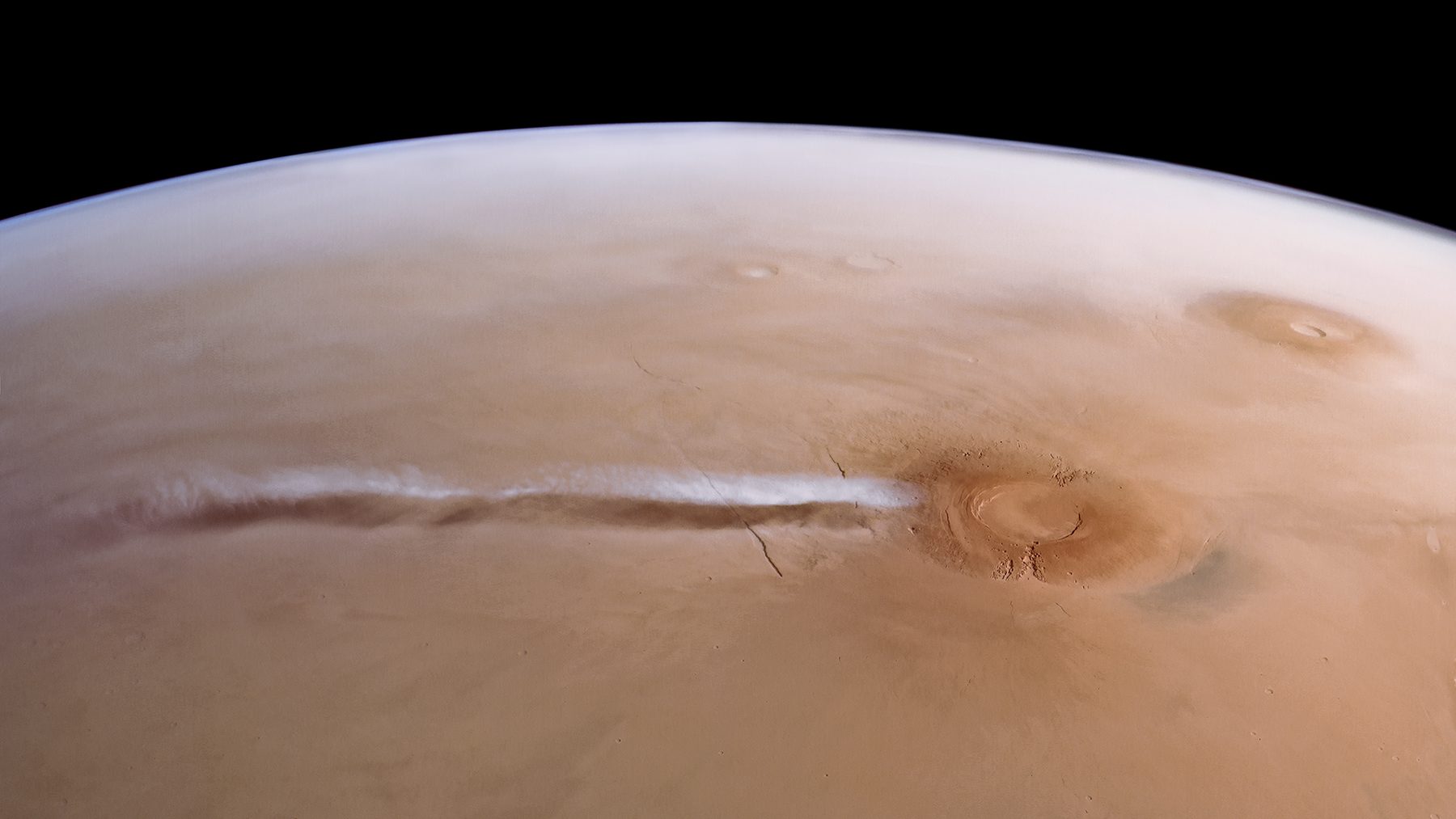
Around sunrise, during the southern spring and summer on Mars, a white streak of water ice starts growing off the western flank of Arsia Mons, a volcano about 12 miles (20 kilometers) tall. In a few hours the Arsia Mons cloud can run for up to about 1,100 miles (1,800 kilometers), and by late morning it has torn loose from the volcano and evaporated.
“To create the AMEC in our modelling, we found that we needed to include some exotic physics… physics that, while included in textbooks, is treated as theoretical and usually thought not to happen in nature. It certainly hasn’t been seen in action before,” said Jorge Hernández-Bernal of the Laboratoire de Météorologie Dynamique (LMD/CNRS/Sorbonne Université) in Paris, in the European Space Agency’s announcement. “Once we included this physics in our simulations, the AMEC emerged just as we hoped.”
He is the lead author of the study published October 7 in Nature Geoscience, written with Anni Määttänen of LATMOS in Paris and Aymeric Spiga and François Forget of the LMD.
The cloud that comes back every year
AMEC is short for Arsia Mons Elongated Cloud. Hernández-Bernal began chasing it as a doctoral student at the University of the Basque Country in Bilbao, Spain, using ESA’s Mars Express orbiter.
“We have been investigating this intriguing phenomenon and were expecting to see such a cloud form around now,” he said in July 2020, when it showed up again. “This elongated cloud forms every martian year during this season around the southern solstice, and repeats for 80 days or even more, following a rapid daily cycle. However, we don’t know yet if the clouds are always quite this impressive.”
Eleni Ravanis, then a young graduate trainee working on the orbiter’s Visual Monitoring Camera, explained why so few spacecraft had seen it whole. “The extent of this huge cloud can’t be seen if your camera only has a narrow field of view, or if you’re only observing in the afternoon,” she said. “Luckily for Mars Express, the highly elliptical orbit of the spacecraft, coupled with the wide field of view of the VMC instrument, lets us take pictures covering a wide area of the planet in the early morning. That means we can catch it!”
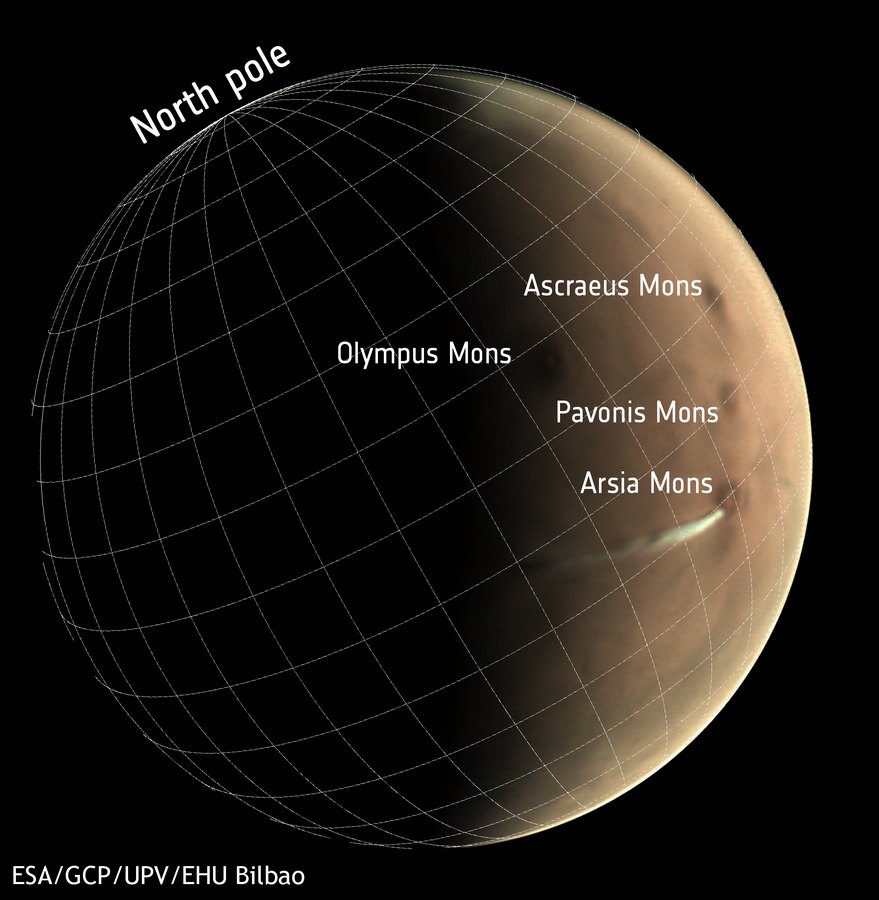
Old images helped, too. “We were especially excited when we dug into Viking 2’s observations from the 1970s,” Hernández-Bernal said in ESA’s 2021 account of his group’s first detailed study, which put the cloud at some 1,100 miles long and 93 miles (150 kilometers) wide. “We found that this huge, fascinating cloud had already been partially imaged that long ago.”
A volcano that bends the wind
Despite appearances, the cloud “is not a plume linked to volcanic activity,” ESA noted in 2020. Arsia Mons belongs to the Tharsis volcanoes, the same group as Olympus Mons, the biggest volcano in the solar system, and the cloud is orographic, meaning wind forced up and over high ground makes it.
“Although orographic clouds are commonly observed on Earth, they don’t reach such enormous lengths or show such vivid dynamics,” Agustín Sánchez-Lavega of the University of the Basque Country, science lead for the camera, said in 2021. “Understanding this cloud gives us the exciting opportunity to try to replicate the cloud’s formation with models.”
Modeling it was harder. Until now, ESA says, “our simulations simply didn’t reproduce what we see in the images.” The cloud shows up in the dusty season, and dusty weather on Mars can loft water vapor far higher than models expect. In a preprint of the new paper, the authors admit that “none of those proposed mechanisms has hitherto convincingly reproduced the elongated tails of these clouds.”
Ice with nothing to grow on
“It is widely accepted that water ice cloud particles below the triple point of water form by heterogeneous nucleation (with the aid of a pre-existing particle),” the published abstract begins. Water vapor freezes or condenses onto salt, pollen, soot or dust, and on Mars the seed is thought to be dust.
“For the AMEC, it seems that cloud formation takes place without needing any of this ‘stuff’,” Hernández-Bernal said. “Water vapour turns directly into icy cloud particles without any middle step. It’s akin to droplets of condensation appearing in the middle of a room, rather than on a window. We call this homogeneous nucleation, and we’ve never seen it before in a planetary atmosphere. It’s wholly unexpected.”
ESA says the process needs relative humidity more than 100,000 times what we experience in daily life on Earth. “We’ve not seen these conditions on Mars before, but our finding now strongly suggests that the planet’s humidity can indeed reach these extreme levels,” Hernández-Bernal said.
Ten minutes of brutal cooling
ESA says Arsia Mons sits where “Mars’s thin atmosphere and the towering height of the nearby Arsia Mons volcano come together to create the conditions needed to see this rare process in action.” In the model, wind hitting Arsia Mons sets off a powerful wave that throws moist air several kilometers up in a few minutes, and ESA says it cools by about 54 degrees Fahrenheit (30 degrees Celsius) in 10 minutes. In the preprint, the air in that cold pocket drops below roughly minus 225°F (minus 143°C).
In the simulation, the ice crystals “grow until they reach thermodynamic equilibrium with surrounding air,” the preprint says. “This is the physical basis of the extraordinary length of the cloud tail: it is in thermodynamic equilibrium, and so once formed, it remains stable as it is advected away from the core cold pocket,” the authors write.
A mission that works the morning shift
The researchers based their model on “the three cameras aboard Mars Express,” and ESA notes the orbiter is “one of the few Mars-orbiting spacecraft” able to observe “during morning hours, when the AMEC is present.” The agency calls this “the first ESA release featuring HRSC imagery of the AMEC,” from the High Resolution Stereo Camera. One frame, from June 24, 2024, spans just under 780 miles (1,250 kilometers) of Mars, with the cloud trailing for about 610 miles (980 kilometers).
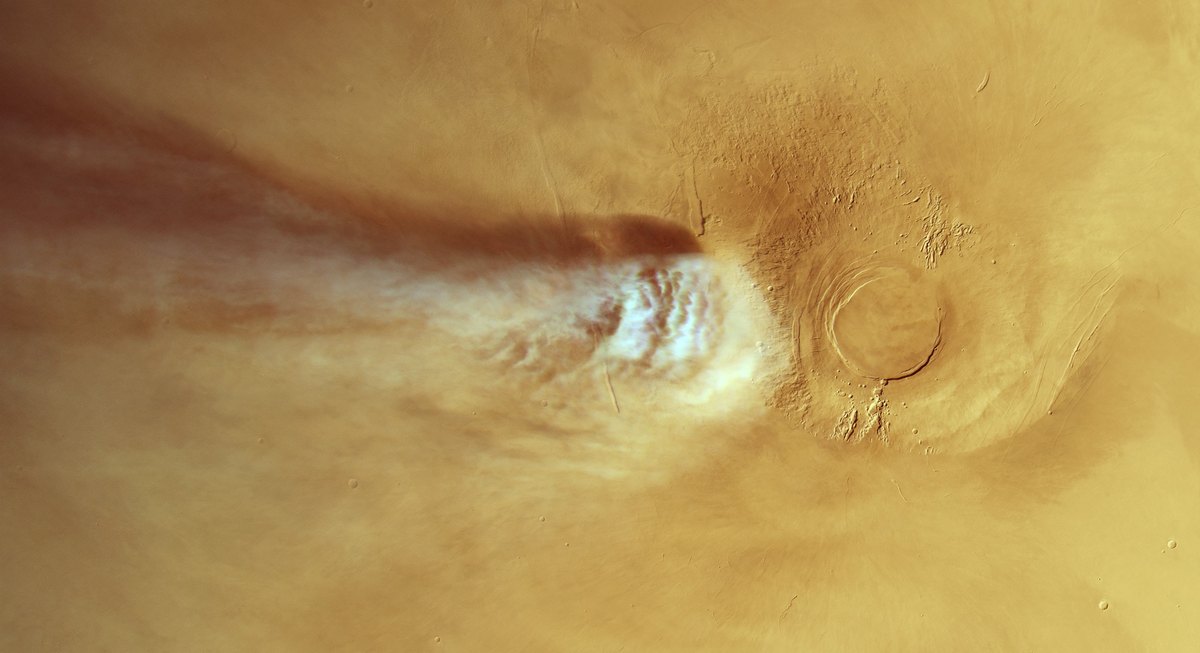
“Mars Express can also track how the cloud is changing on timescales of mere hours, which gives us an unrivalled view of short-lived phenomena on the planet,” said Colin Wilson, ESA’s Mars Express project scientist. “Overall, this finding is a true accomplishment for the mission and its scientists: Mars Express discovered the AMEC, has followed up and monitored it for years, and is now helping reveal the secrets of its formation.”
Where the simulation falls short
ESA’s release concedes that “some aspects of the modelled cloud don’t exactly match the observations.” The published title says homogeneous nucleation is “suggested” by the clouds, while the preprint posted September 29 said “evidenced.”
In that pre-review version, the simulated cloud came out 30 to 50 percent narrower than the real one, started about an hour and a half late and reached roughly a quarter of the observed length before detaching. The authors also could not fully exclude a very fine dust, under 100 nanometers, because nobody has measured it in that season.
Hernández-Bernal still calls the result “remarkable.” “We don’t have nearly as much information about Mars’s atmosphere as we do about Earth’s, so reproducing the AMEC to this degree is a big success for the model,” he said.
Questions for Earth and other worlds
A Nature Geoscience editorial says the work “could prompt a reassessment of cloud formation on Earth, and potentially on Venus as well.” In the preprint, the authors single out Earth’s mesosphere, where the process is “often regarded as improbable or a mere theoretical curiosity,” and say they will look for it in other clouds on Mars. ESA’s release adds that “we should not discount unlikely processes when exploring the planets of the Universe,” and few skies are stranger than Titan’s, with its methane clouds and rain.
“Is homogeneous nucleation a rare phenomenon that only takes place in the AMEC, or does it happen in other cloud formations? Does it play any relevant role in the global water cycle?” they write.
“While clouds on Earth and Mars seem to be governed by the same ‘rules’, understanding this exotic martian cloud required exotic physics,” Wilson said, adding that “this may be true elsewhere in the cosmos.”
The full study was published in Nature Geoscience.
Image: ESA/DLR/FU Berlin (J. Cowart), CC BY-SA 3.0 IGO