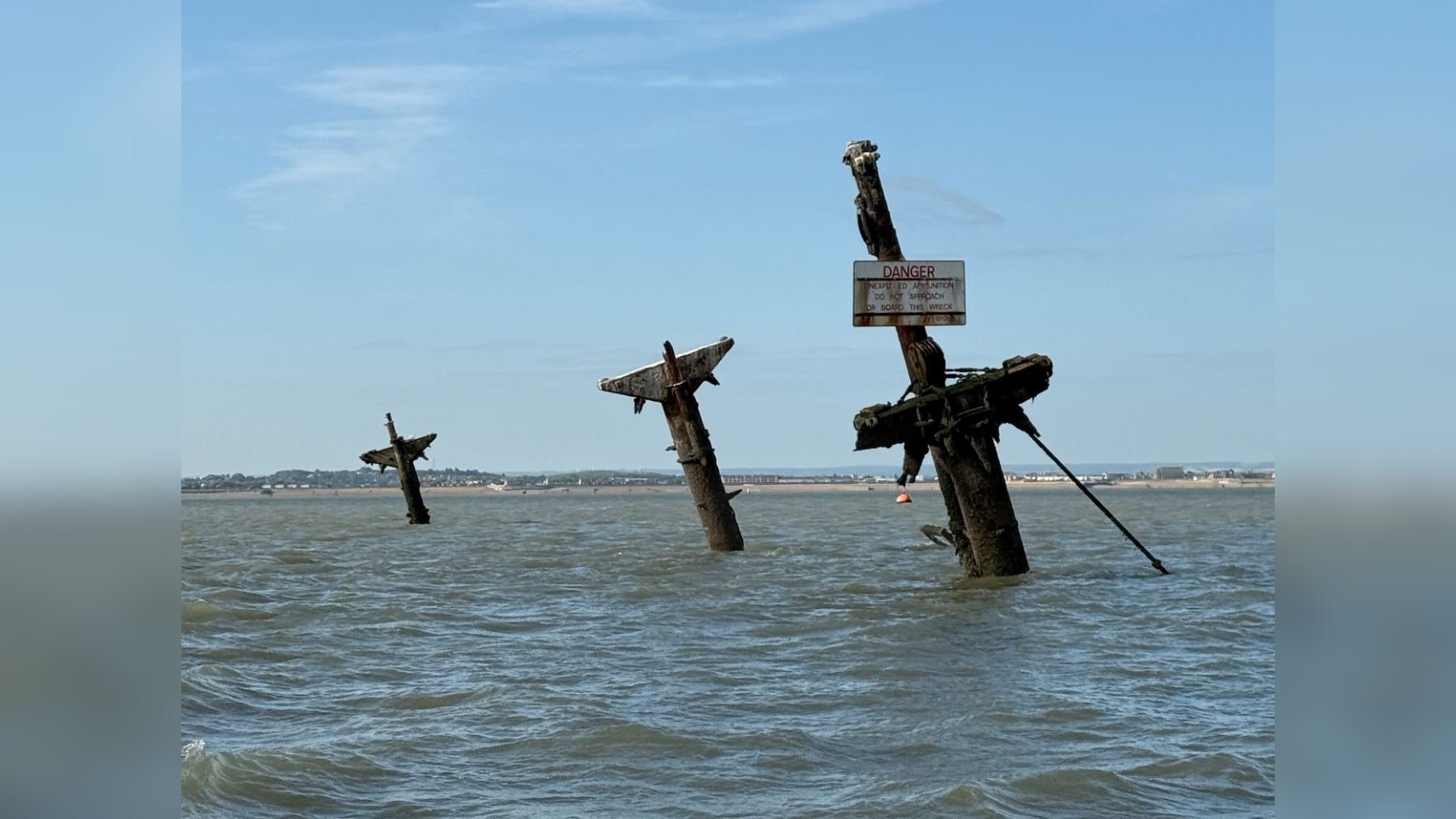
On August 20, 1944, the SS Richard Montgomery dragged its anchor in the Thames Estuary and ran aground on a sandbank about 1.5 miles (2.4 kilometers) off Sheerness, in Kent, England. According to the UK’s Maritime and Coastguard Agency (MCA), around 1,400 tons of explosives are still inside the forward holds of the wreck.
For 82 years, the ship’s three masts stood above the water at every state of the tide, and in September salvors cut all three down. The work is part of a £9.5 million project of the Department for Transport (DfT), which wants to keep the masts from collapsing onto the weakened decks below.
A Liberty ship bound for France
The Richard Montgomery was a Liberty ship, one of more than 2,700 cargo vessels mass-produced in the United States to carry supplies for the war effort. It was built in 1943 by the St. John’s River Shipbuilding Company in Jacksonville, Florida, and was rated at 7,146 gross tons, a measure of the ship’s internal volume.
In August 1944 it crossed the Atlantic in convoy HX-301 with a cargo of munitions, bound for the UK and then for Cherbourg, a French port the Allies had taken weeks after the D-Day landings in Normandy. On arrival it was ordered to anchor off the Great Nore, near Sheerness, to wait for a convoy across the Channel.
The anchorage was too shallow for the heavily laden ship, and as the tide fell it dragged its anchor onto Sheerness Middle Sand. By that evening the vessel was reported to be “badly hogged,” which the MCA’s 2025 survey report describes as “curved-up in the centre and sagging at the ends.”
Half the cargo was saved before the hull broke
Stevedores from Gravesend began unloading the cargo on August 23. The following afternoon the hull cracked further and the bow holds flooded, and by September 8 the ship had broken its back completely, according to the survey report.
When it grounded, the ship was carrying some 6,127 imperial tons of cargo, mainly munitions, and 2,954 tons were salvaged, mostly from the two rear holds. Royal Navy personnel were brought in to finish the job, but they were hampered by deteriorating weather and safety fears as the vessel gradually sank, and the effort ended on September 25, 1944.
About 1,400 tons net explosive quantity, the weight of the explosive filling itself, remained in holds 1, 2 and 3.
A wreck watched around the clock
The site is designated under Section 2 of the Protection of Wrecks Act 1973, and it is an offense to enter the prohibited area without written permission from the Secretary of State for Transport. Medway Ports keeps the wreck under 24-hour radar surveillance, the MCA’s background note says.
The wreck lies about 820 feet (250 meters) north of the Medway Approach Channel, the dredged shipping channel into the River Medway, and about 5 miles (8 kilometers) from Southend. In June 2025, pilots and drone operators were banned from flying within one nautical mile of it for “reasons of public safety,” LBC reported.
David Alexander, an emeritus professor of emergency planning at University College London, told LBC in 2025 that the wreck was a “sitting duck.” In his words, “The Montgomery is a perfect hybrid warfare target: high impact, low cost, and plausibly deniable.”
What the 2025 survey found
The MCA’s latest full survey was carried out on July 27 and 28, 2025, with a multibeam echosounder, a sonar that maps the wreck and seabed with a fan of sound beams, and a laser scanner aimed at the masts. The 2025 survey report compares the results with full surveys from 2023 and 2024.
Of the six “key areas” tracked on the wreck, all but one showed “little to no change.” Key Area 6, which covers the boiler room casing and the bridge and boat decks, collapsed between 2024 and 2025, with a total displacement of about 6.6 feet (2 meters).
“The significant change observed on Key area 6, with a displacement of approximately 2 m, highlights the rate of deterioration of SSRM,” the authors write. They also recorded an ongoing tilt of the forward section toward the east.
Why the masts had to come down
An independent Expert Advisory Group has advised the DfT since 2017, and the 2025 report says lowering the three masts “should prevent further deflection of the connected decks, minimise future potential deterioration and mitigate the risk of collapse onto the decking below.”
“Independent expert advice has confirmed the planned operation can be carried out safely without increasing the risk posed by the explosives remaining onboard,” the DfT said in its July 14, 2026, announcement. Keir Mather, the Aviation, Maritime and Decarbonisation Minister, said: “Safety and preservation of the masts are our absolute priorities.”
Cutting steel next to old bombs
Resolve Marine, a salvage company based in Fort Lauderdale, Florida, started the operational phase in September. “After extensive planning and preparation, we are pleased to move the project into its operational phase,” said Nolan Conway, the company’s naval architect and project manager, and Mather called the start “a hugely significant moment.”
Conway told Forces News that the surrounding seabed could hold “German offensive mines, British defensive mines, air drop bombs, anti-aircraft munition.” He added: “So it’s not just the explosives on the wreck that we’re worried about. It’s the stuff in the area that the barge could impact, that could create a sympathetic detonation on a wreck.”
A sympathetic detonation is an explosion set off by the shock of another one nearby. To limit that risk, the team cut the masts with a diamond wire saw “because it produces lower vibrations, with a lower potential for something to go wrong,” Conway told The Washington Post, and diver Jeff Cornish told the paper that “visibility is measured in inches.”
Forces News reporter Tim Cooper rode out on a catamaran from the Isle of Sheppey for a report published September 30. “Our catamaran reaches the Nore sandbank, and we see two of those masts and a giant barge,” he wrote, adding that “on my visit, the first was already down.”
The first mast came off on September 20, the second four days later and the third and last on September 30, according to the local news site KentOnline.
By early October the cut masts were lying aboard the salvage barge, according to The Washington Post. Some of the steel around them was “paper thin,” Conway told the paper, and he summed up the crew’s approach this way: “We don’t do anything that would upset our mothers.”
The masts are headed to Chatham
The masts will be conserved at the Historic Dockyard Chatham and later shown to the public somewhere in Kent. “The masts of the SS Richard Montgomery have become a familiar landmark for generations of people living around Medway and Swale. Yet their significance extends far beyond the Thames Estuary,” said Paul Barnard, deputy CEO of Chatham Historic Dockyard Trust.
Barnard told The Washington Post that “there’s a lot of interest in that ship,” with “a lot of history, and lore, and speculation, and to be honest, rumor, about what could happen next.”
Kevin McKenna, the Labour MP for Sittingbourne and Sheppey, told LBC: “For many people on Sheppey, the Montgomery masts are far more than wreckage, they’re a cherished landmark.” Old wrecks draw this kind of local attention elsewhere too, as the Nantucket shipwreck uncovered by a nor’easter did after an island resident spotted it on September 26.
The explosives stay where they are
The mast work leaves the munitions in place, and “the existing exclusion zone around the wreck will remain following the mast removal,” the DfT said. According to the MCA, “the hull is subject to the prevailing environmental conditions and is showing evidence of gradual deterioration, however, the wreck is considered to be in a stable condition.”
A 1970 estimate by experts at the Royal Military College of Science, cited by The Washington Post, put the worst case at a column of water and debris about 9,800 feet (3,000 meters) high and a wave of about 16 feet (5 meters). The MCA’s own note says that “the risk of a major explosion is believed to be remote.”
“It is a rare case,” Alexander told the Post, and in a research paper he wrote that the Montgomery “exemplified a very visible, alarming risk, but one which cannot be analyzed with any degree of sophistication and accuracy because there are simply not enough reliable, accurate data.”
The MCA’s 2025 survey report was added to GOV.UK on March 11, 2026, and the DfT announced the mast removal on July 14, 2026.
Explosive wartime wrecks also lie elsewhere in Europe, including the German vessels scuttled in 1944 and exposed by the shrinking Danube this summer.
Photo: Maritime and Coastguard Agency