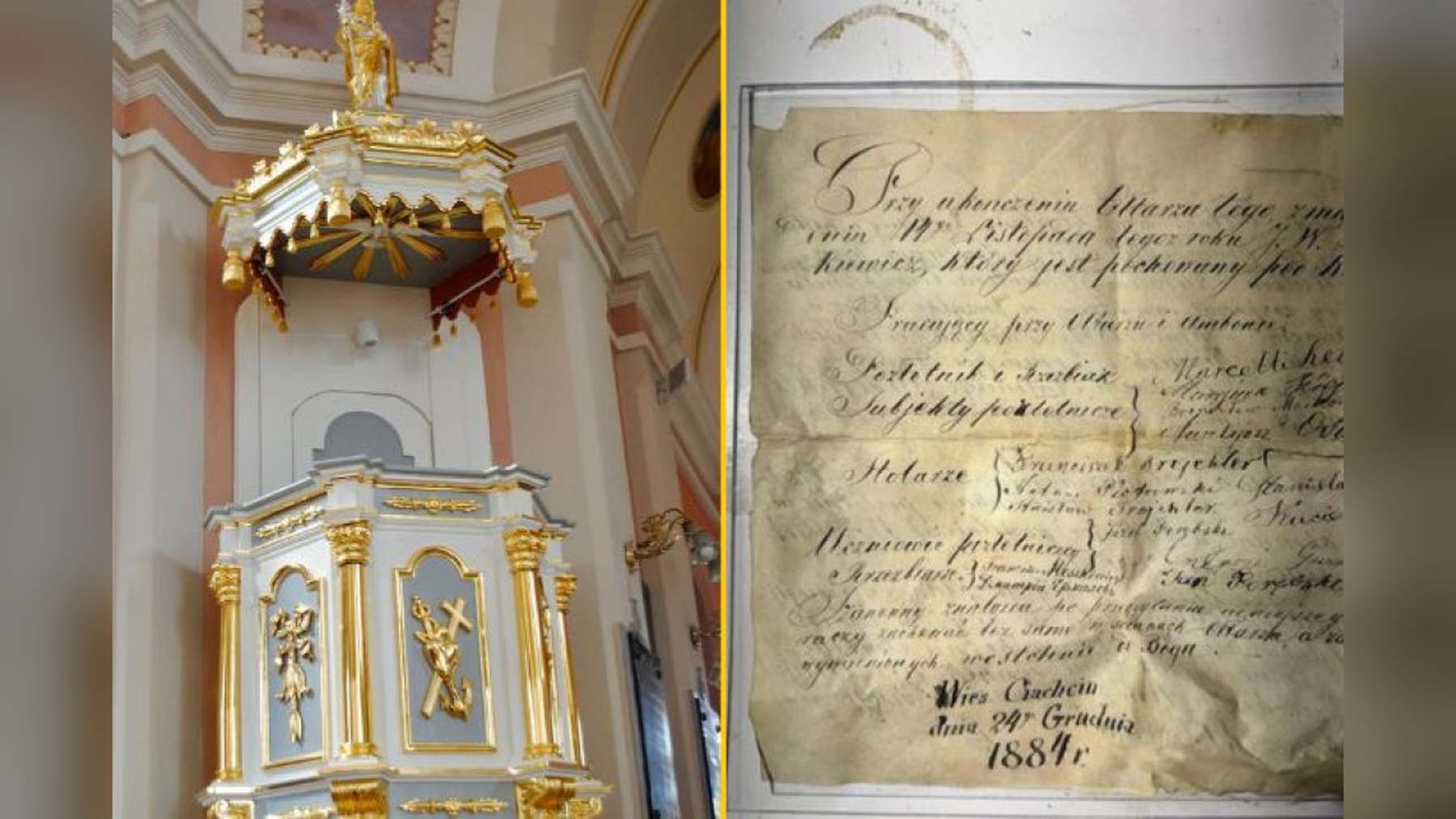
Conservators finishing work on a church pulpit in Ciachcin, a village near Płock in central Poland, found a sheet of parchment inside its carved base, where it had sat since 1884. The last line reads “Wieś Ciachcin, dnia 24 Grudnia 1884 r.” Village of Ciachcin, December 24, 1884.
The Masovian Voivodeship Conservator of Monuments, the state heritage office for the province around Warsaw, announced the find in mid-September 2026. The church is dedicated to St. Stanislaus, Bishop and Martyr. Poland has had other finds lately, from a medieval cemetery under an ice cream shop in Gdańsk to a 2,700-year-old sword in a Polish forest.
Found in the pulpit’s carved pine cone
The pulpit hangs off the wall and ends underneath in a rounded knob. Polish woodworkers call it the “szyszka,” the pine cone.
RMF24 ran the story on September 16 under the headline “Time capsule in the pulpit.” “In the so-called szyszka, the lower part of the pulpit, the conservators came across a parchment document,” the station wrote. “As it turned out, it is a kind of ‘birth record’ of the church, written down by the parish priest of the time, Father Józef Strusiński, the Masovian Voivodeship Conservator of Monuments reports.” That and the other Polish and Lithuanian quotes here are our translations.
“It took the conservators only a moment to realize what they had managed to find inside the object being renovated,” Olaf Kardaszewski wrote for National Geographic Polska.
He opened his piece with a wider point. “Even the most inconspicuous renovation work can lead to an exceptional discovery,” he wrote. “When conservation of the historic pulpit in the Church of St. Stanislaus, Bishop and Martyr, in Ciachcin began, probably no one expected that it would end with the discovery of a previously unknown artifact.”
The priest wrote down who built it
The heritage office’s statement was quoted at length by the Lithuanian news site Lrytas, which worked from Polish broadcaster TVN24. Translated from the Lithuanian, it reads:
“The document written on the parchment is a kind of birth record of the church. It gives information about the completion of the church’s construction in 1884 and about the making of the main altar and the pulpit. Both of these works were made in Płock, at Marceli Leoniak’s guild factory, where the carpentry, sculpture and gilding work was done.”
Strusiński ran the parish for 27 years, from 1865 to 1892. The conservator called him “a man who clearly understood that it is worth preserving for future generations not only the object but also the story of its origin.”
Even the apprentices got their names in
“The author of the document did not limit himself to generalities,” RMF24 wrote. “He listed by name everyone who worked on building the church.”
Lrytas spelled it out. The priest recorded the surnames of the gilders, sculptors, gilders’ assistants and carpenters, “and even the apprentices of the gilders and sculptors who worked on these pieces.”
RMF24 ran the office’s photo of the sheet. One heading says “Pracujący przy Ołtarzu i Ambonie.” Working on the altar and pulpit. Then “Stolarze,” carpenters. Then “Uczniowie pozłotniczy,” the gilding apprentices, with a curly bracket and a few names after each.
“An unusually personal glimpse behind the construction of the church,” Mark Milligan called it in HeritageDaily. The parchment, he wrote, keeps “the identities of workers whose contributions might otherwise have disappeared from the historical record.”
It happens. Elsewhere, maintenance workers lifted a stone cover during routine repairs and found something that left archaeologists speechless. A medieval castle at University College Dublin turned up hiding inside a Victorian-looking building.
A landowner and his wife paid for it
“The manuscript also mentions the founders,” RMF24 wrote, “Councilor of the Credit Society Antoni Klimkiewicz, heir to the estates of Goślice, Ciachcin, Józinek and Żerań near Warsaw, and his wife Józefa, née Bońkowska.”
According to the parish’s own history page, the brick Neo-Romanesque church went up in 1883 and 1884, designed by Ludwik Gosławski and paid for by Klimkiewicz, “with a characteristic portico of a Corinthian colonnade and a rose window directly above the portal.” Bishop Henryk Kossowski consecrated it in 1888.
There was a church in Ciachcin by 1418. The parish page lists a wooden one noted in 1598, a new one in 1775 and another in 1817 that lasted until 1883. National Geographic Polska adds that the building was overhauled in 1967 after war damage, when the interior got its painted decoration.
A second note went back inside
“After copying, the original parchment returned to its place in the pulpit, enriched with a new note on the current conservation work,” RMF24 wrote.
The conservator, as quoted by Lrytas: “In 100 or 150 years, future restorers will find not one but two records of the history of the same place.”
Kardaszewski described the addition. “In this way, beneath the 19th-century account, a new note appeared, written 140 years later,” he wrote. “Who knows whether, during later work inside the church, future generations will not also come across a mysterious document. Let’s hope that they, too, will then add their own comment.”
Milligan was more direct. “Its location suggests Father Strusiński intended that the record should survive alongside the object whose history it described,” he wrote. “More than a century later, that plan worked.”
What is still unclear
No full transcription has been published, a## What is still unclear
No full transcription has been published. The photo is only partly legible, so the number of names is unknown.
HeritageDaily wrote that “the conservators placed a new note” in the pulpit. National Geographic Polska says the parish clergy added it. HeritageDaily also put the find in “the parish church of St Stephen the Martyr,” while the parish itself is named for St. Stanislaus.
RMF24 published the heritage office’s announcement, with its photo of the parchment, on September 16, 2026.
Visitors to Ciachcin can see a copy of the document in the church porch, RMF24 reported.
Image: Mazowiecki Wojewódzki Konserwator Zabytków (via RMF24)