“I’m worrying how long this old temple is going to stay with us,” Phin Tra, 25, told The Cambodia Daily in May 2002, a few days after a 13-foot (4-meter) section of roof fell at Ta Prohm temple in Cambodia, in a part of the complex marked with one of its 30 “No Entry” signs.
Phin Tra had lived nearby as a child and often visited, and the guards on duty sadly recounted how the roof gave way on May 15, a casualty, the paper wrote, “of old age and the destructive power of tree roots that embrace the temple’s crumbling walls.”
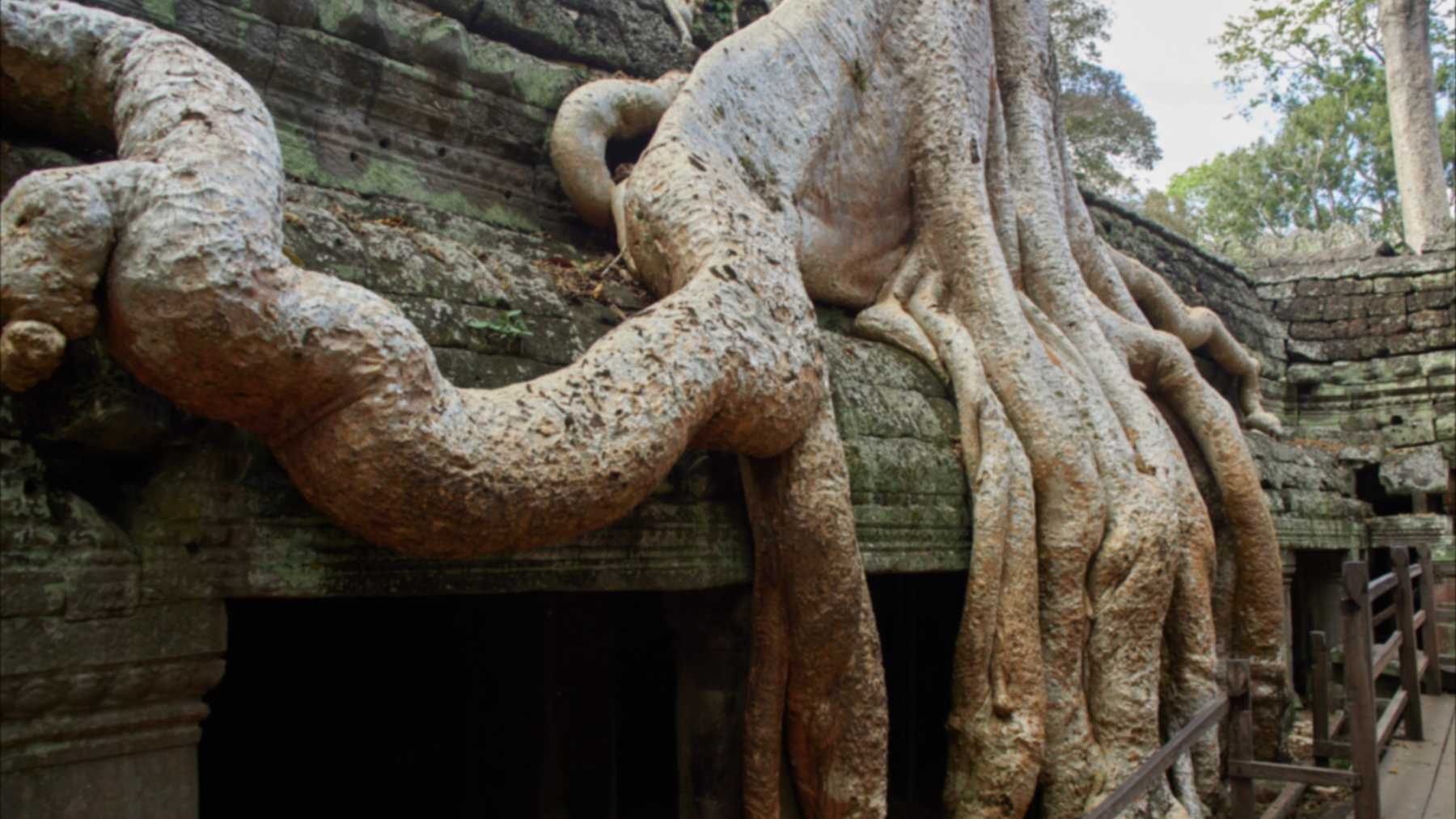
One of those guards, Nam Neoun, 55, had worked there for only three years and already saw the difference. “When I came here the first time, I saw a tree root as small as an incense stick, but now the root is larger than a human hand,” he said.
Those trees are still in place 24 years later, and in March 2026, during a visit by Indian foreign ministry official P. Kumaran, India’s public broadcaster reported that the Archaeological Survey of India (ASI), which leads restoration and conservation at Ta Prohm, had completed two phases of work, “with the third phase currently underway.”
A Buddhist temple built for a king’s mother
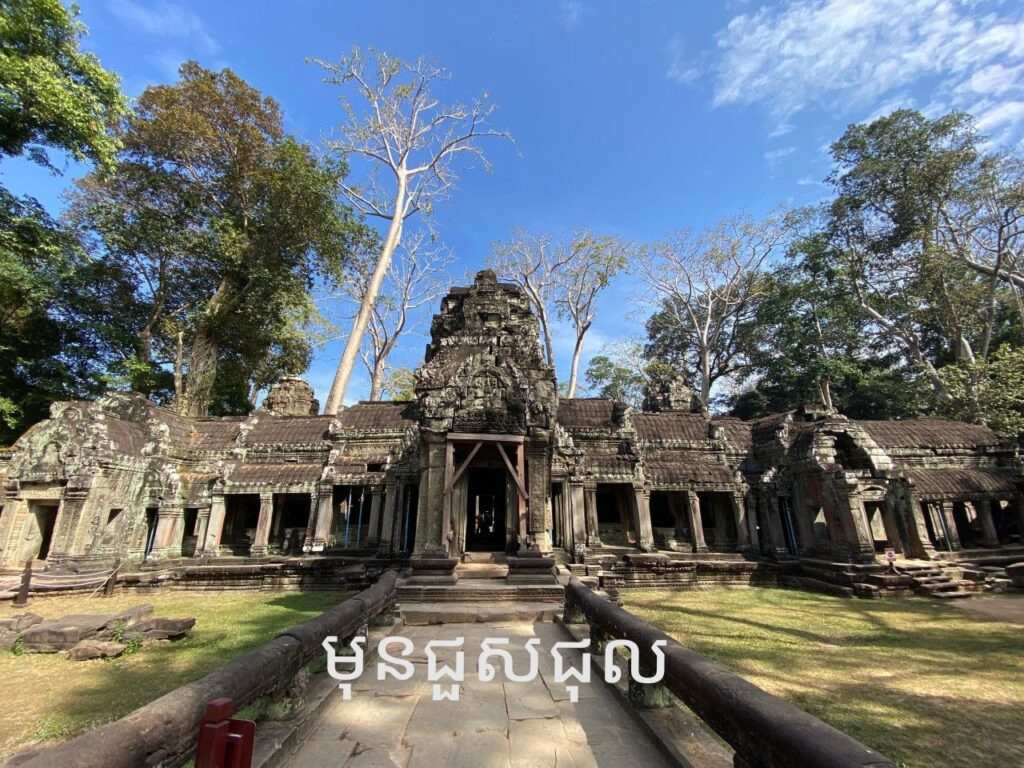
The 1186 inscription at the site, The Cambodia Daily explained in 2004, “attributes the Buddhist temple to Jayavarman VII, the builder king who erected Angkor Thom,” and two years earlier the same paper had noted that the temple was dedicated to the king’s mother.
That Sanskrit stele was found by a French mission in 1882, and the scholar George Coedès published its text with a French translation in 1906 in the Bulletin de l’École française d’Extrême-Orient, counting 145 stanzas on the four faces of the stone.
Published summaries of the inscription list 615 dancers among the temple’s people and gold, pearls and silks in its stores, a royal boast carved in stone much like the stele tied to Assyrian king Ashurbanipal recovered at Bab Shamash, and The Cambodia Daily wrote that the complex covers “nearly 70 hectares that, according to an inscription at the temple, once housed 80,000 people.”
French archaeologists chose to leave it wild
Early on, the French archaeologists working at Angkor decided to leave this one to nature, and Maurice Glaize wrote in his 1944 book “Angkor” that it was picked because it was “one of the best absorbed by the jungle, to the point of becoming an integral part of that jungle.”
“Some monuments are just ruins, but Ta Prohm is a beautiful ruin,” Michel Verrot, a French advisor to the APSARA Authority, told The Cambodia Daily in 2004, and some of the trees there stand 45 meters (about 148 feet) high and, in the paper’s words, “have nearly swallowed the carved stone galleries and towers.”
Roots that crack the stone and hold it in place
Roots had already worked their way into the stone, and A.C. Grover of the ASI, head of the Ta Prohm restoration mission, said in December 2002 that “the roots are spreading into the structure and in some cases coming out of the structure, creating cracks,” adding that “certain structures are falling down” and that in the previous year “we have seen two instances.”
The Cambodia Daily reported in February 2004 that a branch had recently fallen while Angkor’s international committee toured the temple on a sunny day without even a breeze, and John Sanday, then the Angkor field director of the World Monuments Fund, said, “Those trees are the devil in disguise,” before adding, “And yet, I’m the first one to want to hug a tree.”
On that same visit Shym Singh, the ASI’s chief horticulturist, was asked how to stop a tree that had grown into the temple, and he answered, “The tree is not damaging the structure at all,” and then, “It’s actually holding the structure,” a point The Art Newspaper had made in 2003 when it reported that conservationists thought cutting some trees would be dangerous “because they are also supporting the structures now.”
A dispute over the trees divided the experts
The argument broke into the open at a December 2002 meeting of the committee, when Grover said, “At present we have not considered harming any of the trees. But we will have to make some difficult decisions,” and the international experts in the room took that to mean some of the trees would eventually have to go, according to The Cambodia Daily.
Azedine Beschaouch, the Paris-based UNESCO official who headed the committee’s secretariat, pointed to one of the giant trees and asked, “People have painted this, photographed it; writers have written about it. It is engraved in the memory of people all over the world. How can we cut it? How can we destroy that memory?” and the paper reported that “a murmur of assent greeted this speech.”
Michel Tranet, an undersecretary of state in Cambodia’s Ministry of Culture, answered angrily that “there is no poetry here, only culture,” and that “like you, I like poetry, but I like the temple more,” while the Italian structural expert Giorgio Croci said not a single tree should be cut because “the temple is exceptional in the world” and “they must find an exceptional solution.”
By February 2004, India’s ambassador to Cambodia, P.K. Kapur, was telling a symposium on the temple that “there will be no cutting or chopping,” and that “millions of people all over the world associate Cambodia with those trees.”
India paid to restore the Hall of Dancers
When the restored Hall of Dancers opened to the public in November 2022, with the costs covered by India, Long Kosal, spokesman for the APSARA National Authority, told The Phnom Penh Post that “it took us two years to renovate the temple’s Hall of Dancers because we had to document everything and propose renovation procedures and then we discussed the procedures for approval from the Angkor committee.”
Chhay Sivlin, president of the Cambodia Association of Travel Agents, hoped it would bring more people in. “We hope that there will be more visitors because before nobody was able to see the Hall of Dancers, it was just a pile of rocks that you imagined dancers may have performed in and now it’s there for everyone to see, no imagination required, and it looks beautiful,” she said.
Digging keeps turning up new pieces
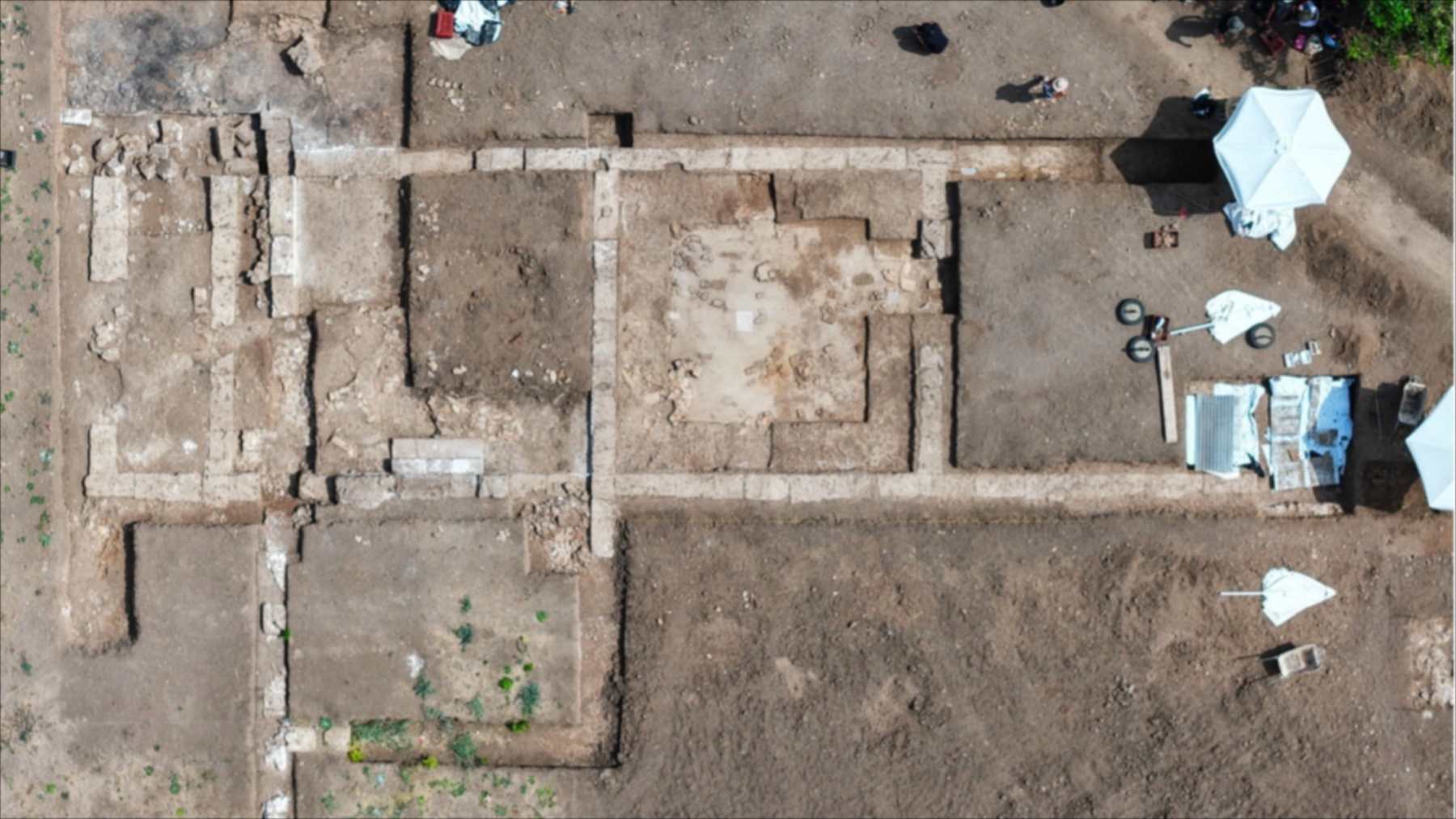
In 2024, APSARA specialists removing built-up soil south of the laterite wall of the third enclosure found “more than they bargained for,” as The Phnom Penh Post put it, when “an unexpected number of significant pieces of ornate carvings were unearthed,” some under just 4 to 6 inches (10 to 15 centimeters) of soil.
According to archaeologist Neth Simon, the team recognized the importance of the finds and immediately sought permission to expand the dig, and more than 100 pieces were identified, among them seated and standing Buddhas and nagas, the snake-like guardians of Khmer legend.
“We don’t know what remains under the earth in this area. This is why it is necessary to preserve the location,” Long Kosal said, and forests have hidden other sites the same way, from a lost Maya city that a student found with a Google search to a circular structure that emerged at El Tigre in Guatemala’s Petén.
Hollywood made the trees famous
Lara Croft: Tomb Raider, the 2001 film starring Angelina Jolie, used Ta Prohm as a location, and The Phnom Penh Post described it in 2022 as the temple “where Hollywood star Angelina Jolie filmed part of her movie Tomb Raider.”
What the record leaves open
Even the age of the trees is disputed, since Grover told The Art Newspaper in 2003 that “the trees are about 70 years old,” while K.T. Narasimhan, the archaeologist then leading the ASI team, said in 2004 that about 145 trees in the compound were between 150 and 200 years old, and The Art Newspaper had noted of the stones and roots in 2003 that “it is difficult to tell which is supporting the other now.”
The figures for the temple’s population and treasure come from the king’s own inscription, published summaries of it do not agree on every total, and the third phase of restoration, which APSARA said in February 2025 would end by late that year, was still underway in March 2026.
The March 22, 2026, report published by News On AIR gave no new end date for the work.
Back in 2002, Grover said privately that some of the trees would have to go one day. “In due course they will have to be cut. If not by us, then in 10 or 20 or 30 years, by the next generation,” he said. “The temple is immortal. Trees, like humans, are mortal.”
Photo: lumoplank / Wikimedia Commons (CC0)