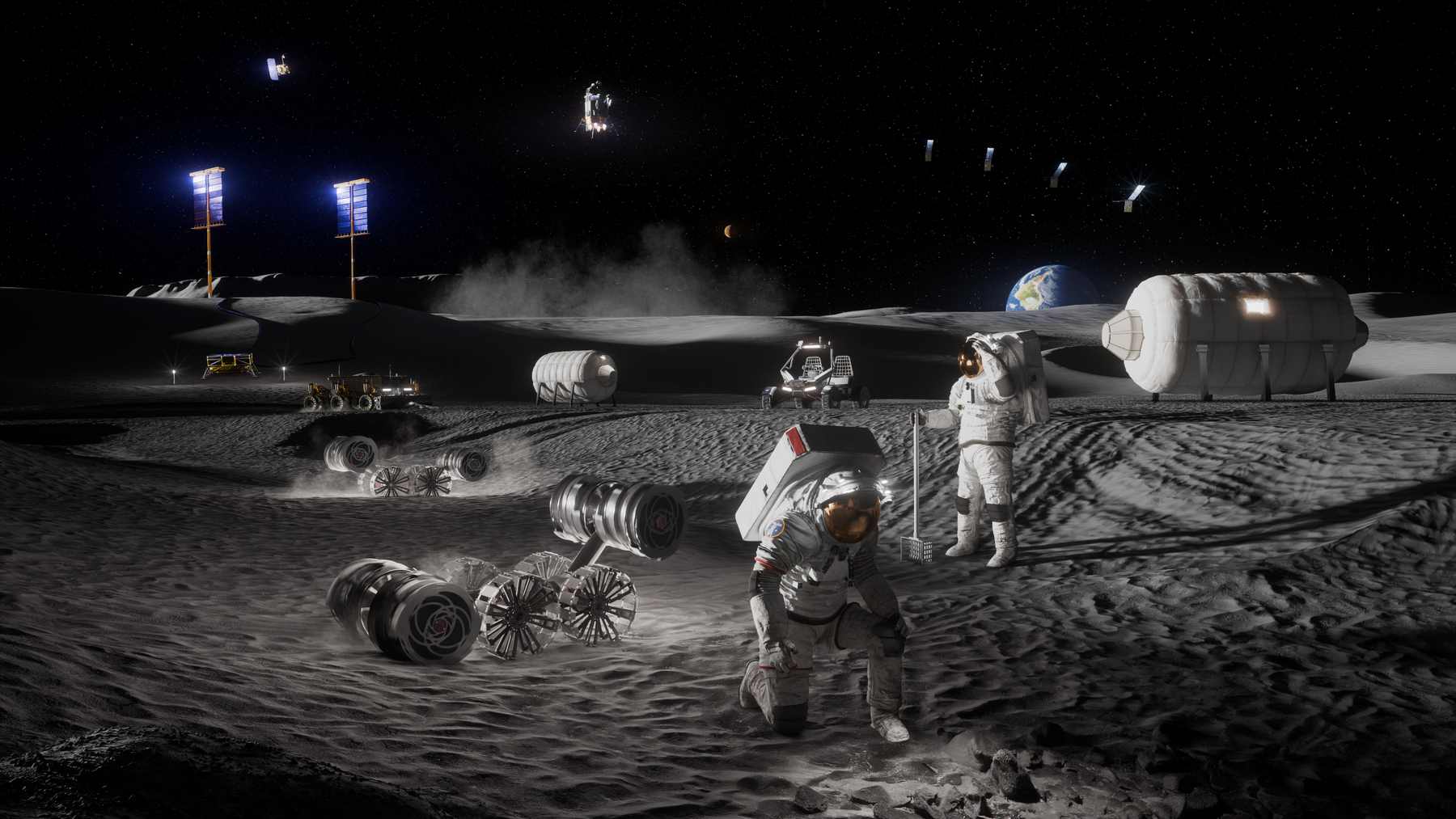
“Can the Moon’s resources support cities?” Martin Elvis and Jonathan McDowell ask at the start of their new paper. After adding up how much water on the Moon a large settlement would use, they conclude that a city of 1 million people would run dry in about a century, and that is the best case.
Elvis is a senior astrophysicist at the Center for Astrophysics | Harvard & Smithsonian. McDowell, who worked at the same center for nearly four decades before retiring this year, is now an honorary professor at Durham University’s Space Research Centre in the U.K.
Their starting point was Elon Musk. In February he said SpaceX had shifted its focus from Mars to “building a self-growing city on the Moon,” possibly “in less than 10 years,” a pivot from Mars to a lunar city that got a lot of people asking who would live there.
That raised the question, “Well, how big a city could you support on the moon with that water supply? And the answer was very surprising,” Elvis told CNN.
Where the Moon keeps its ice
Near both poles, crater floors sit in shadows “that have not seen direct sunlight for some 4 billion years and so could be accurately described as pits of eternal darkness,” the authors write. In the coldest ones, below 110 Kelvin (minus 262°F), ice escapes at “no more than 1 mm per billion years.”
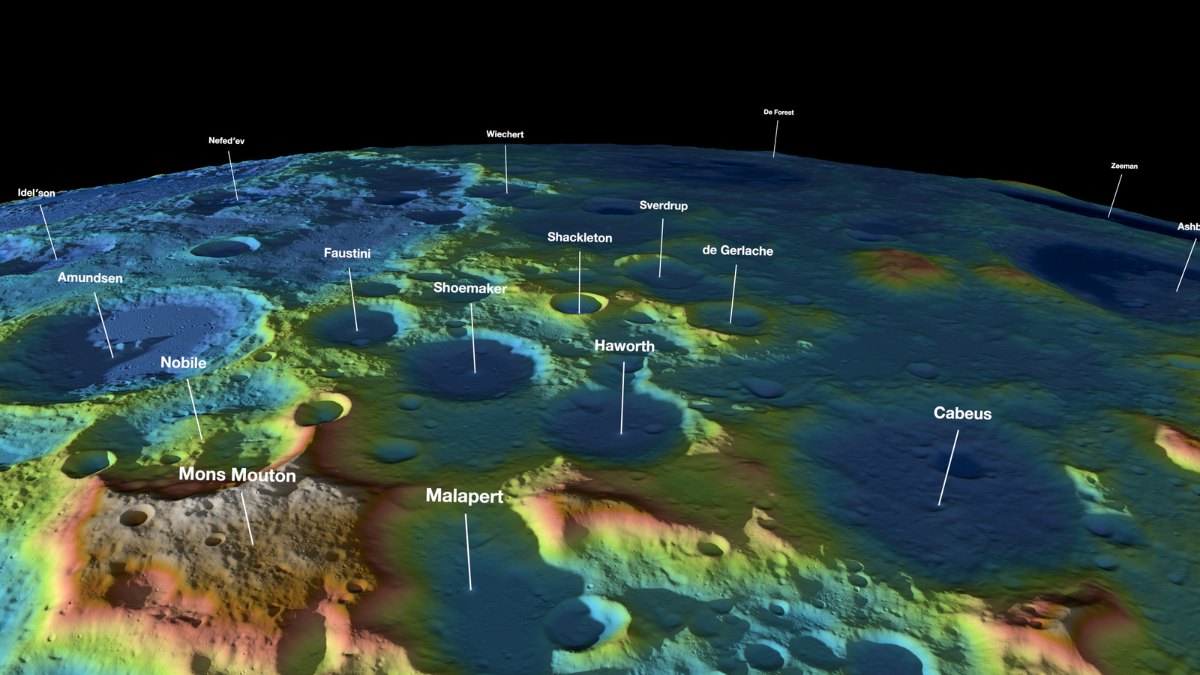
They assumed those craters hold 1 billion tons of water, on purpose a generous figure. “A billion tons of water sounds like a large amount. It is one cubic kilometer,” they write. Spread over the 843 acres of Manhattan’s Central Park, that much water would stand about 960 feet (293 meters) deep.
Surveys so far find less. A 2022 analysis put the water in the eight richest craters at about 34 million tons, and in an op-ed for Space.com Elvis wrote that “today’s best estimates of the amount of water on the moon are about 30 times less than a billion tons, shortening the time to water exhaustion by the same factor.”
Power is the easy part
“The good news is that power, even without nuclear reactors, is not a problem,” Elvis wrote. Solar panels on towers about 3,300 feet (1 kilometer) tall, placed on crater rims that are lit almost all the time, could supply around 3 gigawatts.
By the paper’s numbers, a city of 1 million would need roughly 2.1 gigawatts once homes and industry are counted. “For both solar and fission sources power generation is a weak constraint on the lunar population,” the authors write.
Most of the water goes to food
The pair used a typical U.S. per-person rate, about 125 tons of water per person a year, or “80–100 gallons/day/person.” Making oxygen to breathe adds about 1.8 tons each.
Farming is the big one. A World Bank estimate says feeding a person takes 2 to 5 tons of water a day, and even after assuming lunar farms would use half the low end, the authors land on 500 tons per person a year in total.
“At the usage rates in Table 2, a population of one million would exhaust the known water supply in just 2.4 years. Clearly efficient water recycling will be needed to support a city on the Moon,” they write.
Rocket fuel is a smaller worry. “Propellant production is not overly demanding on lunar water,” the paper says, since a billion tons could fill almost a million Starship upper stages, about three a day for 1,000 years, and it is one reason engineers keep designing plants that turn buried ice into propellant.
What 98 percent recycling buys
The International Space Station recycled 94 percent of its water until 2023, when a new Brine Processor Assembly raised it to 98 percent. “That may sound like a small change, but it is a major achievement, cutting the losses threefold,” the authors write.
At that rate, 1 million people would use up the billion tons in 100 years, and 100,000 people would take 1,000 years. “For such a large investment, a lifetime of about a century seems to fall short of the sustainable, long-term settlement beyond Earth that some advocate,” the researchers write, while the smaller city “seems long enough to justify being called sustainable.”
Even the century needs well-behaved residents. “That depends on people being very nice” about their water use, Elvis told CNN, including “always using rather dubious toilets and not doing laundry,” and that is “unlikely to be sustainable, I would think.” Anyone who remembers what happened inside Biosphere 2 knows closed systems rarely behave as planned.
McDowell put the smaller numbers this way. “If you have a small town of only 10,000 people… then you’ve got… 10,000 years’ worth of water, and that starts feeling like, okay, on a 10,000-year timescale, we can find another solution,” he told CNN.
“Water seems to impose a limit of a few hundred thousand on the long-term lunar population,” the paper says.
Four ways to stretch the supply
A 1,000-year supply for a city of 1 million would take recycling above 99.75 percent, which the paper describes as a tenfold improvement over the space station. That goal “will be hard to reach and to maintain, even for a disciplined and motivated population,” the authors write.
People could also use less. One vertical farm in Virginia says it uses “97% less water than traditional farming” for strawberries, and beef takes at least six times as much water as soybeans, per kilogram.
For a city of 1 million recycling 98 percent, shipping water in, probably from asteroids, would mean landing about 10 million tons a year, or 27 landers a day carrying 1,000 tons each. There is “a lot of water in the solar system,” McDowell said. Still, “it’s hard to see practically how to do that with current technology, but in the long term, maybe you can do that.”
The fourth option is finding more ice deeper down, since current instruments only probe the top few meters. “Of these it may be this last hope that is most promising,” Elvis wrote, and “if the ambitious plans of the space billionaires are to be realized, then finding more water will be the first step.”
Outside scientists call for careful stewardship
“This is an important study. I think the authors have done a valuable service by injecting some realism into the discussion of longer-term plans for establishing large human settlements on the Moon,” Ian Crawford, a professor of planetary science and astrobiology at Birkbeck, University of London, who was not involved in the research, told CNN.
Simeon Barber, a senior research fellow at the Open University who searches for lunar water, warned that the ice “is not in the form of pristine sparkly ice cubes that we could melt and drink; it is likely laced with a cocktail of poisonous chemicals that first must be removed.” He added that it preserves “a chemical and physical record of the environment in which our Earth has existed for all this time, and which led to the development of life on Earth.”
With only a handful of big craters, Elvis worries that interested parties might “try to grab the biggest and best of them and exploit the water,” and he urged them to work together, CNN reported.
Careful management of the limited reserves, Crawford said, “implies the need for an internationally agreed regulatory framework, to prevent a ‘goldrush’ mentality developing which could prematurely deplete a valuable lunar resource.” Rules like that are still missing even as NASA and China prepare to build lunar bases.
Elvis and McDowell agree. Humanity “will need to plan, govern and regulate the use of lunar water, rather than adopt a ‘first come first served’, free-for-all approach to water extraction and use,” they write.
Limits of a first estimate
The paper only looks at power and water. “Many other factors will need to be considered to make a functioning Moon Village. These factors are beyond the scope of this study,” the authors write, and every deadline in it moves up or down with the water total they picked.
“It is worth noting that the fraction of water that can be recovered will surely not be 100%,” they add. Oil fields, for comparison, have given up a third to half of what they hold.
Water “is going to be the gold of the solar system,” McDowell told CNN, but there is “huge uncertainty in how much water there actually is on the moon.” He added, “But also, how easy is it going to be to extract?”
Smaller plans look fine on paper. For a “Moon Village” of about 1,000 people, roughly the number who spend the winter in Antarctica, “we can be relatively carefree in our use of lunar water,” the study says. Even that is a distant goal, since NASA’s commercial Moon deliveries planned for 2028 still carry instruments, not settlers.
The full study was published in Frontiers in Space Technologies.
McDowell has his own guess about Musk’s plan. “I would say within 30 years we might have a town on the moon. That would be the way that I would translate what Elon said,” he told CNN.
Image: NASA