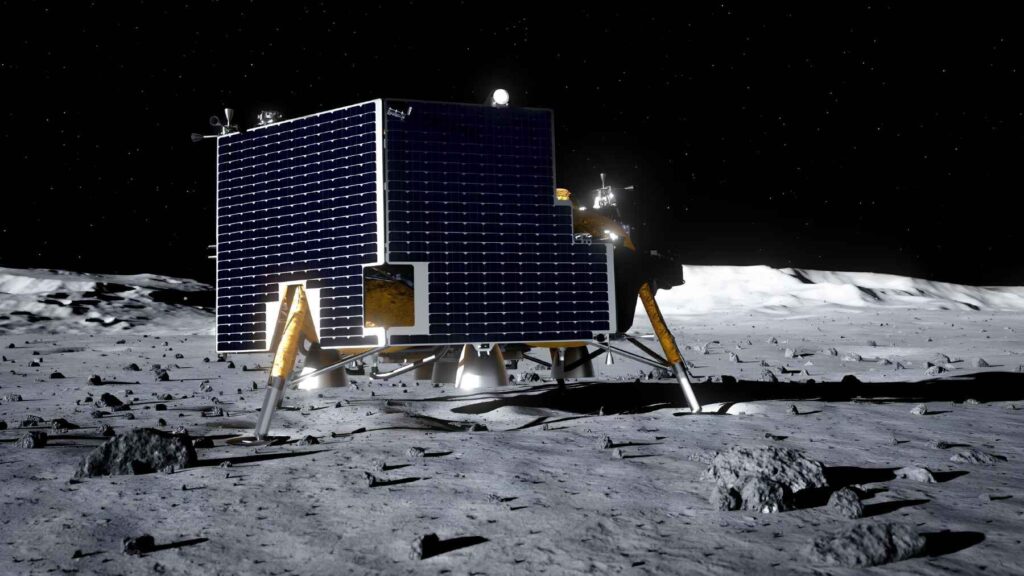
NASA has committed $590.4 million to four uncrewed Moon deliveries by Astrobotic, Firefly Aerospace, and Intuitive Machines, with the missions targeted for late 2028. Astrobotic will receive $297.9 million for two trips, while Firefly gets $144.2 million and Intuitive Machines $148.3 million for one delivery each. The awards sit inside NASA’s Commercial Lunar Payload Services initiative, which the agency now describes as a backbone of its Moon Base effort.
Despite some reports framing these flights as construction runs, NASA’s announcement does not list habitat walls, bags of cement, or lunar bricks among the standard payloads. The cargo identified for all four landers is a set of instruments that will measure landing dust, radiation, and position. In practical terms, the agency is expanding the Moon’s environmental and navigation network before it builds the rooms where astronauts may one day sleep.
What the money buys
Each lander will carry the same three NASA payloads. They are the Stereo Camera for Lunar Plume Surface Studies, the Laser Retroreflector Array, and the Linear Energy Transfer Spectrometer. NASA is also reviewing whether the flights can carry additional equipment.
The companies will use updated versions of landers that have already flown, rather than beginning with completely new spacecraft. That is central to the agency’s faster approach, which Ryan Stephan, NASA’s acting director of cargo landers, described simply as “a proving ground for Moon Base operations.”
Dust comes before walls
The camera system known as SCALPSS will use four cameras to build a three-dimensional view of what happens when a lander’s engine exhaust strikes lunar soil. That blast can erode the surface and fling dust and small particles away from the touchdown zone. As spacecraft become larger and land closer to valuable equipment, the problem grows harder to ignore.
What good is a habitat if the next cargo lander sprays abrasive dust across its solar panels? On Earth, crews inspect the ground before pouring a foundation, but on the Moon the arriving vehicle can change the worksite in its final seconds. NASA’s Joel Kearns compared the repeated instrument packages to “weather stations in different locations on Earth.”
Radiation and navigation are infrastructure
The radiation detector will measure how much energy incoming particles carry during different routes to the Moon and at different surface locations. Radiation beyond Earth’s protective atmosphere is one of the major health hazards for astronauts, so those readings can inform shielding choices and the planning of longer missions.
The retroreflector is much smaller, roughly the size of a cookie, but its job may last for decades. Made with eight quartz prisms and requiring no power or maintenance, it reflects laser beams so orbiters and landers can determine their position more precisely. Think of it as a permanent survey marker on a world with no road signs or familiar landmarks.
A commercial strategy with real risk
NASA is buying delivery services rather than designing and operating every lander itself. That can spread work among several companies and create more chances to fly, but the recent record shows why the agency keeps talking about learning and improving. Firefly’s Blue Ghost landed upright in March 2025, Astrobotic’s Peregrine failed to land in January 2024, and two Intuitive Machines landers reached the surface but ended up on their sides.
The new contracts require the companies to assess earlier landers and apply lessons from those missions. NASA has openly accepted that some CLPS missions may fail, arguing that frequent commercial attempts can still deliver useful knowledge and gradually improve reliability. For a permanent outpost, however, “almost landed” will not be enough.
The wider lunar schedule has other weak points. Blue Origin’s New Glenn rocket exploded during a ground test on May 28, 2026, damaging its only operational launch pad and raising questions about missions tied to the vehicle. That accident does not directly rewrite the four new awards, but it shows how quickly a crowded Moon calendar can be disrupted.
Why the lunar south pole matters
NASA wants its base near the Moon’s south pole, where water ice has been detected in permanently shadowed areas. If accessible deposits can be used responsibly, that water could support crews and potentially be converted into breathable oxygen or rocket fuel. The quantity, concentration, and practical accessibility of the resource remain open questions.
This is also an unforgiving place to work. NASA says some shadowed areas can fall to -334°F, while nearby sunlit ground can reach roughly 130°F. Add steep terrain, long darkness, abrasive dust, and radiation, and a simple delivery starts to look less like dropping off a package and more like threading a needle in the dark.
When construction really begins
NASA’s first phase runs through 2029 and could include as many as 25 missions, including 21 landings, plus rovers, hopping drones, communications systems, and power demonstrations. The second phase, planned for 2029 through 2032, moves toward early habitation, larger cargo flows, and expanded solar and nuclear power. Only after that does the agency envision more spacious semi-permanent habitats, routine crew rotations, and continuous activity.
Later plans include testing whether lunar soil can provide oxygen, water, hydrogen, and durable construction material through techniques such as sintering and three-dimensional printing, but the technology, funding, and schedule remain uncertain. For now, the $590.4 million is paying for the measurements and markers that could make construction possible without turning the lunar south pole into a blind, dusty worksite.
The official press release was published on NASA.