In the mountains of southwestern China, Yanjin squeezes homes and roads into a river valley that narrows to about 98 feet. Often described online as the “world’s narrowest city,” its compact center shows how people build when steep slopes leave little room to spread out.
But the familiar claim that 400,000 people live inside this thin corridor mixes up the town with its much larger county. The more revealing story is how residents have adapted to limited land, and how development is now creating room beyond the crowded old center.
How narrow is Yanjin?
The county seat lies in northeastern Yunnan Province, within the mountainous area administered by Zhaotong. Buildings follow the Guan River between steep hillsides, forming an elongated settlement that bends with the valley instead of spreading across a broad plain.
Reports put the narrowest sections of the old urban corridor at roughly 98 feet and the widest at about 984 feet. Those measurements describe the narrow town, not the surrounding county. Official Chinese coverage calls it “China’s narrowest county seat,” while the worldwide title remains a popular description rather than an independently verified record.
What the population figures mean
The distinction matters because a Chinese county can contain multiple towns, villages, and rural communities. Counting everyone in that administrative area as a resident of one photographed riverfront neighborhood creates a misleading picture of how crowded the place really is.
The 2024 statistical bulletin from the Yanjin County Statistics Bureau recorded 395,400 registered residents across the county, close to the widely repeated 400,000 figure. It separately counted 299,500 people residing in the county, including 104,900 across its urban areas. Neither total measures the narrow old town alone.
Why buildings stand on pillars
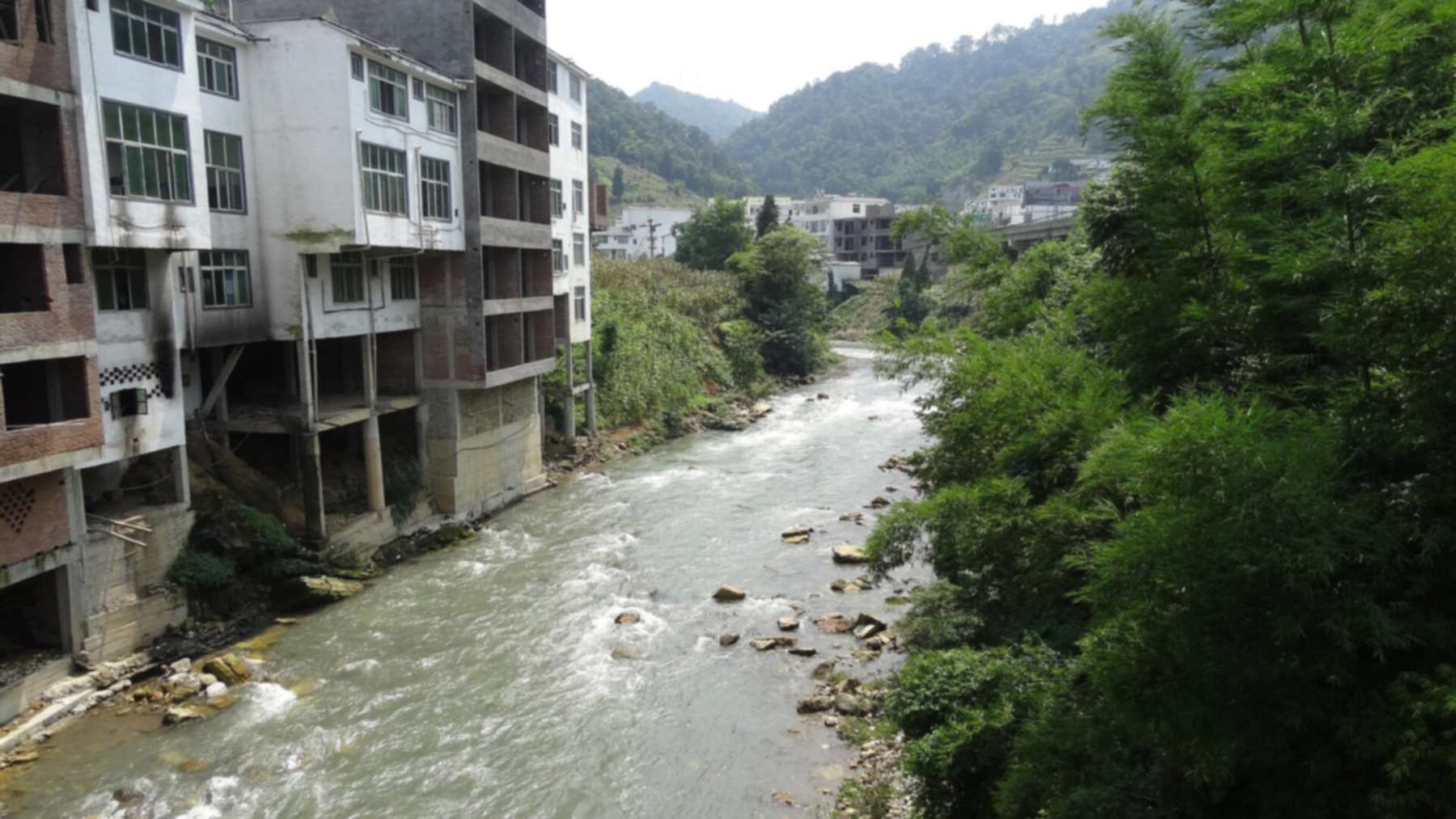
What happens when there is almost nowhere to build sideways? Along the river, multistory buildings use tall supports to occupy the steep banks, placing living space above ground that would be difficult to develop as ordinary flat building lots.
These structures are often called “stilt houses,” but Yanjin’s familiar riverside examples stand on concrete pillars. The arrangement helps explain the striking photographs, with rows of homes appearing to rise straight out of the riverbank and the mountain pressing close behind.
Flooding remains a concern
The water below those buildings is also a hazard. A January 2026 report in China Water described Yanjin’s continuing flood exposure and improvements to rainfall monitoring, warning systems, and evacuation arrangements, showing why raised floors should not be confused with complete protection.
Near a former school, past flood levels have been marked on a building’s exterior. “We marked the water levels on the building,” county water bureau director Liu Zexiong explained in the report, in remarks translated from Chinese. The wall preserves a visible record of earlier floods.
The slopes bring another concern during heavy rain. A government disaster-prevention plan published in 2015 identifies landslides, rockfalls, and flows of mud and debris as local hazards, meaning safety planning must account for both the river below and unstable ground above.
A valley with a trading past
Yanjin’s setting may look inconvenient, but the area has long connected people moving between Yunnan and Sichuan. Nearby surviving sections of the ancient Wuchi Road point to a trading history stretching back more than 2,000 years, while boats once carried salt, copper, and tea along the river.
That history helps explain why a settlement developed in such difficult terrain. The valley offered a passage through the mountains, and later infrastructure followed too, including a railway tunnel more than 5,900 feet long beneath the county town.
Beyond the photographs
The town’s unusual shape has become part of its appeal to visitors. In February 2026, Xinhua reported on two European travelers who decided to visit after seeing a photograph of Yanjin on social media, a small example of online attention becoming an actual trip.
Recent images also show riverside buildings painted in soft blues, pinks, and other bright colors. Yet the practical questions behind those pictures are familiar in any town, from maintaining streets and public spaces to making room for homes and everyday services.
Finding room to grow
Building higher is only one part of Yanjin’s response to limited land. A 2023 document from the Yunnan Department of Natural Resources supported relocation away from geological hazards and identified the Shuitian new district as a place to accommodate development and disaster-related moves.
An April 22, 2026 local report described a broader plan to ease pressure on the old town while improving another district and expanding Shuitian. The new area has a planned footprint of about 6.1 square miles, with development organized into three phases and schools and a hospital already operating.
The same report recorded renovations to 337 building facades in the old town, showing that improving existing neighborhoods remains part of the work. These projects suggest that Yanjin’s next chapter involves both adapting its narrow center and finding space elsewhere. The main report on this redevelopment was published by Zhaotong Daily.
Photo: dgykx / Wikimedia Commons (CC BY 3.0)