Leonce Viator Jr. had taken his nephew out to their favorite fishing hole on Lake Peigneur early on November 20, 1980. “I said something is wrong. Water began creeping towards the mine site and the fish were jumping to joy,” Viator told Fox 8 in New Orleans years later. “I said give that boat all the gas she can swallow and lets get out of here.”
He was right to run. Before the day was over, the shallow lake in Iberia Parish had gone down a hole into the Diamond Crystal Salt Company mine under Jefferson Island, along with a Texaco drilling rig, barges, a tugboat, trees and a good piece of the island.
A drilling rig above a working mine
Jefferson Island is the top of a salt dome. Diamond Crystal had been digging rock salt out of it for decades, and its lawsuit later said one excavated room sat on the mine’s 1,300-foot level.
Out on the lake, a rig operated for Texaco by Wilson Brothers was drilling an oil well that Texaco called Lake Peigneur well number 20. Diamond Crystal said that rig went through the roof of the room.
It started, Fox 8 said, as a 14-inch hole. Fresh lake water dissolves salt, though, so the hole did not stay small for long.
“No one was injured Thursday when Lake Peigneur emptied into the crater, although seven workers had to abandon the oil rig, and 50 others had to flee the salt mine,” UPI reported from Jefferson Island two days later.
Miners raced the water to the surface
Myrna Romero was a surveyor for the company, and it was a Thursday, which she told KATC was “safety day” at the mine. When warning lights flashed on the lowest level, she figured it was a meeting.
“We didn’t know. Until we got to the 1,200-foot level, we thought it was just a meeting,” Romero said. “Oh my goodness, no, it wasn’t.”
“When we got to the top of the thing, you could hear it,” she said. “There were waves, big waves. It sounded like you were in an ocean.”
The crew had won the National Mine Rescue Championships three years running, KATC noted, and it still did not take the fear away. “You never think that you’re gonna make it out, especially when it’s water,” Romero said. She took the last cage up, saying the Act of Contrition on the way.
“Because mine emergency evacuation procedures were immediately followed, there were no injuries or loss of life,” the Mine Safety and Health Administration wrote afterward.
MSHA’s timeline shows how fast it went. At 8:20 a.m. a call reached Baton Rouge that water was coming into the mine, everyone underground was taken up in four trips between 8:40 and 9 a.m., and an 11:15 a.m. federal order already noted “visible swirling water motions in the nearby bay.”
A whirlpool swallowed barges and land
Mike Richard, who owned Rip Van Winkle Gardens when Fox 8 talked to him in 2011, had felt it coming all morning. “All that morning we had been hearing tremors or feeling tremors at uniform intervals about 10-15 seconds apart,” he said.
“One of the superintendents from the salt mine came by and said we advise you to evacuate all your employees because there’s been an accident,” Richard said.
He went up on the balcony of a house on the lake with his Super 8 camera. Viator and his nephew were stuck out on the exposed bottom by then. “There was nothing we could do for them. They were out in the mud flat. Water had run out and they were stranded on this mucky bottom,” Richard said.
“The crater started growing. It started changing direction. It was peeling off as much as an acre of land at a time, just peeling off.” The house he filmed from ended up in the water too.
Sheriff Errol Romero told UPI that land was falling off the edge of the crater in 35-foot chunks. Dolan Kleinpeter, a Soil Conservation spokesman, guessed 50 acres had gone in. Amy Gary, a former tour guide on the property, put it at 65 acres in 2024.
Susan White ran the newsroom at KANA radio in New Iberia, and she went up in a plane. “It was awesome,” she told UPI. “It looks like a great big hole in the ground. There are 10 barges, at least one drilling rig and a tugboat in the bottom of it. They just look like toys.”
The canal ran backward and refilled the lake
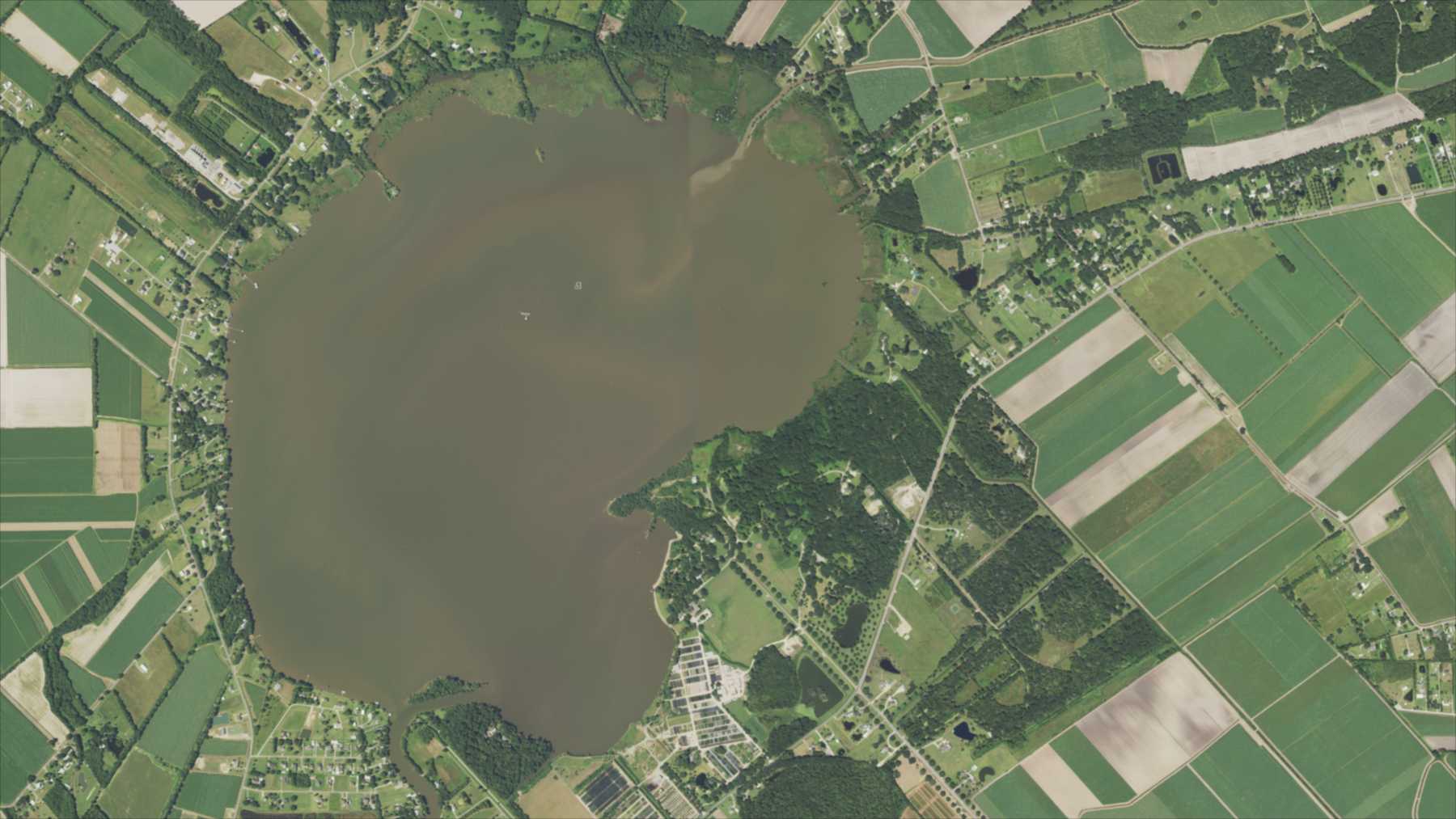
Normally the Delcambre Canal carries water from Lake Peigneur toward the Gulf of Mexico. That day it ran the other way, and Fox 8 said the water dropped more than 150 feet into the sinkhole, with nearly two days needed to fill the lake back up.
Amy Gary, who used to give tours at Rip Van Winkle, told KATC in 2024 how it looked. “The water began to rush in and it took off and started to do this swirl thing, almost like a toilet going down the drain,” she said. “It took with it barges, it swallowed up this land.”
The Aral Sea needed decades of Soviet irrigation to shrink into a desert full of stranded ships. Lake Peigneur was empty and full again inside a week.
There was a gas fire on the water for days. “There’s still a little fire in that water area, but it’s died down some,” a sheriff’s spokesman said on November 24, and a federal mine official told UPI that “there’s no motion going on at this time.”
Diamond Crystal had 275 employees to worry about. “They’re the kind of people who give you an honest day’s work for their pay,” said Paul Bergeron of Diamond Crystal, who was calling around for jobs.
The lake that came back was not quite the old one. A 2002 water quality study done for the EPA put its typical depth at 3 feet, but listed a hole near Jefferson Island “approximately 200 feet deep.” Mines and pits that fill with water tend to leave their mark, which researchers also saw in a Spanish coal pit that became a lake with chemically distinct layers.
Texaco and the salt company blamed each other
The salt company sued Texaco in federal court in Lafayette the following day. Texaco shot back. “Although the salt company was aware at least 10 months prior to the start of drilling, it failed to notify Texaco that salt mining operations were being conducted in the area where the rig was lost,” a Texaco spokeswoman said.
Max Hebert, Texaco’s public affairs coordinator, was blunt about where the rig had been. “The fact that the well was drilled exactly where it was approved by the Corps of Engineers has been confirmed by registered professional engineers,” he said.
That was aimed at Charles Grote, director of the Louisiana Geological Survey, who had been quoted saying the rig probably “was not set up where it was supposed to be.”
Politicians grabbed onto it fast, because Washington was looking at Louisiana’s salt domes to store oil and nuclear waste. “What if we had whatever stored in those mines?” asked Cliff Aucoin, an Iberia Parish police juror. “If it was oil, I don’t think we could guess what the ecological effect would be. If it was nuclear waste, we wouldn’t be standing here talking about it.”
It took until July 1983 to settle. Diamond Crystal had sued for $260 million and took $32 million from Texaco and Wilson Brothers, and the owners of Live Oak Gardens got $12.8 million, UPI reported. Wilson Brothers’ share was 6.25 percent, about $2 million, and Texaco paid the rest.
The drilling contractor’s lawyer still would not concede the basic story. “There are a number of experts who have reached contrary conclusions that the well did not drill into the salt mine,” he said.
What the federal investigation could not settle
The mine agency did the official investigation, with one big hole in what it could see. “In the case of Texaco’s oil and gas drilling operations, however, MSHA had no jurisdiction whatsoever, nor any records prior to the inundation,” its team wrote.
Nobody could go into the flooded mine to look. Because of “the circumstantial nature of the information available,” the 1981 report said, “it would be extremely difficult to determine the precise cause of the inundation.” It listed possible causes instead, including the stuck Texaco drill string and the chance that years of mining had weakened the structure. The record is also messy in smaller ways. UPI counted 50 people fleeing the mine in 1980, while Fox 8 later put it at more than 50 mine workers.
One popular version says the rig was about 400 feet off its mapped spot. Space Daily dropped that line in a September 2026 correction, saying the official investigation never settled the cause.
Drilling and what it does to the ground underneath still comes up, as people in a town in Surrey with more than 100 small earthquakes near an oil well found out decades later.
The full investigation was published by the Mine Safety and Health Administration in August 1981 as The Jefferson Island Mine Inundation.
Viator told Fox 8 he still had nightmares. “I went and seen a priest and he says just say prayers when you go to bed at night. And I said I do that but it still bothers me. Looks like I see that whirlpool spinning,” he said. “But thank god I didn’t get stuck in it.”
Image: USDA-FSA NAIP / NOAA Office for Coastal Management (public domain)