“The idea is quite cool. You take water bottle plastic; you zap it with a laser to make diamond. How practical it is, I don’t know,” Marius Millot, a physicist at Lawrence Livermore National Laboratory in California, told Science News in 2022, when a team including Dominik Kraus showed that laser shocks could turn PET, the plastic in many drink bottles, into nanodiamonds. Millot, who was not involved in that work, said it was unclear how easily the diamonds could be recovered.
Kraus and his colleagues now report that they have recovered them. In a study in Diamond & Related Materials, researchers from the University of Rostock, the Helmholtz-Zentrum Dresden-Rossendorf (HZDR) and the ELI Beamlines laser facility in the Czech Republic describe pulling intact nanodiamonds out of laser-shocked PET film, with an average diameter of 3.23 nanometers and a spread of less than 1 nanometer among the 98 particles they measured.
“We did expect nanodiamonds to form under these conditions. What surprised us, however, was how quickly it happened, which immediately sparked the idea of a potential technical application,” Kraus, founding director of HZDR’s Institute of High Energy Density Physics and a professor at the University of Rostock, said in the institute’s announcement.
A laser shot every three minutes
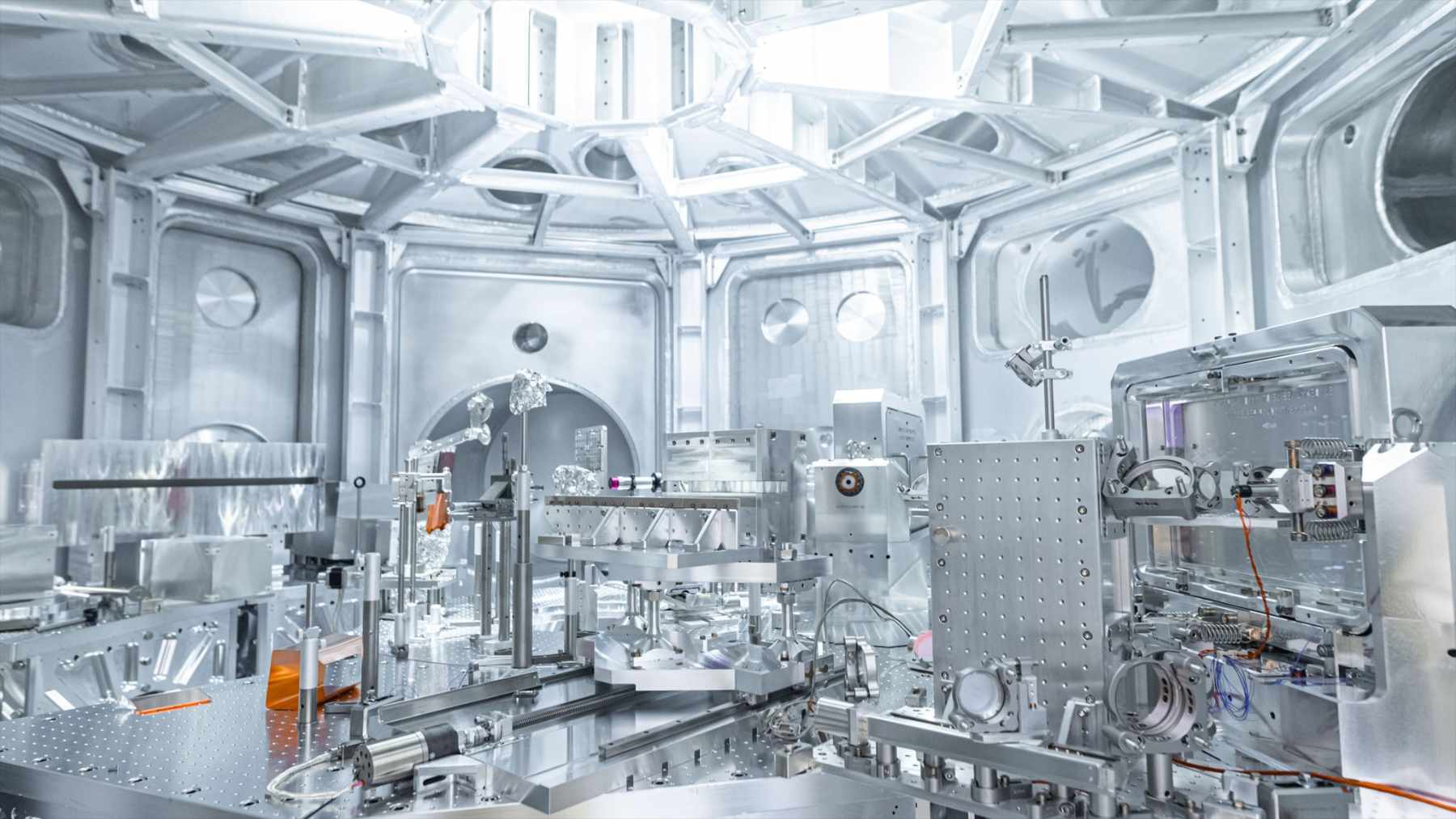
The experiments ran at ELI Beamlines, south of Prague, where the L4n laser fired pulses lasting 5 nanoseconds, with 25 joules of energy, at a PET tape 100 micrometers thick, about a tenth of a millimeter, that moved along after each shot. Each pulse drove the plastic into the conditions where diamonds form, which the paper puts at about 80 gigapascals and 3,800 kelvin, and its title rounds to “around 100 GPa,” roughly a million times the air pressure at sea level.
The team collected the debris from 133 shots, fired at a rate of one every three minutes, according to the paper. That works out to more than six and a half hours of shooting for a single sample.
Catching diamonds at meteorite speed
Getting the diamonds back in one piece was the hard part. “When the compression wave reaches the end of the sample, it abruptly enters a vacuum, accelerating the nanodiamonds to speeds of more than ten kilometers per second – comparable to a meteorite impact,” Kraus said, which is more than 22,000 mph. “To prevent the diamonds from immediate destruction upon impact with the collection cylinder, we need to use a very soft collection medium.”
The researchers chose a water-soluble ionic gel that can sit in a vacuum, packed into a glass tube 20 millimeters behind the plastic. Afterward they dissolved the gel in water, concentrated what it had caught, cleaned it with nitric acid and put it under an electron microscope in Rostock, where the material turned out to be almost entirely carbon, with no trace of the gel.
“After extracting the nanodiamonds from the catcher material and purifying them, we were able to see them for the first time directly using the ELMI-MV. That was a special moment we had been working towards for years. With this instrument, we can even resolve individual atoms,” said Ben Heuser of HZDR, the study’s first author, who ran the experiments for his doctoral thesis at the University of Rostock.
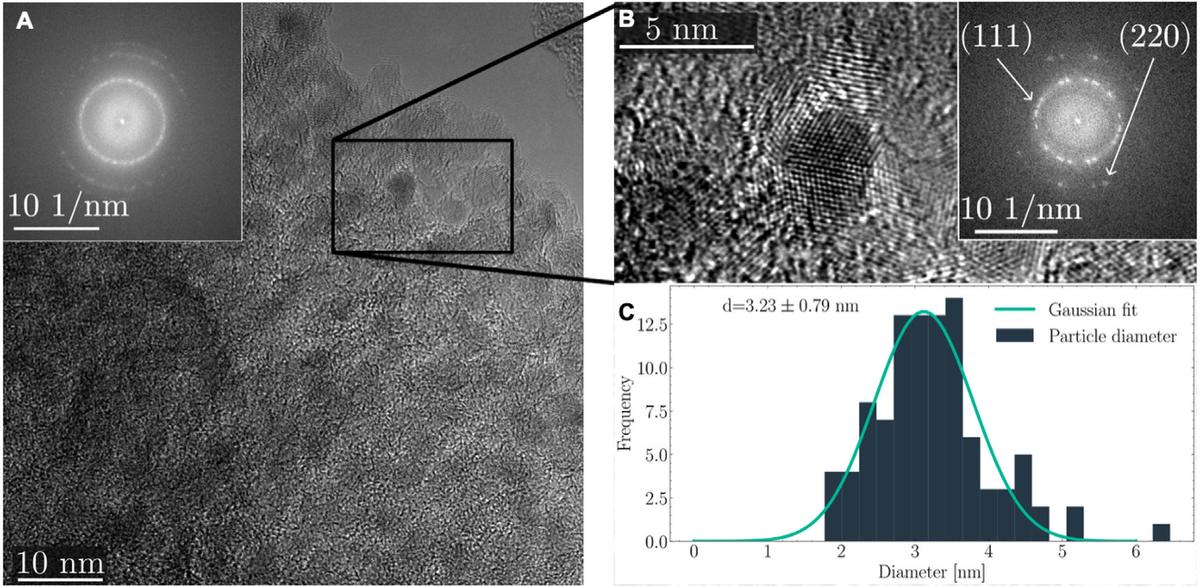
Heuser and his colleagues also spotted a few “carbon onions,” little balls of nested graphite shells, along with some graphite-like patches, and they think those formed after the particles had left the high-pressure zone or when they slammed into the catcher.
Trillions of diamonds that weigh almost nothing
Each shot fires approximately ten trillion diamonds of nearly the same size into the cylinder, which according to HZDR “sounds like a lot, but yields very little mass,” because a single one holds about 3,000 carbon atoms, and the whole run produced only a few hundred micrograms, less than a milligram but enough to study under the microscope, while the next goal, the authors write, is samples of more than a milligram.
Back in 2022, when the first PET experiments were run with an X-ray laser at SLAC National Accelerator Laboratory in California, Kraus was already picturing a production line. “So far, diamonds of this kind have mainly been produced by detonating explosives,” he said in a University of Rostock release at the time. “With the help of laser flashes, they could be manufactured much more cleanly in the future.”
The new paper puts some numbers on that hope, pointing to diode-pumped lasers that deliver 100 joules in 10 nanoseconds at 10 shots per second while turning 10% to 20% of their electricity into laser light, a pace that would mean 1,800 shots in the three minutes the team waited between two of its own. With more than half of the carbon in the shocked plastic able to become diamond, the authors expect the method “to be highly competitive in terms of yield and cost,” helped along by the money now going into laser-driven fusion research.
Diamonds made to order
What Kraus liked from the start was control, since with lasers “the nanodiamonds could be custom cut with regard to size or even doping with other atoms,” as he put it in 2022. The commercial synthetic diamond particles made with explosives are typically around 5 nanometers wide and often carry metal impurities, according to the new paper, whose authors write that tuning the plastic’s chemistry might let them add selected atoms as the diamonds form, “unlocking routes to tailor quantum or catalytic properties.”
PET got the job for planetary reasons. “PET has a good balance between carbon, hydrogen and oxygen to simulate the activity in ice planets,” Kraus said in 2022, and the oxygen helps, he told Science News, because “the oxygen sucks out the hydrogen,” leaving carbon free to form diamond, much as scientists suspect happens deep inside Uranus and Neptune. For a future factory, though, the authors suggest plastics made from starch or cellulose, with a similar makeup but “non-petroleum-based.”
As for plastic waste, the experiment used a clean, uniform PET tape and says nothing about dirty, mixed bottles from a recycling bin, nor about how much energy each milligram of diamonds would cost at scale, so Millot’s 2022 doubt about how practical it all is hasn’t gone away.
Photo: ELI Beamlines