A planetary sunshade made of about 5,000 spacecraft would block 1 percent of incoming sunlight and cool Earth by about 1.8°F (1°C). That is the estimate from the Planetary Sunshade Institute, a U.S. nonprofit that says it is funded by the UK’s Advanced Research and Invention Agency.
The institute has now released its Space Reflector Baseline Survey, which compared six sunshade architectures using climate models. Its first key finding says, “A sunshade is buildable with no new physics, but is realistically 20–40 years away.”
For now the concept exists only in engineering studies and climate models. According to the institute, only governments can authorize and fund a deployment.
Blades 6 miles long
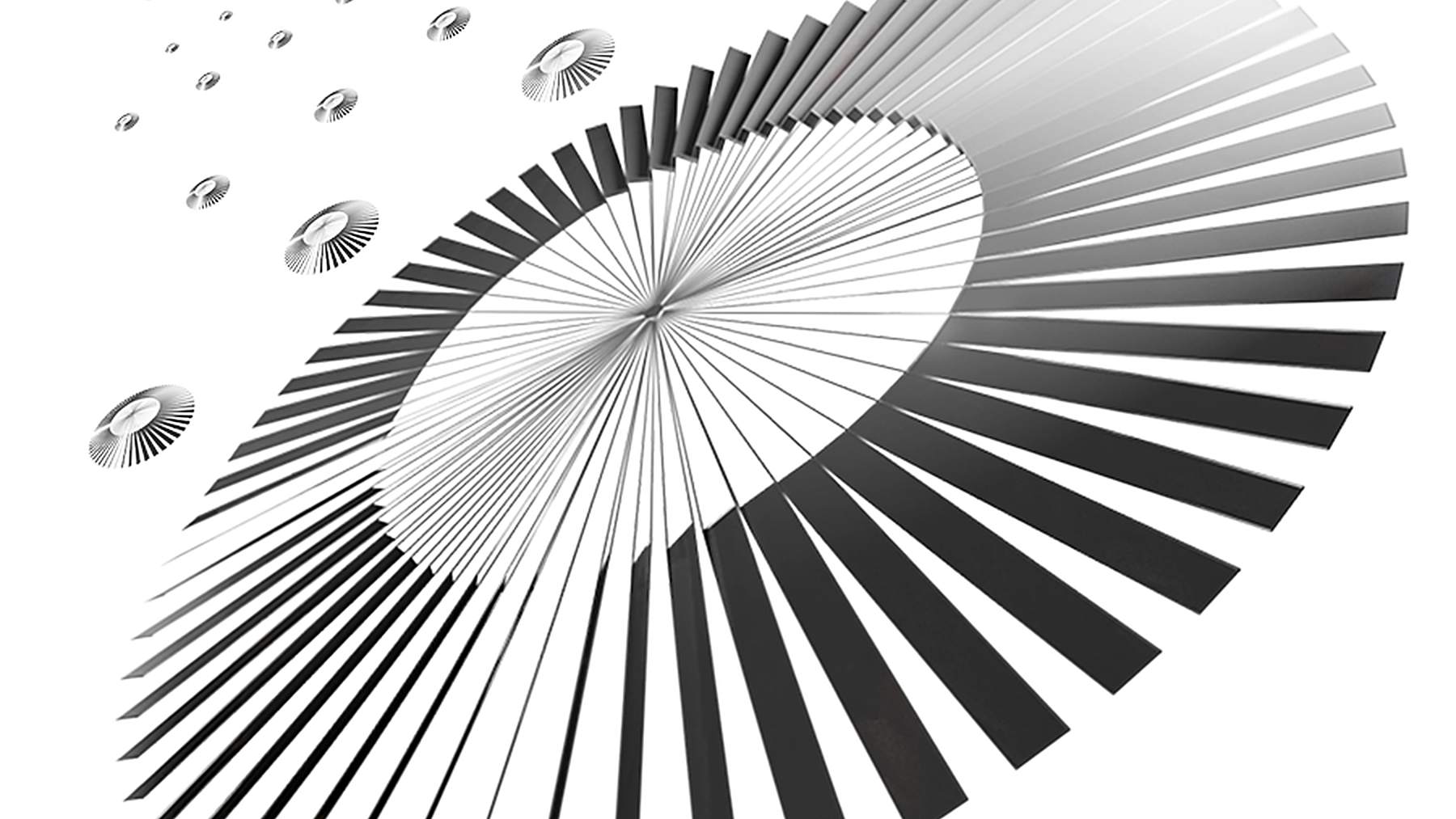
The institute’s favored design uses heliogyros, a type of solar sail with long, thin blades around a central hub. Its engineering page lists each craft at 25 miles (40 kilometers) across and 13,000 metric tons. The aluminum blades and silicon cables each run about 6 miles (10 kilometers).
Under this plan, factories on Earth would make only the hubs. Those would hold the computer, batteries, sensors and motors.
The fleet would gather about 1.47 million miles (2.36 million kilometers) from Earth, near the Sun-Earth Lagrange 1 point. Objects in that region circle the sun in step with Earth, so they can shade it around the clock.
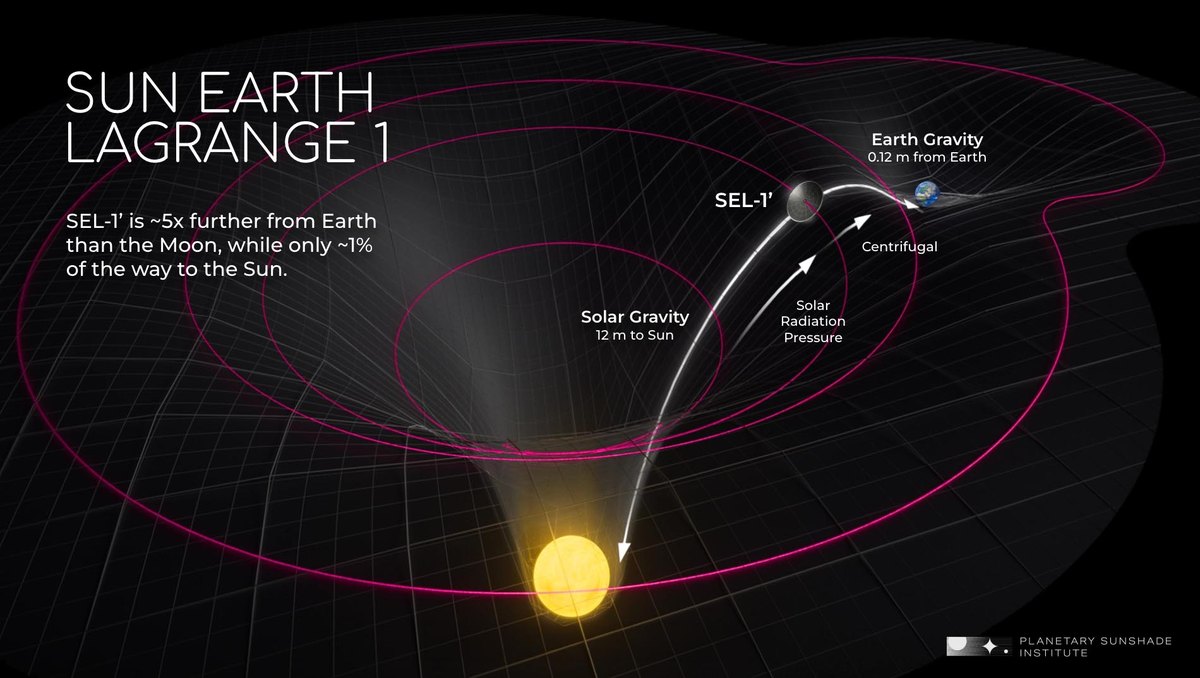
The spot is not perfectly stable, the institute’s climate science page explains. Each craft would keep correcting its position by tilting its surfaces and using sunlight as thrust.
Together, the craft would provide about 1.16 million square miles (3 million square kilometers) of shade. The institute says the dimming would be even and invisible from the ground.
65 million metric tons of hardware
Multiplying 5,000 craft by 13,000 metric tons gives 65 million metric tons. The institute’s press page gives a range of 50 million to 100 million.
An earlier literature review by the institute put everything humanity had launched to orbit at 15,000 tons. By that older tally, the fleet would weigh more than 4,000 times as much.
Launching it all from the ground would carry a climate bill of its own, including greenhouse effects and ozone damage, the institute warns. Rockets also bring other risks, such as the falling debris that concerns airlines.
An older benchmark aimed for more shade. A 2015 paper in PLOS ONE noted that most scenarios target a 1.7 percent cut in sunlight, enough to offset doubled carbon dioxide. Its authors, Joan-Pau Sánchez and Colin McInnes, calculated a disk of about 2.5 million square miles (6.5 million square kilometers).
Aluminum and silicon from the Moon
According to the survey, two factors will set the schedule. One is how often heavy-lift rockets can fly, and the other is how fast large-scale lunar mining develops.
Early demonstrations would almost certainly leave from Earth. Even so, the institute considers it very likely that the Moon would end up supplying the vast majority of the mass.
By the institute’s figures, lifting material from the lunar surface to the sunshade’s position takes about 1/35th of the fuel needed from Earth. Space mining has its own rivals, and China has set long-range goals of its own.
In 1989, James Early of Lawrence Livermore National Laboratory proposed “a thin glass shield built from lunar materials” near the first Lagrange point.
Earth orbit fares badly in a September report by the institute’s executive director, Morgan Goodwin. A cut of just 0.1 percent from there would take 464,000 craft. Each satellite in that shell would be struck three to four times a year.
Rain, oceans and uneven cooling
Shading the planet would leave carbon dioxide in the air, and the institute says a sunshade cannot replace emissions cuts. Oceans absorb about 25 to 30 percent of human carbon dioxide emissions, so acidification would keep threatening corals.
Global precipitation would also fall if shade cooled the world while carbon dioxide stayed high, the climate page says. A uniform dimming would cool the tropics more than higher latitudes.
Similar worries surround solar geoengineering with sulfur balloons, the other known global method. The survey says a sunshade could be adjusted within days. It adds that blocking only certain wavelengths might ease the rainfall problem, although that result is very preliminary.
A dust cloud 600 times lighter
Among the alternatives in the survey, a controlled cloud of dust offers a 600-fold mass advantage over sails. The institute cautions that work to verify control of such a cloud is at an early stage.
A roadmap for the sail-based route, by Catello Leonardo Matonti and nine co-authors in Advances in Space Research, targets initial operations by 2040 and full capability by 2080.
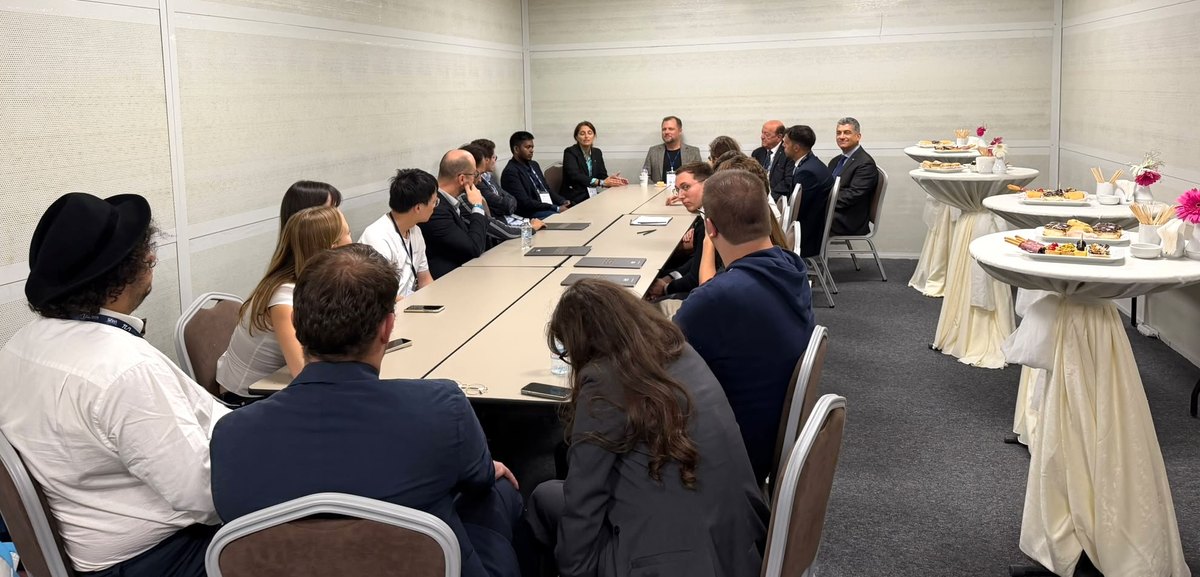
Chantal Cappelletti, one of those co-authors, works with the NottSpace team at the University of Nottingham. She helped organize a meeting of about 20 participants at the International Astronautical Congress in Antalya, Türkiye.
Afterward she wrote that “many of the technological building blocks required for a Planetary Sunshade system are already under active development.”
Who pays and who decides
Construction cost is the largest blank on the institute’s public pages, which give no price for the fleet. Several papers behind the survey are also still going through peer review.
No body currently exists to decide whether a sunshade gets built, the institute acknowledges. It also accepts that the project could tempt governments to ease off on decarbonization.
Its home page warns that “the capability to build a planetary sunshade is arriving faster than the governance to oversee it.” The governance page names SpaceX as the only private company for which such a project is conceivable.
The main source is the institute’s 2026 Space Reflector Baseline Survey summary, together with its technical pages.
Image: Planetary Sunshade Institute