Solar panels installed among native plants on a rooftop in western Sydney generated 11.1 percent more electricity on average than panels on a conventional roof in summer 2025. The figure comes from an assessment by the University of Technology Sydney, publicized on August 10, 2026.
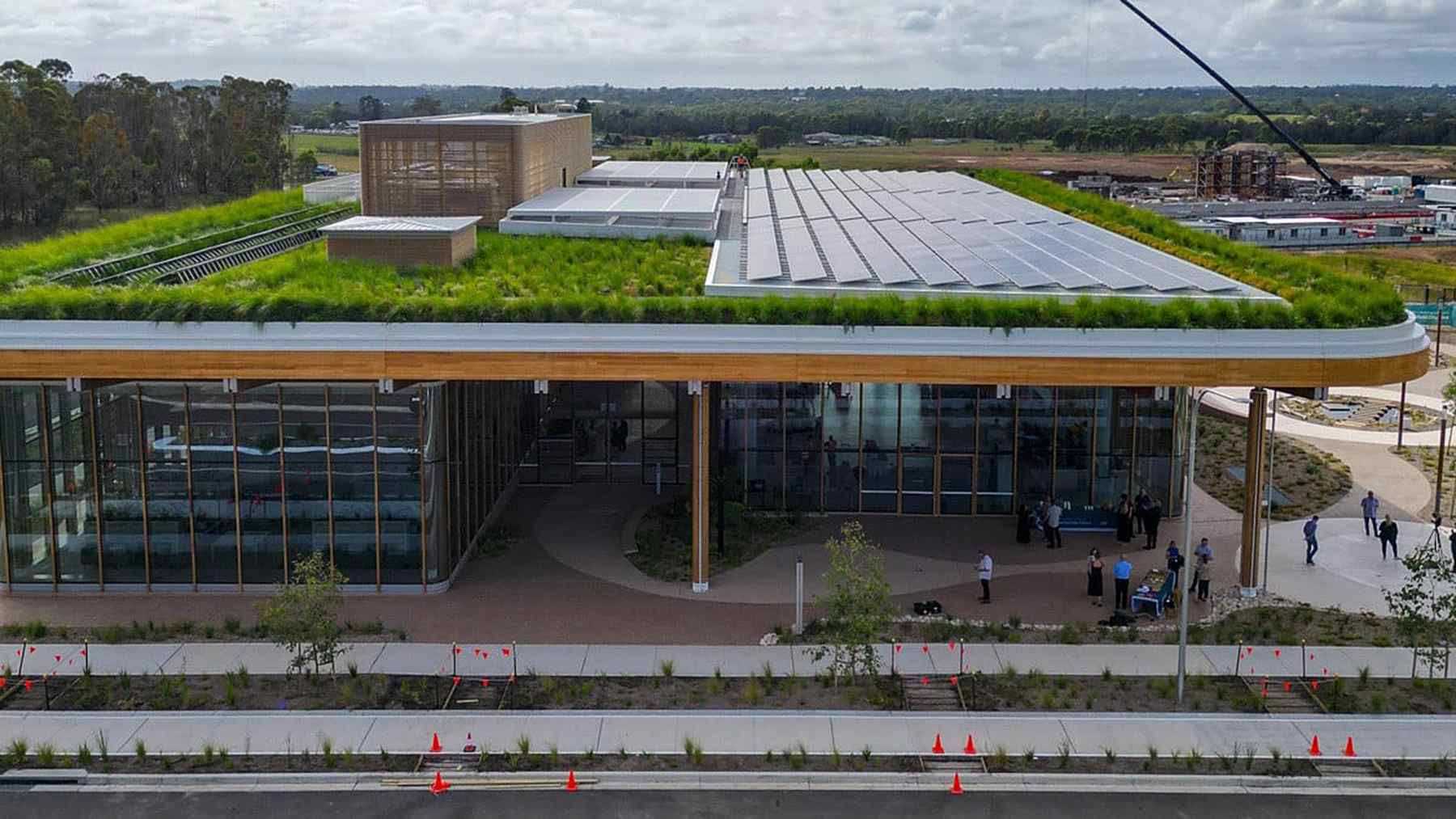
The system sits on the First Building in Bradfield City. Ken Morrison, chief executive of the Bradfield Development Authority, describes the place as “Australia’s first new city in a century.”
Its 1,300-square-meter roof, about 14,000 square feet, holds 319 north-facing panels. More than 14,000 Cumberland Plain plants grow around them. This pairing is known as a biosolar roof.
Hotter days brought stronger cooling
According to the U.S. Department of Energy, higher temperatures bring a slight gain in current and a much larger loss of voltage. A warm panel therefore delivers less power.
At Bradfield, evapotranspiration from the plants cools the air around the modules. The panels, in turn, partly shade the vegetation. Lead researcher Peter Irga said the cooling “became more effective as the ambient temperature rose.”
During extreme heat, the planted surface ran up to 28 degrees Celsius cooler than aluminum roofing, or about 50 degrees Fahrenheit. That number describes the roof, and it says nothing about neighborhood air. Cities use the same effect at street level, as in Singapore’s plan to plant a million trees for shade.
0.24 kilowatt-hours per panel daily
The report’s official summary puts the average gain at 0.24 kilowatt-hours per panel per day. Rooftop pairings vary widely, from vertical panels over a green roof in Queens to saffron grown beneath semi-transparent modules in Colorado.
On high-irradiance days the gain peaked at 23.25 percent, the summary says. Under low light, the arrays showed no meaningful difference.
A 2021 report for the City of Sydney compared two neighboring buildings in Sydney’s Barangaroo district. Panels over the green roof were on average 3.63 percent more efficient during eight months of monitoring.
That work covered a longer period and used simulated lighting to correct for nearby towers. The two percentages cannot be swapped.
Four inches of soil on timber
Architecture firm Hassell designed the roof with Three Owls Landscaping, the Sydney family business of Richard Downes. In an authority video, Downes said his team had never put this much soil and material on a timber roof before. The soil layer measures just 110 millimeters, about 4.3 inches.
Beneath that layer, a drainage system holds 20,000 liters of water, roughly 5,300 gallons. The irrigation network runs 6.5 kilometers, about 4 miles. Solar modules cover around 30 percent of the surface.
The roof mixes 15 plant species, six of them edible, according to the authority.
On each weekly service, Downes and his son weed, prune, check moisture levels and inspect the irrigation lines.
A blue-banded bee among 39 species
A combination of field surveys and environmental DNA analysis recorded 39 species of birds, insects, mammals and gastropods. Flowering native plants drew 13 pollinator species, including the rare blue-banded bee.
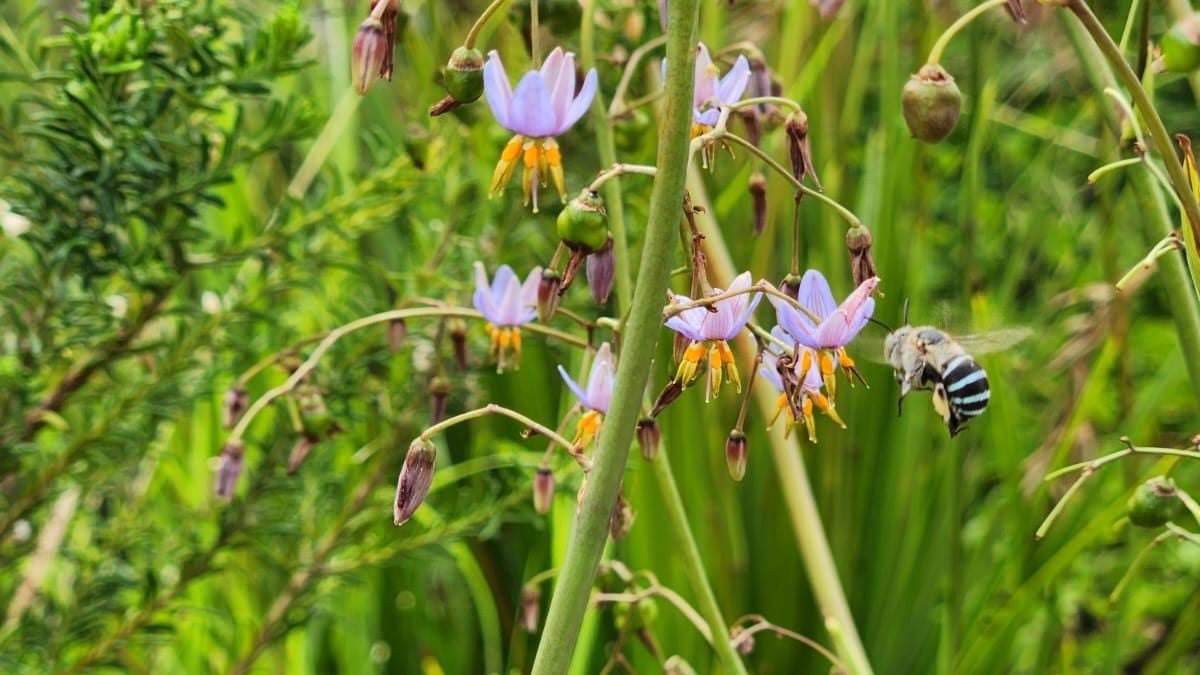
Flowering groundcovers such as lilies and wild geraniums feed and shelter insects through the year. Spiders and kookaburras followed, and Irga called it “remarkable” that a multi-level food web had formed “in little more than a year.”
Wider construction had yet to start around the building. That removed much of the traffic pollution and trapped heat that distort these tests. Irga said that gave his team “a much cleaner baseline.”
Six modeled storms and filtered metals
The 73 percent average stormwater retention derives from hydrological modeling of six design storms. Nobody measured six real downpours on the roof.
In five of those six scenarios, the summary says, the roof held all the rain falling on its footprint. Only the most extreme case, a six-hour storm, reached the limit of its storage, at 70 percent retention.
The university also reported removal of 99.9 percent of manganese and 98.7 percent of arsenic from runoff. Nickel reached 99.8 percent and zinc 91.75 percent. The vegetation is estimated to capture nearly 24 kilograms of air pollutants a year, roughly 53 pounds.
One summer leaves the year unmeasured
The Bradfield study covered four months of summer 2025, which leaves a full year of generation unmeasured. Winter output at a Swiss dam solar plant shows why the season matters.
The official summary also leaves unexplained how the 73 percent average fits with the five full-retention scenarios. And the commissioning body is the same authority developing the city.
Bradfield’s master plan requires green or biosolar roofs on 80 percent of suitable roof space in new buildings. Later projects should offer more data.
The full assessment appears in the University of Technology Sydney’s research repository. Its main findings are in the university’s news release.
Photo: Elmich, via University of Technology Sydney