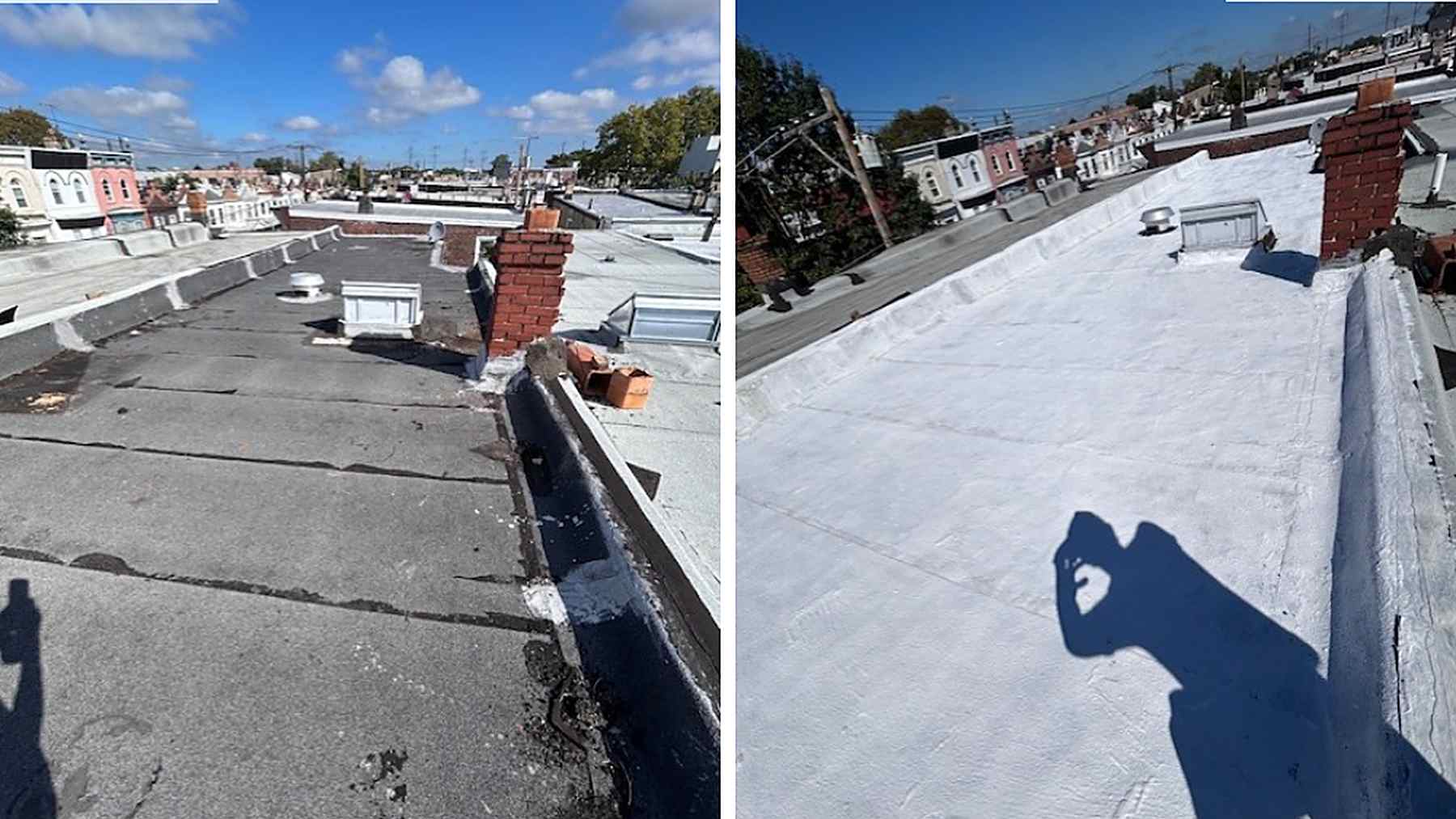
Philadelphia’s Energy Coordinating Agency applied a white roof coating to 338 row houses occupied by low-income seniors during its Cool Homes pilot from 2001 through 2003. According to the final evaluation, peak ceiling temperatures fell about 4°F to 5°F on hot days in bedrooms without air conditioners. Bedroom air cooled by about half that amount.
Michael Blasnik of M. Blasnik & Associates in Boston completed that report on November 5, 2004. The city is now running a similar test in Strawberry Mansion, with 62 coated homes.
Black tar above the bedrooms
Cool Homes grew out of a specific Philadelphia problem. The evaluation points to the “prevalence of flat roof rowhouses with black tar roofs,” which can overheat the bedrooms directly below. Many windows could not open because they were painted shut or had broken weight chains.
Money shaped the risk as well. About 90 percent of participants had at least one window unit, yet many low-income seniors worried about the electric bill and held back on cooling.
Over three years the pilot reached 375 senior households. Crews coated 90 percent of the roofs, put whole house fans in 84 percent of the homes and insulated two thirds of them. Each coating job took two coats and averaged $1,502.
Sensors at the ceiling line
ECA staff placed small data loggers in 35 homes to record temperatures every hour. Blasnik later threw out four of those houses. One logger had reported a bedroom at 130°F, and others had apparently moved or fallen.
Two nearly identical houses gave the clearest picture, with one roof coated on July 10 and the other on July 16. For those six days the coated house stayed well below its neighbor, and then the two bedrooms converged.
From there the evaluator used regression, a statistical method that separates the effect of each upgrade. He kept only days above 90°F that followed days above 88°F, when a cooler roof surface should count most.
From 95°F to about 90°F overhead
In bedrooms without air conditioners, the full package cut maximum ceiling temperature by 4.8°F and maximum air temperature by 2.5°F. On a 95°F day, the ceiling went from roughly 95°F to about 90°F. The report calls that “a dramatic reduction in heat gain to the room.”
Nothing in the evaluation says indoor temperature fell by half. The air drop was about half the size of the ceiling drop, which is a different claim. In those same rooms, peak heat flowing down from the attic fell by an estimated 88 percent.
With skin averaging about 93°F, according to the report, a ceiling above that level warms the person lying under it, while a cooler one lets the body shed heat by radiation.
Bedrooms with air conditioners changed less, with peak ceilings down 2.7°F and peak air down 0.4°F. Several of those households seem to have run their units less often after the work.
Insulation at half the price
The often repeated saving of about 560 kilowatt-hours a year comes from a computer model of a fully air-conditioned row house. Annual cooling use fell from 1,736 kWh to 1,178 kWh with coating and insulation together. Coating alone saved 472 kWh.
Real participants looked different. Among 47 households with enough billing history, the estimated cooling load averaged 823 kWh a year.
Roof insulation saved 486 kWh in the same model, at about $750 a home. Doing both added fewer than 100 kWh over either one alone. The simulation also credited insulation with 197 therms of winter gas savings a year.
Blasnik still saw a case for the coating because of the roof itself. ECA had found roofing problems among about 40 percent of its low-income clients, and a cooler surface should last longer.
The Department of Energy’s cool roof guidelines say reflective roofs “are never a substitute for using sufficient thermal insulation.” Insulation in a home’s shell limits heat loss and gain in ways a reflective surface cannot.
Strawberry Mansion runs the test again
In fall 2025, the city’s Office of Sustainability and ECA gave 62 Strawberry Mansion households a free cool roof coating. A federal Department of Energy block grant paid for it. The city describes the area as one of its warmest neighborhoods in summer.
Anna Shugoll of the Office of Sustainability wrote on the city’s website in September that some neighborhoods “can get up to 30°F degrees hotter than others.” That gap is the urban heat island effect, and the pilot asks whether coated roofs can ease it.
Residents will report on indoor temperature, energy use and extreme heat after summer 2026. Current EPA guidance says cool roofs can cut peak cooling demand in air-conditioned homes by 11 to 27 percent. Peak demand is the highest load, a different measure from electricity saved over a year.
Post-coating electric bills never arrived
The local electric utility did not take part, so ECA typed in earlier usage by hand from copies of customers’ bills. No data existed for the period after the work. Blasnik expected total electric use to have declined by “perhaps 5%-10%,” but he could not confirm it.
Health went unmeasured too. The evaluation recorded no medical outcomes, and its comments on heat stress rest on earlier research about mortality above roughly 92°F.
Hot days averaged 95°F before treatment and 93.3°F after, which complicates any comparison. Insulation and coating often came so close together that the regression could only estimate them jointly. The sensors also sat where the ceiling met an interior wall, so peak readings may run low.
The full evaluation is available as a PDF through the Cool Roof Toolkit.
Photo: Energy Coordinating Agency