In 2007, homeowner J. Tomanec was doing earthworks in his garden in Morkůvky, a village in South Moravia, and found a stone with one corner sticking out of the ground. That block is half of a Bronze Age spearhead mold more than 3,000 years old, and petrographic analysis suggests its rock came from northern Hungary, about 155 miles (250 kilometers) away.
Before anyone recognized it, the stone had gone into the foundations of a barn at the corner of the garden, according to Masaryk University. Ordinary jobs have hidden odd objects before. A Michigan farm once used an iron meteorite as a doorstop.
Barn footing, then museum inventory
Z. Omelka of Hrušovany nad Jevišovkou brought the find to the Moravian Museum in 2019, and Milan Salaš of the museum’s Archaeological Institute studied it with a team that included Antonín Přichystal and Jan Petřík of Masaryk University.
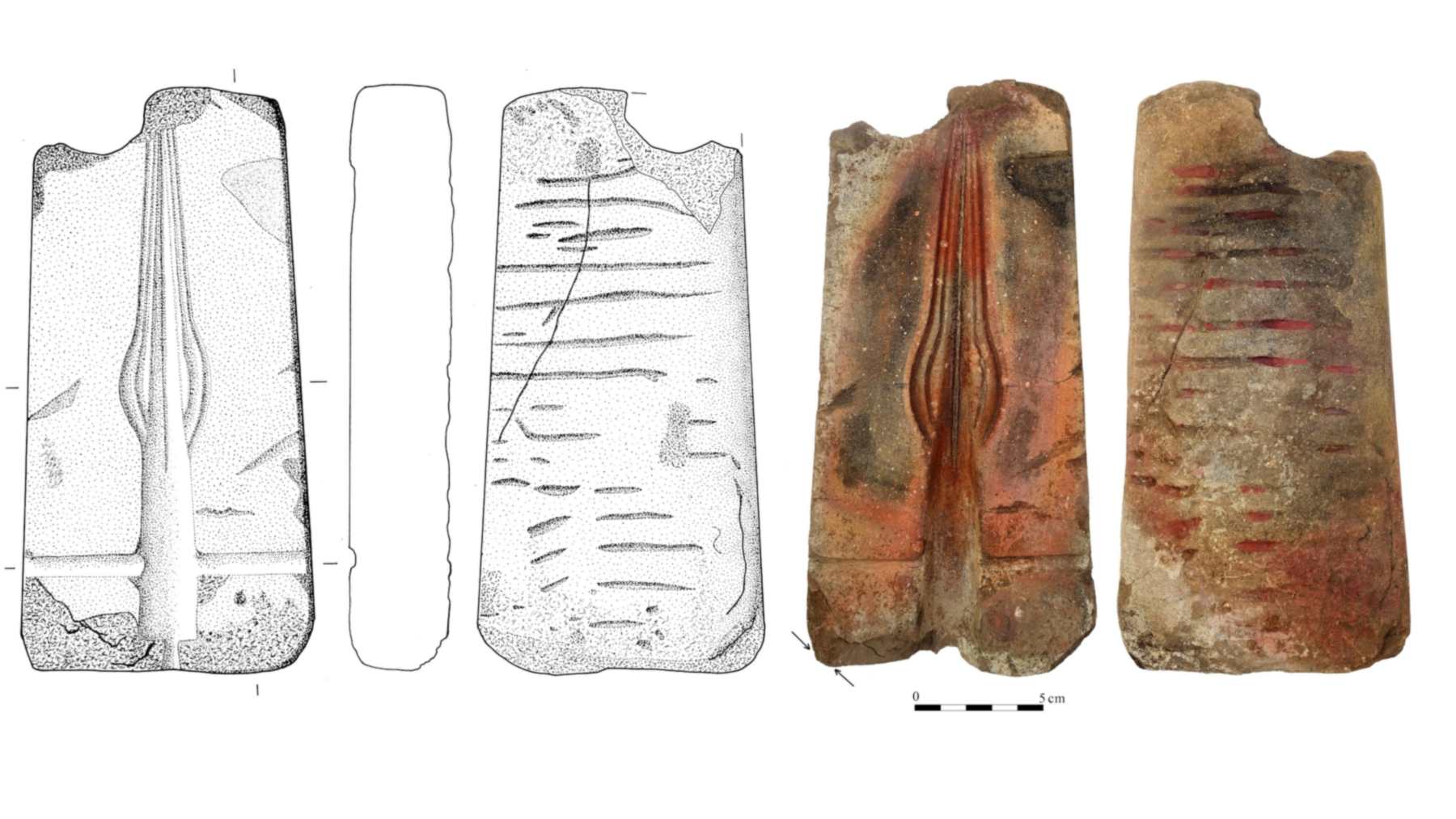
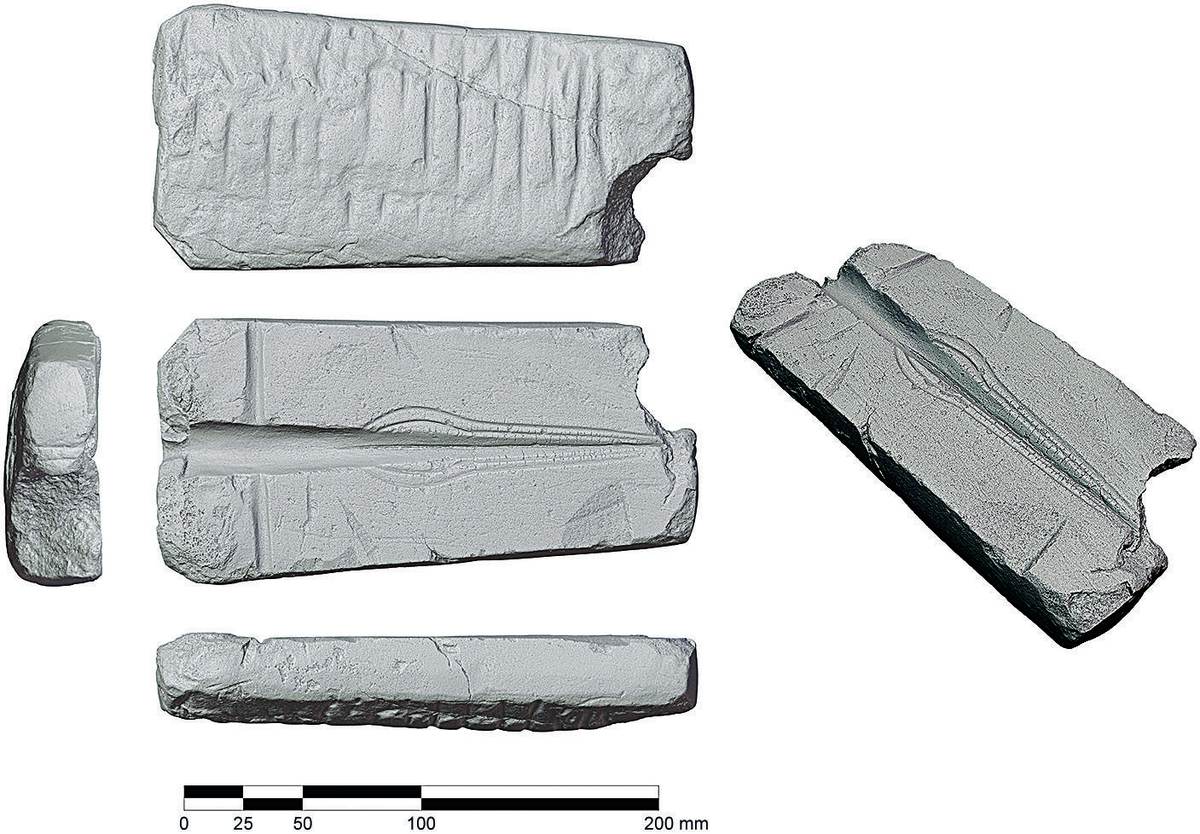
Their paper describes a flat slab 8.9 inches (227 millimeters) long and up to 4.4 inches (112 millimeters) wide. It weighs 2.4 pounds (1,093 grams). One face still carries almost the entire negative of a socketed spearhead, the kind that slots onto a wooden shaft.
Nothing prehistoric has turned up on that plot or the ones beside it. The authors think people moved the stone there in modern times. A settlement of the Urnfield culture, a Bronze Age society named for its cremation burials, lay about 380 feet (115 meters) away.
Heat cracks from repeated pours
Red, gray and black scorch marks cover the working face of the slab. On one corner, the rock has turned into glassy, bubbly slag. Small cracks inside the spearhead’s outline record sharp swings in temperature.
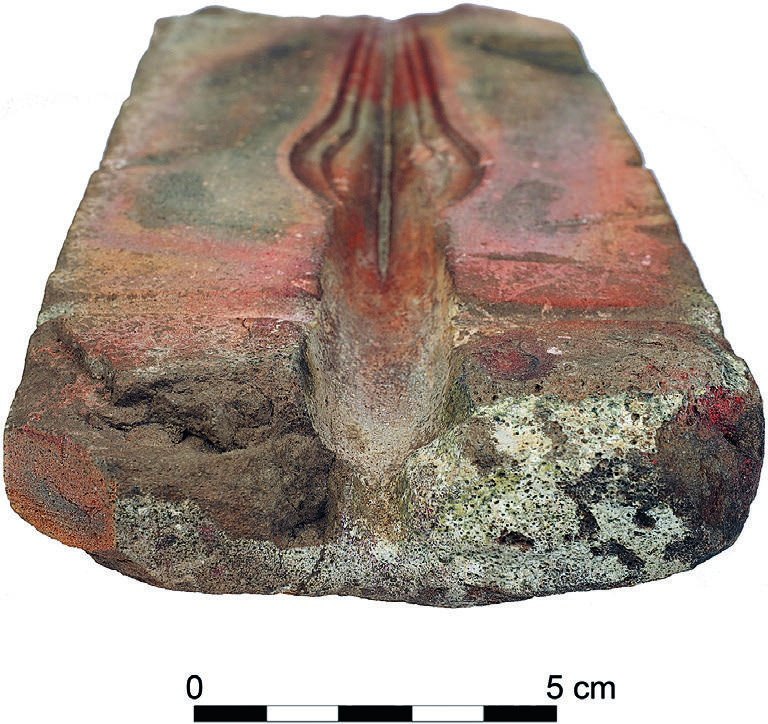
Salaš’s team scraped powder from the channel where the metal went in and ran it through X-ray fluorescence, which reads a sample’s elements. Copper, tin and lead showed up there, while the rock itself has only traces of them.
Clay molds were mostly single-use, but stone ones could work for a long time. The authors say this one could have cast up to dozens of spearheads. They also cite estimates of up to a hundred casts from one stone mold.
Later metalworkers organized on a larger scale, as at a Gallic mint on France’s Corent plateau. In Morkůvky, the evidence comes down to one heavily used tool.
Red grooves and copper wire
Uneven grooves run across the back of the slab, and many are stained red. At first the team suspected a ritual, with casters painting red dye onto the stone, and the authors could find no parallels for it anywhere.
Then the lab results came back with more copper and tin in the red filling than on the bare surface. So the ritual idea gave way to something more practical, a copper wire cinched around both halves.
“Prehistoric casters poured tin bronze into vertically positioned halves of a mold held together with copper wire,” Petřík said in the university’s statement.
Volcanic tuff from northern Hungary
Under a polarizing microscope, Přichystal identified the slab as rhyolite tuff, a rock made of compacted volcanic debris. The authors know of no source in Moravia, Silesia, Bohemia or Poland. It is also the first Bronze Age mold of this stone documented in the Czech lands.
Their source is still only a preliminary candidate: the Gyulakeszi Rhyolite Tuff, a rock that crops out near the Hungarian town of Salgótarján. From that area to Morkůvky is about 155 miles in a straight line. The real journey would have covered at least 217 miles (350 kilometers).
Petřík called the mold “demonstrably the result of long-distance import.” Copper ingots reached Moravia over long distances too, the paper notes. Much later, 500 Iron Age iron bars probably sank with a boat on the Danube.
Two fragments of this spear type
The shape carved into the stone supports the same route. Spearheads with these ribs on the blade and socket are common in the Carpathian Basin. Moravia has produced just two fragments, from hoards at Drslavice and Polešovice.
Those hoards place the mold early in the Urnfield period. Masaryk University dates the Late Bronze Age to between 1300/1250 and 1050/1020 BC. The authors argue the mold traveled as a finished tool, since imported raw stone would more likely have become a local design.
Only two other spearhead molds have been reliably documented in Moravia, and this one is the best preserved. “Despite minor damage, it is one of the best-preserved halves of casting molds of this type in the Czech Republic,” Petřík said.
One half, no workshop
Because the stone is a stray find, no workshop or furnace can anchor it. Its age rests on the spear type and the hoards where that type appears. The authors also cannot yet name the specific place where the rock came from.
How much casting happened in the Carpathians, and whether any happened in Moravia, remains open. A working mold needs both halves and a core. The paper is blunt on this point: “Importing only half of the mould would have no practical sense, except perhaps as an object of ritual practices or a rarity.”
The full study was published in Archeologické rozhledy.
Since November 2024, the stone has been part of the Moravian Museum’s archaeological collection, under inventory number 215 933.
Image: A. Vaníčková and M. Salaš / Archeologické rozhledy, CC BY 4.0